After more than three decades in Vietnam’s real estate market, Quang has led the group with a philosophy of “selling what the market needs and keeping our promises.”
In an interview with Readhe discussed value in real estate, balancing the interests of different stakeholders and developing distinct identities for urban developments as the market undergoes restructuring and faces interest rate pressures.
With the market facing multiple pressures, how do you assess current buyer demand?
There are always two main types of demand in the market: buying a home to live in and buying property as an investment. Real value in real estate must first meet buyers’ expectations, be commensurate with what they pay, and retain its value over time.
For homebuyers, real value is reflected in their everyday living experience, including a healthy residential environment, property management services, comprehensive amenities and affordability.
Investment demand is also real. In this case, value is measured by long-term appreciation potential, the ability to generate rental income and liquidity when owners need to sell.
Regardless of the segment, real value exists only when a developer delivers what it has promised. Conversely, if a project is marketed with appealing promises and expectations of rapid price growth but fails to develop a functioning residential community after the units are sold, then the product has failed to deliver value.
When the market is challenging, products that address these fundamental needs are more likely to sustain demand.
|
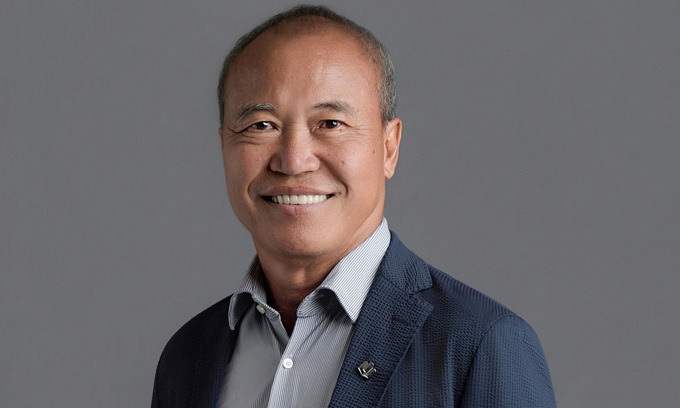
Nguyen Xuan Quang, founder and chairman of Nam Long. Photo courtesy of Nam Long |
How should the concepts of “real value” and “low price” be understood?
Real value does not mean a low price. Homebuyers’ preferences have changed significantly compared with 20 years ago. They no longer simply buy a plot of land or an individual home and leave it there. They consider infrastructure, amenities and whether a functioning residential community can be established.
If businesses equate real value with low prices, they may compete to cut costs regardless of the consequences. This can result in low-cost products being sold quickly to recover capital. But then who will invest in schools, hospitals, supermarkets or transport connections? The result can be that residents do not move in and projects become “ghost towns.”
Selling quickly by offering low prices and then neglecting the future of an urban development is not a sustainable approach for a developer.
 |
|
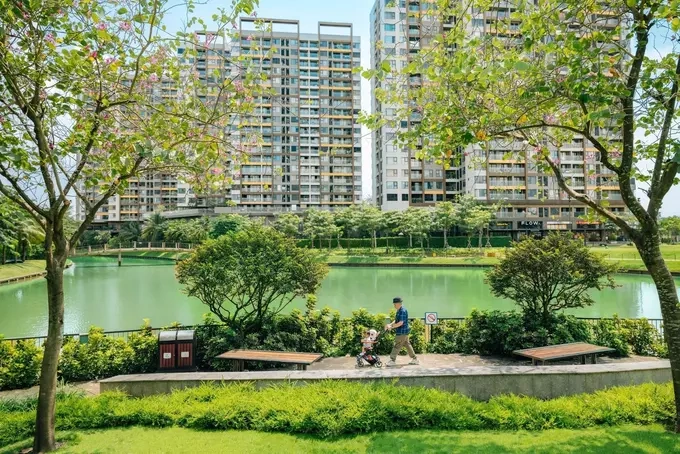
Living spaces at Mizuki Park. Photo courtesy of Nam Long |
Developing value-driven housing begins with planning, followed by architectural design and construction. From the planning stage, land-use indicators, construction density and the cost structure must be carefully calculated for the target customer group.
If the cost structure is unsuitable from the outset, it becomes difficult to offer the final product at a price buyers can afford.
Since the 1990s, Nam Long has studied urban development models in more mature markets such as Singapore, Thailand and Malaysia to determine what might suit Vietnamese incomes, culture, climate, family structures and living conditions.
For example, urban management fees alone in Singapore can reach US$600 a month. If such a model were applied directly in Vietnam, people might be able to afford the home itself but struggle to cover the monthly service costs.
Around the world, there is a concept of a “studio apartment” — a compact space designed to provide the functions required for everyday life. This approach reduces the financial burden associated with costly private spaces. A capable developer needs to calculate, balance and standardize these factors to create an appropriate solution.
To address this challenge, Nam Long applies the concepts of “shared amenities” and “shared spaces.” In a development, we design compact, efficient apartments while allocating appropriate areas for shared facilities such as parks, sports areas and community spaces.
I often compare the concept to the sharing economy. It allows thousands of residents to use a range of amenities while keeping the per-capita cost at a reasonable level.
Of course, real estate prices also incorporate land costs, financial obligations, construction expenses and building materials. These are factors that businesses cannot determine on their own. Therefore, developing value-driven housing on a large scale requires coordination among the government, businesses and the financial system.
Housing costs have a major impact on buyers’ decisions. How does Nam Long address financial security for homebuyers when interest rates fluctuate?
When the economy fluctuates, cash flow pressure becomes a major obstacle for homebuyers.
A family earning VND30 million (US$1,140) a month can typically allocate no more than 30%, or around VND10 million, to mortgage repayments. If higher interest rates push monthly repayments to VND20 million, household finances face significant risks, directly affecting daily life.
Understanding this, Nam Long works with partner banks to establish interest-rate caps over several years or extend payment schedules based on buyers’ financial capacity.
Sharing risks with customers means accepting lower profit margins and a longer capital recovery period. In return, we can maintain liquidity, demonstrate our commitment to accompanying customers and protect the credibility we have built over decades.
Returning to urban planning, what specific solutions does Nam Long use to share amenities and spaces while bringing real estate closer to its actual value?
To address this, we accept the need for long-term investment and take a systematic, step-by-step approach.
First, we invest in essential urban amenities in advance, which we refer to as our “city facilities standard.” Nam Long does not wait until residents move in. We proactively develop schools, clinics, parks, bus routes connecting projects with city centers, outdoor cinemas and sports facilities.
We regard these as basic standards for ensuring residents’ quality of life from the time their homes are handed over.
Next, we organize activities that turn our developments into destinations, including cultural and sporting events, fireworks festivals, marathons and other community activities. These can attract visitors to experience the urban environment.
Third, when the number of actual residents reaches a certain threshold, typically around 2,000 households, internal consumer demand becomes large enough to attract professional commercial operators.
At that stage, Nam Long invites retail brands, coffee chains, international schools and major hospitals to operate within the urban ecosystem.
 |
|
A family ride bicycles at Izumi City. Photo courtesy of Nam Long |
A good master plan and detailed renderings can show all the amenities you have mentioned. How do you ensure those plans become reality rather than remain promises?
Precisely. The difference lies in feasibility and execution.
Before deciding to implement a project, we have to assess market demand, infrastructure connectivity, electricity, water, transportation and implementation costs. All of these factors must be incorporated into the project’s cost structure.
If, after these calculations, the product cannot meet the required standards at a price the market can afford, then the project is not viable. Good planning only has value when it is feasible.
In addition, investment in essential amenities within an urban development has always been incorporated into the business plans of Nam Long and its partners. Therefore, this is not simply a promise but a commitment that has become part of Nam Long’s development standards. This is how we seek to create urban areas with functioning communities.
Credibility does not come automatically. It has to be built over decades and tested by the market.
Japanese partners such as Hankyu Hanshin Properties, Nishi-Nippon Railroad and Tokyu Corporation have chosen to work with Nam Long because we share a similar business philosophy: focusing on what the market needs, creating quality products and selling them at a price the market can absorb.
 |
|
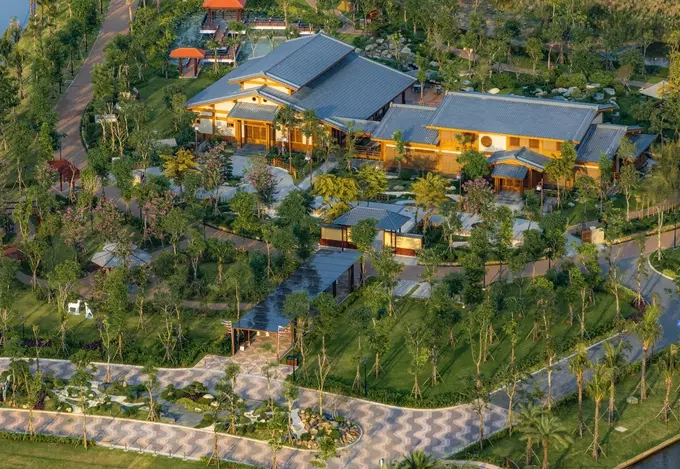
The Vietnam-Japan Cultural Village at the Waterpoint integrated township. Photo courtesy of Nam Long |
What kind of urban development does this process ultimately create?
It creates a distinctive Nam Long urban environment, based on a planning philosophy that respects nature and considers how spaces are organized.
Before drawing up a master plan, we study the site’s natural conditions, including river flows, prevailing wind directions and native vegetation.
At Waterpoint, a 355-hectare township, for example, we established a 50-meter ecological setback stretching 5.8 kilometers along the Vam Co Dong River to help preserve the river and its natural riverside ecosystem.
The township also features an 8.6-hectare artificial freshwater bay and more than eight kilometers of canals running through the development. Designed by Dutch engineering consultancy Royal HaskoningDHV, the water system helps regulate water levels across the area and is designed to provide flood resilience for decades to come.
Beyond physical infrastructure, what gives an urban area vitality is what I call a “community space scenario.”
These are shaded walkways and benches beneath trees that encourage residents to leave their homes, walk around the neighborhood and meet, interact and greet one another.
Each Nam Long township tells its own story and has its own identity as part of our approach to creating real value.
Waterpoint, spanning 355 hectares, reflects the openness and generosity associated with southern Vietnam. The 26-hectare Mizuki Park creates a setting where nature and urban life coexist. The 170-hectare Izumi City represents the vibrant, modern rhythm of a growing city, while the 45-hectare Elyse Island is designed around a more refined pace of life while preserving the tranquility of its natural island setting.