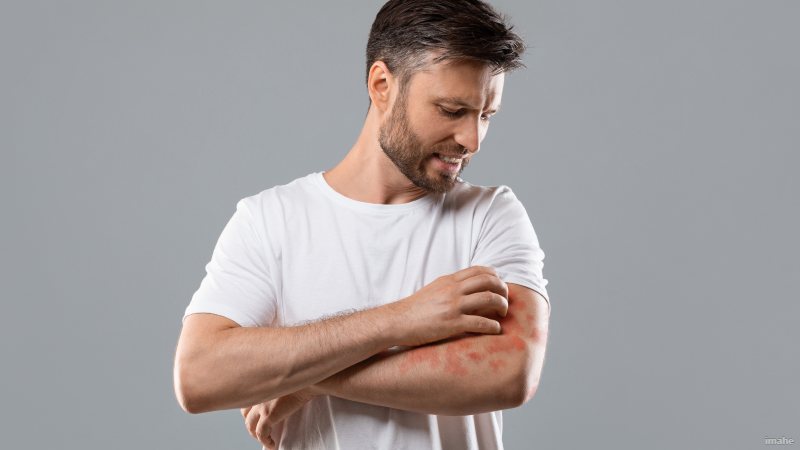
In today's time, due to the hustle and bustle of daily life, pollution, wrong eating habits and uncontrolled lifestyle, skin related problems are spreading rapidly among the common people, some of which may look similar in appearance but are very different and complex from inside. Whenever red rashes, constant itching, swelling or dry crusts start forming on a person's skin, most of the people consider it to be a normal allergy or minor ringworm and apply any simple cream from the medical store, which gives relief for some time but is not able to eliminate the problem from its root. According to medical science and dermatologists, the two most prominent and serious chronic diseases occurring on the skin are Eczema and Psoriasis, the symptoms of which are so similar in the initial stages that not only the common man, but even the common doctors get confused in the initial examination. It is very important for every person to know what is the basic difference between eczema and psoriasis, because due to the existence of both, their marks on the body and their treatment are completely different. Let us know in this detailed and special report on the basis of medical science, what is the real secret of these red rashes and white scabs forming on the skin and how you can identify both these skin diseases.
Skin is the largest and sensitive organ of our body which protects us from external infections, but when any kind of internal disturbance occurs in the immune system of our body or in the upper layer of the skin, then these diseases arise. Eczema, also known as atopic dermatitis, is primarily caused by the weakening of the skin's moisture barrier and exposure to external allergens, causing the skin to become extremely sensitive, dry and dull. In contrast, psoriasis is an autoimmune disease in which the body's own white blood cells mistakenly attack healthy skin cells, causing skin cells to grow several times faster than normal and new layers to form over old dead cells. In both these conditions, the patient has to face such intense and unbearable itching that many times he loses sleep at night and due to repeated scratching, the skin starts bleeding, which further increases the risk of infection.
Eczema usually begins in childhood and most commonly affects areas of the body where skin folds, such as the inner elbows, backs of the knees, neck, wrists and cheeks. Skin with eczema typically becomes extremely dry, red, rough, and inflamed, sometimes oozing a clear watery fluid called vesicles. A variety of triggers can be responsible for the emergence of eczema such as harsh soaps, detergents, perfumes, synthetic clothing, dust, pollen, and even excessive mental stress or certain foods such as milk, eggs, and nuts. When a person comes in contact with these triggers, his skin begins an Itch-Scratch Cycle that doesn't seem to stop. Eczema patients are strongly advised to keep their home environment dust-free and always keep their skin moisturized so that infections can be controlled.
Psoriasis is a long-term condition whose effects are not limited to the skin but can also affect joints (psoriatic arthritis) and other internal organs. The most prominent and recognizable symptom of psoriasis is the formation of thick, red rashes on the skin over which a thick layer of silvery or white dry scales forms. When this scab is lightly scratched, very fine dots of blood become visible, which is called 'Ospite sign' in medical language. Psoriasis most commonly occurs on the scalp, elbows, knees, and lower back and can be worsened by changes in weather, extreme cold, injury to the skin, or consumption of certain medications. Patients suffering from psoriasis not only have to face physical pain, but due to the misconceptions spread about this disease in the society, they also have to suffer from mental stress and inferiority complex, to overcome which social awareness is very important.
The biggest and most obvious difference between eczema and psoriasis is that in eczema the skin can be extremely moist and oozing with intense itching being the main symptom, whereas in psoriasis the skin is dry, hard and silvery flaky with a burning and stretchy feeling. Furthermore, eczema affects the flexible parts of the joints of the body, while psoriasis usually attacks the outer and tight parts of the elbows, knees and head. For the diagnosis of both these diseases, physical examination and sometimes skin biopsy is taken by the dermatologist so that the exact cause can be known. In modern medical science, both these problems can be controlled to a great extent through steroid creams, immunomodulators, phototherapy (UV Light Therapy) and biologic medicines, provided the patient consults a good doctor in time and takes special care of eating habits and cleanliness in his daily routine.