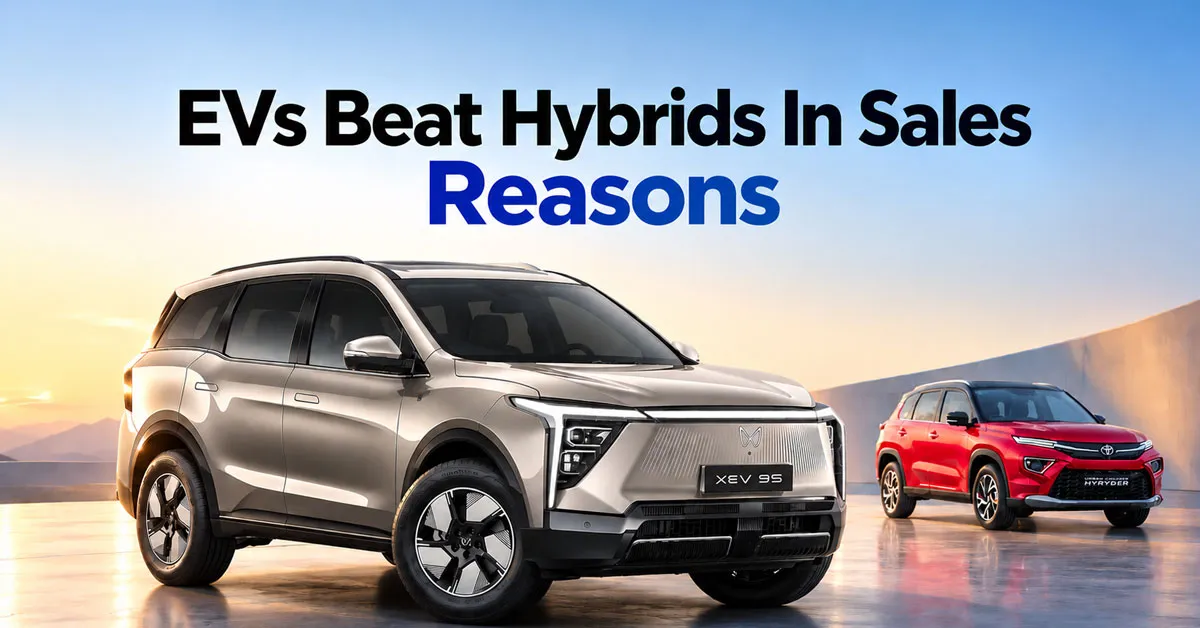
The hybrid market is slowly opening up in India. Till recently, this segment used to have just a small number of products. Now, more manufacturers are coming up with new hybrid launches. Hybrid cars and SUVs of different nature- strong hybrids, plug-in hybrids, and even series hybrids- are being readied. Even so, sales numbers from August show an interesting pattern- electric vehicles sold five times more than strong hybrids! Let’s try to explore the reasons behind the same.
In August 2026, 36,593 electric vehicles were sold in India. Strong hybrids, on the other hand, stood at 7,877 units. EV sales were roughly 4.6 times higher. This contrast remains particularly striking because we have seen EV and hybrid sales stand close to each other in the past. In the first half of 2024, for instance, 52,415 EVs were retailed and the hybrid numbers stood at 51,832 units. Fast forward to 2026 August and we see a drastic change in the balance.

There are three main reasons for the wide gap in EV and hybrid adoption. One, there is plenty to choose from when it comes to electric vehicles. Several manufacturers now have all-electric products on sale, spanning segments and price brackets.
Towards the affordable end of the segment, we have the likes of MG Comet and Tata Tiago EV, and towards the more expensive side of the mass-market segment are products like the Tata Harrier.EV and MG Hector Tomahawk EV.
Yes, there are several products in luxury and premium EV segments as well. From the likes of Kia EV6 to German luxury EVs like the Mercedes G-Wagen Electric and BMW i7. We will limit the scope of this discussion to the mass-market alone.
In the case of EVs, the mass-market segment is already crowded. Tata Motors continues to be the manufacturer with the strongest and most extensive EV portfolio. Hybrids present a totally different case. There are very few strong hybrid options available in the mass-market space now.
Toyota dominates India’s mass-market strong hybrid space, with the Hyryder and Hycross being the key volume drivers. The sharp contrast in the number of available options between the two is the primary reason for the wide gap in their sales numbers.

As we said in the beginning, the hybrid market is now opening up. As more hybrid products go on sale here, we may see the standings improve and the gap getting narrower. Manufacturers like Renault and MG are betting big on hybrids.
Renault, for example, is set to announce the prices of its much-awaited 1.8L strong hybrid Duster in the coming weeks. MG has already launched the Tomahawk PHEV as the country’s most affordable plug-in hybrid offering.
The initial market sentiment towards these will show the direction that the future sales numbers will likely take. If priced and positioned well, hybrid cars and SUVs can get very popular.
The second and more important reason is the difference in price. EVs have come a long way. Now, many mass-market EVs have almost achieved price parity with their internal combustion counterparts. Government incentives and favourable tax slabs have played key roles in keeping prices competitive.

EVs benefit from a low GST slab of just 5%. Taxes on hybrids, on the other hand, go up to 40% in some cases. This makes it difficult for manufacturers to price hybrids competitively. In the case of EVs, battery financing schemes (like Battery as a Service (BaaS)) have further brought down upfront costs.
Long story short, hybrids continue to be expensive buys. In most cases, the buyer has to pay a sizeable premium for hybrids, over non-hybrid internal combustion versions. Some states also provide tax and registration cost exemptions on EVs. No such move is usually seen on hybrids.
And finally, the improvements in home charging speed and public charging infrastructure have increased buyers’ confidence in EVs, leading to their increased adoption. Range anxieties have come down significantly.