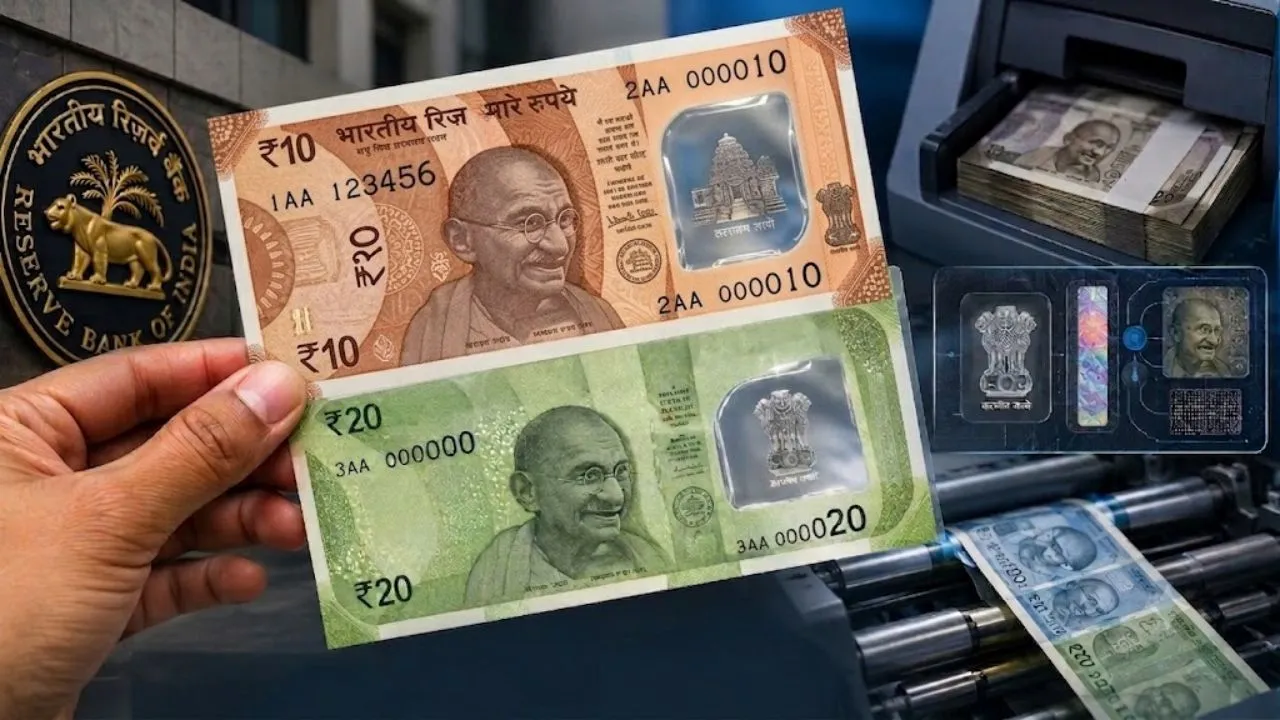
The Reserve Bank of India (RBI) believes this will make the notes more durable, secure, and usable for longer. If the trial is successful, notes of other denominations may also be printed in polymer in the future. Let us explain why the government suddenly decided to issue plastic currency notes in the country. What is its connection to Australia? And what are its advantages and disadvantages?
When was the plastic note first issued?
Plastic currency notes originated in Australia. Within months of the new currency’s introduction in 1966, a large number of counterfeit 10 dollar notes entered the market. Surprisingly, this work wasn’t done by a large gang, but rather by a photographer, an artist, a tailor, and a shopkeeper. Following this incident, Australia’s central bank asked scientists to create a note that would be extremely difficult to counterfeit. After nearly 20 years of research, the world’s first polymer note was issued in 1988.
What plastic are these notes made of?
Polymer notes aren’t made of ordinary plastic. They use a special polymer called “bi-axially oriented polypropylene” (BOPP). It’s produced from petroleum and natural gas. It’s considered very strong, flexible, and durable. This is why polymer notes don’t tear easily and retain their shape for a long time.
Polymer notes are made from bi-axially oriented polypropylene (Source – Social Media)
The plan to introduce plastic notes in India isn’t new. The RBI first proposed it in 2009. Subsequently, in 2012, the then government approved trials of ₹10 polymer notes. They were planned to be tested in different climates in cities like Kochi, Mysore, Jaipur, Bhubaneswar, and Shimla. However, the project could not proceed further due to the 2016 demonetization and the need to modify ATM machines. Now, the government has decided to restart it.
Will be more durable than paper notes
According to the RBI, polymer notes can last two to six times longer than paper notes. They are not easily damaged by water, moisture, oil, and dust. They are less likely to tear even after repeated folding. When they are no longer usable, they can be recycled and used to make new products or new notes.
Polymer notes will be more durable than paper notes (AI generated image)
The initial cost of printing polymer notes is higher than that of paper notes. According to experts, their printing costs can be 30 to 60 percent higher. However, they last longer than paper notes, reducing the need to print new notes frequently. This reduces overall government costs in the long run. Countries like Australia have seen significant savings over the years by adopting polymer notes.
Effective in preventing counterfeit notes
The biggest advantage of plastic notes is their security. They can be equipped with transparent windows, special inks, microprinting, and many other advanced security features. Counterfeiting them requires advanced technology and significant investment. This is why countries that have adopted polymer notes have seen a significant reduction in counterfeiting.
Challenges facing the government regarding polymer notes
Although polymer notes have many advantages, their full implementation will not be easy. The biggest challenge is updating ATMs, note counting machines, and cash handling systems to accommodate the new notes. This will require significant investment. Furthermore, experts say that over time, criminals may attempt to create counterfeit polymer notes using new technologies such as 3D printing and artificial intelligence.
Issuing polymer notes easier for the government (AI-generated image)
Currently, only 10 and 20 rupee polymer notes will be field-tested in India. Their strength, security, and practical use will be assessed. If the results are satisfactory, 50, 100, and 500 rupee notes may also be issued in polymer in the future. However, the process of replacing paper notes with plastic notes across the country may take several years to complete.
Also Read – Rahul and Priyanka level serious allegations against the new Education Minister, saying a rapist has been made a minister.
Indian currency could undergo a major change
The introduction of plastic notes could prove to be a major change in the Indian monetary system. This would increase the lifespan of notes, strengthen control over counterfeit currency, and reduce printing costs in the long run. However, its success will depend on how successful the trial is and how quickly the country’s banking and ATM infrastructure is able to prepare for this change.