
Famous Youtuber’s Innova HyCross Problem Due To Contaminated Fuel, Not E20: Toyota Issues Official Statement

In the past few days, we have come across multiple of people claiming that the use of E20 (20% Ethanol-blended) petrol has caused damages to their respective vehicles. The most recent was a Bihar-based YouTuber who claimed that E20 damaged his Toyota Innova Hycross. It crossed 3 lakh views in just two days. Toyota Kirloskar Motor has now come up with an official response in this case. It has stated that the issue was caused by the use of contaminated fuel, and was not due to E20.
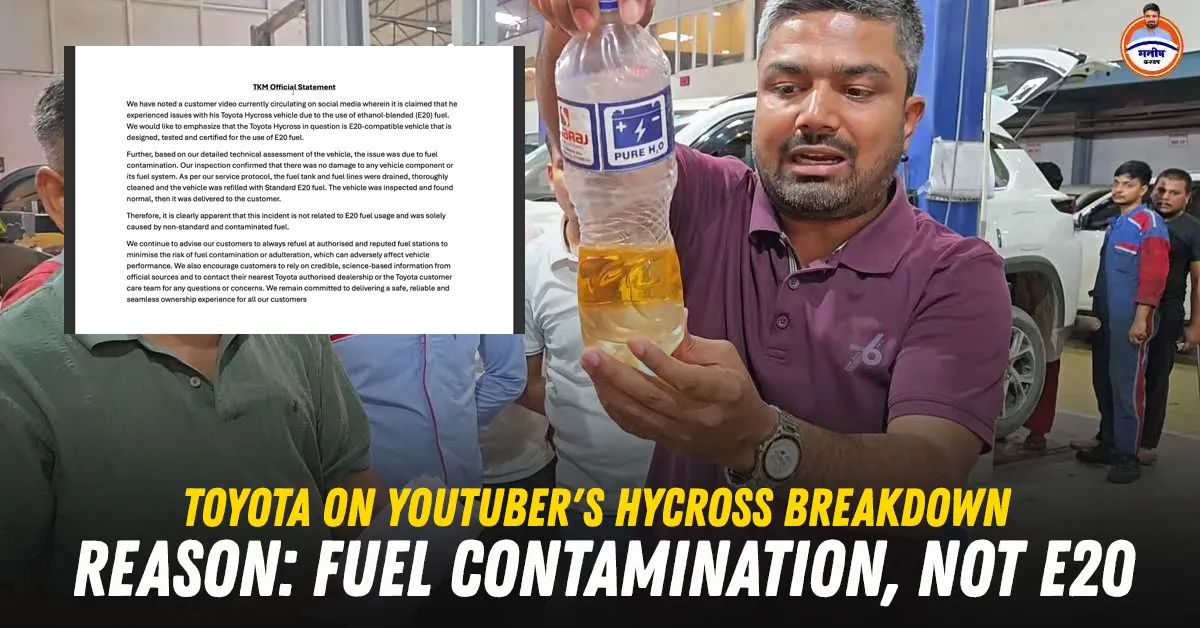
In its statement, Toyota clarified that the Hycross in this case, is an E20-compatible model. It has been designed , tested and certified to run smoothly on E20 fuel. It further explains that detailed technical inspections were performed on the MPV. These revealed the real issue- the use of contaminated fuel. The statement also mentions that no damage to any vehicle component or fuel system was found during inspections.
According to the carmaker’s service protocol, the vehicle’s fuel and fuel lines were completely drained and cleaned. Later the Hycross was refilled with standard E20 petrol. In the inspection that followed, the vehicle behaved normally and was later delivered to the customer.
In short, Toyota claimed that the use of sub-standard fuel caused the issue in this vehicle and advised users to only refuel at authorised and reputed fuel stations and only use standard E20 fuel.
Details of this incident were shared on YouTube by Manish Kashyap. He is an extremely popular Bihari YouTuber. His new Innova Hycross Hybrid, that had just around 12,000 km on its odometer, recently developed a bunch of issues. It was soon taken to a nearby Toyota service centre. Primary inspection revealed that the car had fuel system-related issues. Kashyap said on video that the dealership said they would not take any responsibility of this issue, despite the vehicle being under warranty.
Kashyap said that it wasn’t long ago that he did the 10000km service. The vehicle has lately been having several problems. The video also shows the chief technician at the dealership. He can be seen holding a bottle of E20 petrol drained from the Hycross’ tank. The technician claimed that the petrol obtained from the car had 40% Ethanol and debris in it. These caused the aforementioned issues in the car.
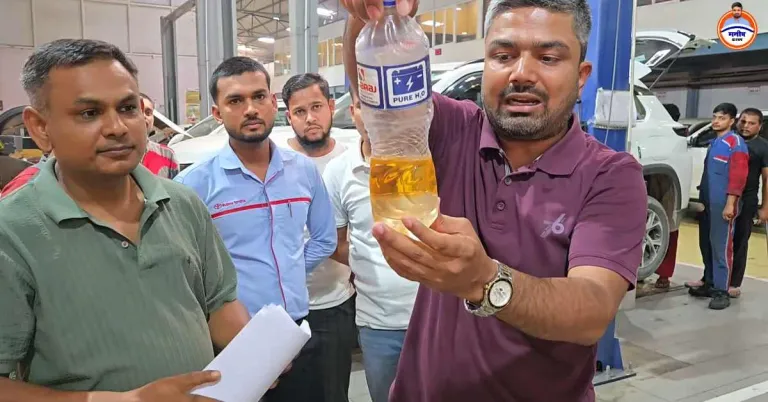
Look closely and you will notice that the Ethanol and petrol are seen in two separate layers inside the bottle. Now, look at the volume. Clearly, the water/ethanol layer measures more than 20% of the total quantity. What we can understand here is that the E20 petrol has undergone phase separation. Due to the hygroscopic nature of Ethanol, it absorbs water aggressively. This phenomenon can be triggered if water content is introduced into E20 petrol, in some way.
In the video, the vlogger focusses on the (indicated) high percentage of Ethanol in the fuel. The technician even adds that it is not possible for a vehicle owner to add Ethanol into the fuel tank separately. This even leads to an assumption that additional Ethanol may have entered the vehicle during refuelling. The video even shows some confusing assumptions and theories around the suspected high ethanol content. These are mostly baseless. We have explained these in detail in our previous story.
Interestingly, the dealership’s chief technician mentions that other Toyota models have also been facing similar issues lately. The vlogger expresses his sheer frustration and dissatisfaction in this issue. He finds it concerning that a vehicle he has paid over Rs 40 lakh for, is giving him such headaches in early phases of ownership. He even mentions on video that he opted for the more-expensive strong hybrid variant to be environment-friendly. The frustration indeed stands valid. However, we think Toyota’s explanation makes more sense in this case.
We have said this before and we say it again: E20 petrol and water do not go well together! If water is introduced to E20 in any way, it can immediately trigger phase separation. The separated layer of Ethanol-water mixture will settle down at the bottom of the tank and will be sucked into the engine. This can damage the engine and other components of the fuel system.
In this case, the fuel seems to have been contaminated. It seems to have water content in it. In some cases we have seen water getting mixed with petrol at bumps due to compromised or damaged storage mechanisms, especially in places with heavy rains and waterlogging.
Petrol is usually stored in underground tanks and in some areas, water may seep into them. While we can’t be certain on this front, the fact that the fuel used was contaminated and the technician’s words that more vehicle are facing the same problem, it is safe to assume that such an issue may exist at petrol bunk (s) of this particular region.
Comments are closed.