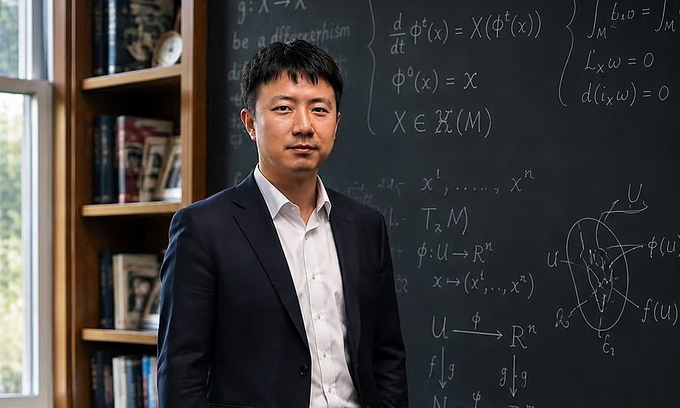
Yu Deng, 37, a University of Chicago professor who shared the 2026 Fields Medal in July, wrote on Chinese social media on Sept. 11 that if AI could solve all math problems he would “go home and write my yuri novel,” a reference to a Japanese genre depicting romantic relationships between women.
He told the South China Morning Post the following day that the line was a joke and that he does not believe AI will reach the point of solving every mathematical problem, at least not the ones he had in mind.
The statement he signed, titled “Serious Misalignment of AI in Mathematics,” carries the names of 25 Fields medalists including Terence Tao and Peter Scholze, roughly a third of the living recipients.
It argues that solving problems is a proxy for conceptual understanding rather than the point of the discipline, and that AI companies using problem-solving as a benchmark of model capability are producing results faster than mathematicians can check them.
|
Chinese mathematician Yu Deng, a 2026 Fields Medalist. Photo from Xiaohongshu |
AFP reported the signatories also raised attribution disputes and the loss of knowledge passed between generations of researchers.
OpenAI announced on Sept. 8 that an unreleased internal model had resolved the Navier-Stokes existence and smoothness problem. It is one of seven Millennium Prize Problems named by the Clay Mathematics Institute in May 2000, each carrying a $1 million award.
Only one has been settled before. Grigori Perelman proved the Poincare conjecture in papers posted in 2002 and 2003, then declined the Fields Medal in 2006 and the prize money in 2010.
The model showed that a fluid can start smooth and at rest and reach infinite speed in finite time, Nature reported, establishing the breakdown statements in Clay’s formulation rather than proving the equations always hold.
OpenAI said it does not intend to claim the prize, and the Washington Post reported the result has not been independently verified or accepted by the institute.
The company said the model was “significantly more capable than GPT-6 Astra” and ran as roughly 10,000 coordinating agents that exchanged 2.7 million messages and generated about 130 billion output tokens over 88 hours, with a further 17 hours spent verifying the proof in the Lean programming language.
OpenAI estimated that reproducing the run at its published pricing would cost around $10 million.
Scientific American reported that on the night before the announcement, New York University professor Tristan Buckmaster said he and Anthropic researcher Levent Alpoge had proven that the Euler equations, the frictionless counterpart to Navier-Stokes, break down in finite time.
The pair used Anthropic’s Claude alongside OpenAI’s Codex and posted three Lean-verified preprints.
OpenAI acknowledged its own effort began Sept. 1 after hearing a rumor it later connected to the two men.
Company mathematician Sebastien Bubeck told reporters OpenAI had solved the Euler problem independently by different means, while conceding its Navier-Stokes solution followed a method similar to theirs.
In a statement posted with his preprints, Buckmaster wrote that Bubeck twice pushed to remove Alpoge from authorship because he works for a competitor, and that when he threatened to go to the press he was asked, “Why would you ruin your career?” TechCrunch reported that OpenAI denies pressuring him.
American Mathematical Society president Ravi Vakil and chief executive John Meier credited a chain running from Diego Cordoba and Luis Martinez-Zoroa through Alpoge and Buckmaster to OpenAI’s mathematicians, writing that “the purpose of mathematics is human understanding.”
Austrian mathematician Julia Stadlmann, now at the University of Illinois Urbana-Champaign, posted a 34-page paper on Aug. 31 cutting the proven gap between infinitely recurring prime pairs from 246 to 240, the first improvement since 2014 and, Tao noted, one reached without AI.
Her doctoral supervisor at Oxford was James Maynard, who shares credit for the 246 result and won the 2022 Fields Medal.
Her record lasted three days. Science News reported that the startup Axiom Math reached 212 before OpenAI announced 186 alongside its GPT-6 Astra release on Sept. 3, a result whose Lean verification rests on three unproven assumptions by the company’s own account.
Had benchmark-driven AI firms existed in 2005, Tao wrote in a Sept. 5 post, the bound would have fallen within weeks and the problem been declared exhausted, leaving two decades of number theory unwritten.