
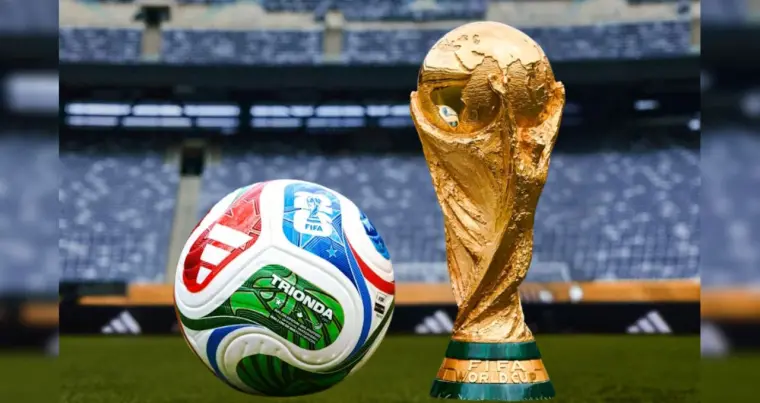

The crisis regarding broadcasting in India has deepened before the FIFA World Cup 2026. Till now no channel has bought the rights. Broadcasters are holding back due to expensive deals, late night matches and low advertising revenue.
Sports: A shocking situation has emerged for Indian football fans. There are less than two months left for the start of FIFA World Cup 2026, one of the world’s biggest sporting events, but till now no TV network or digital platform in India has bought its official broadcasting rights. This situation is not only unusual, but has also become a matter of concern for crores of football fans of the country.
Deal completed in Asia, India still lagging behind
FIFA has already finalized broadcast agreements in Asian markets such as Japan, Indonesia, Singapore and Hong Kong. But India, which is considered to be a rapidly emerging football market, has not been able to feature in this list so far.
This is irony because recently the World Cup trophy was brought to India as part of sponsorship activities, due to which tremendous enthusiasm was seen among the fans here. Despite this, there remains uncertainty regarding broadcasting rights.
How has broadcasting been done in India before?
The telecast of the FIFA World Cup in India has always been with the big networks.
- Ten Sports in 2002
- ESPN-Star in 2010
- Sony Pictures Network in 2014 and 2018
- Viacom18 in 2022
These platforms brought matches to audiences on both TV and digital mediums. But no buyer has come forward yet for the 2026 edition.
5 big reasons for not selling broadcasting rights
1. Less advertising opportunities than cricket
The bulk of the sports market in India is advertising based. In cricket matches, there is an opportunity to show advertisements after every over, due to which broadcasters earn more.
In contrast, football consists of 45-45 minute halves, with very limited opportunities for advertising in between. This is why broadcasters consider it less profitable.
2. Rights still expensive
According to reports, FIFA had earlier priced the combined rights for the 2026 and 2030 World Cups at around ₹928 crore. Later it was reduced to about ₹324 crore.
Despite this, Indian broadcasters are considering it an expensive deal. Media companies are estimating the value of this package to be around ₹200-250 crore.
3. No economic conversion of football viewership
Football is discussed a lot on social media in India, but this viewership does not directly translate into revenue.
TV viewership has declined between 2018 and 2022, while advertising revenue on digital platforms is also relatively low. In such a situation, broadcasters are avoiding big investments.
4. IPL eats up advertising budget
The Indian Premier League dominates the sports advertising market in India.
In 2026 also, IPL will run till the end of May, while the World Cup will start in June. Big companies—like automobile, FMCG, fintech and telecom—spend most of their advertising budgets on the IPL. Due to this the budget for the World Cup remains limited.
5. Timing not suitable for Indian audience
FIFA World Cup 2026 will be held in America, Canada and Mexico.
This means that most of the matches will take place after 10 pm Indian time. It is estimated that out of more than 100 matches, about 85-87% of the matches will be telecast late night.
In such timing, both viewership and advertising are affected, which reduces the enthusiasm of broadcasters.
What could be the possible options?
Prasar Bharati’s entry
State broadcaster Prasar Bharati has started preliminary talks with FIFA.
Through Doordarshan and digital platform ‘WAVES OTT’, it can become a big option, especially for free-to-air viewers.
YouTube and digital platforms
FIFA also has the option of platforms like YouTube as part of its digital strategy.
Although it is not clear whether all the matches will be available live or not, highlights, clips and some selected matches can be shown through digital medium.
Mandatory broadcasting under law
Under India’s “Sports Broadcasting Signals Act”, it may be mandatory to share big matches like semi-finals and finals on free-to-air platforms.
This can ensure that at least the big matches reach the Indian audience.
What does it mean for Indian football fans?
This situation raises a big question for the Indian football market—is the popularity of football in the country still economically unsustainable?
While the younger generation is following European leagues and international football on digital platforms, it is still considered a risky investment for broadcasters.

Comments are closed.