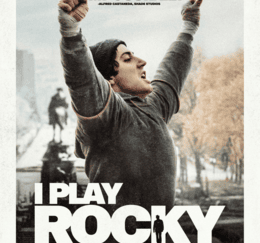
While watching a film, the title rarely plays on the audience’s mind. Sucked into the narrative unfolding on the screen, the title is probably the last thing on their minds.
But once in a while — and not every film manages this — a film throws its title back at the viewers, particularly in a way that feels so natural that it brings a smile to their faces. I Play Rocky is a slightly odd title, a bit too self-reflexive, perhaps. It doesn’t quite roll off the tongue. But when, nearly halfway into the movie, Anthony Ippolito, playing Sylvester Stallone, utters that line — not once but twice, perhaps even thrice — it suddenly makes sense. The stubborn plainness of that line lies at the heart of this film, directed by Peter Farrelly, which gives the audience a behind-the-scenes account of the incredible story of how Stallone made Rocky happen.
Being Rocky
In 1975, Stallone is a struggling actor with a handful of bit roles in B-movies and little to show for his ambitions. Unable to find leading roles, he begins writing scripts for himself, insisting that he be the one to play the protagonist. The breakthrough comes one night, when he watches the boxing match between Muhammad Ali and Chuck Wepner.
Struck by the underdog Wepner’s refusal to go down, Stallone rushes home and writes Rocky in three days. The screenplay catches the attention of producers Irwin Winkler and Robert Chartoff, but there is a catch: the studio head they reach out to wants a Burt Reynolds or James Caan (recognisable stars at the time) in the lead. Stallone refuses to sell unless he gets to play Rocky.
Also read: Wildwood review: An ambitious studio vehicle that puts the artiste first
What follows is a series of increasingly lucrative offers, each of which he turns down. He is barely able to pay his rent, has sold his beloved dog because he cannot afford to feed him and has a baby on the way. Yet he won’t budge.
There is something deeply satisfying about watching someone refuse the easy way out, even when the alternative is financial ruin. In a sense, I Play Rocky is also a celebration of defiance against money — the idea that not everything has a price and that creative conviction can sometimes trump the most lucrative of deals. In an industry where everything is negotiable, Stallone has found the one thing he cannot compromise on. These negotiations are among the film’s most enjoyable stretches, thanks in no small part to PJ Byrne and Toby Kebbell, who make for an effective, often amusing duo as Winkler and Chartoff. There is something almost comical about watching them return with one offer after another, only to be met with the same stubborn refusal, even as they root for Sly and believe in him all along.
The trouble is that once Stallone finally gets his way, I Play Rocky struggles to sustain this momentum. His reward is a meagre budget and an unforgiving schedule. Any significant overrun could cost him the job. The production encounters the usual assortment of problems — difficult locations, actors falling ill, scenes that refuse to come together — and the filmmakers resort to guerrilla tactics to get the film made. But for a movie about the making of one of Hollywood’s most celebrated underdog stories, the actual filmmaking process feels surprisingly uneventful. Obstacles appear and are dispatched with relative ease.
Letting familiarity do the heavy lifting
There is also something rather safe about the enterprise. A film about the making of Rocky is already trading in nostalgia and the audience comes armed with the knowledge of what it is building towards. Iconic moments like the Philadelphia Art Museum steps scene, all the running filmed by a then-novel Steadicam and the eventual arrival of that theme music are designed to deliver a rush of recognition. But recognition isn’t quite the same thing as emotion. When Stallone struggles to get the famous speech right, for instance, the people around him seem deeply moved when he finally nails it. The audience, on the other hand, might find themselves wondering why the moment isn’t quite landing. The film seems to assume that familiarity with the original will do much of its emotional heavy lifting.
Ippolito bears a striking resemblance to Stallone and the film makes great use of this right from its opening shot, gradually revealing his face through an interplay of light and shadow. His slightly mumbled delivery helps conjure the familiar screen persona, even if it occasionally makes him difficult to understand. There is something magical about the very act of casting someone who can approximate another person so convincingly: a reminder that cinema is, after all, a lie told in the service of a truth.
Also read: Student of the Year: After Dark review — Squid Game take, Shanaya Kapoor act not enough to save series
I Play Rocky isn’t a bad film. It is standard Hollywood fare: engaging, competently put together and occasionally moving. But it never quite earns the rousing emotional payoff it reaches for. Its most affecting moments are often those in which we catch glimpses of the Rocky we know and love.
The irony is that the original film, with its modest ambitions and extraordinary journey, remains the more stirring underdog story. This one tells us why we should be moved. It doesn’t always manage to move us.