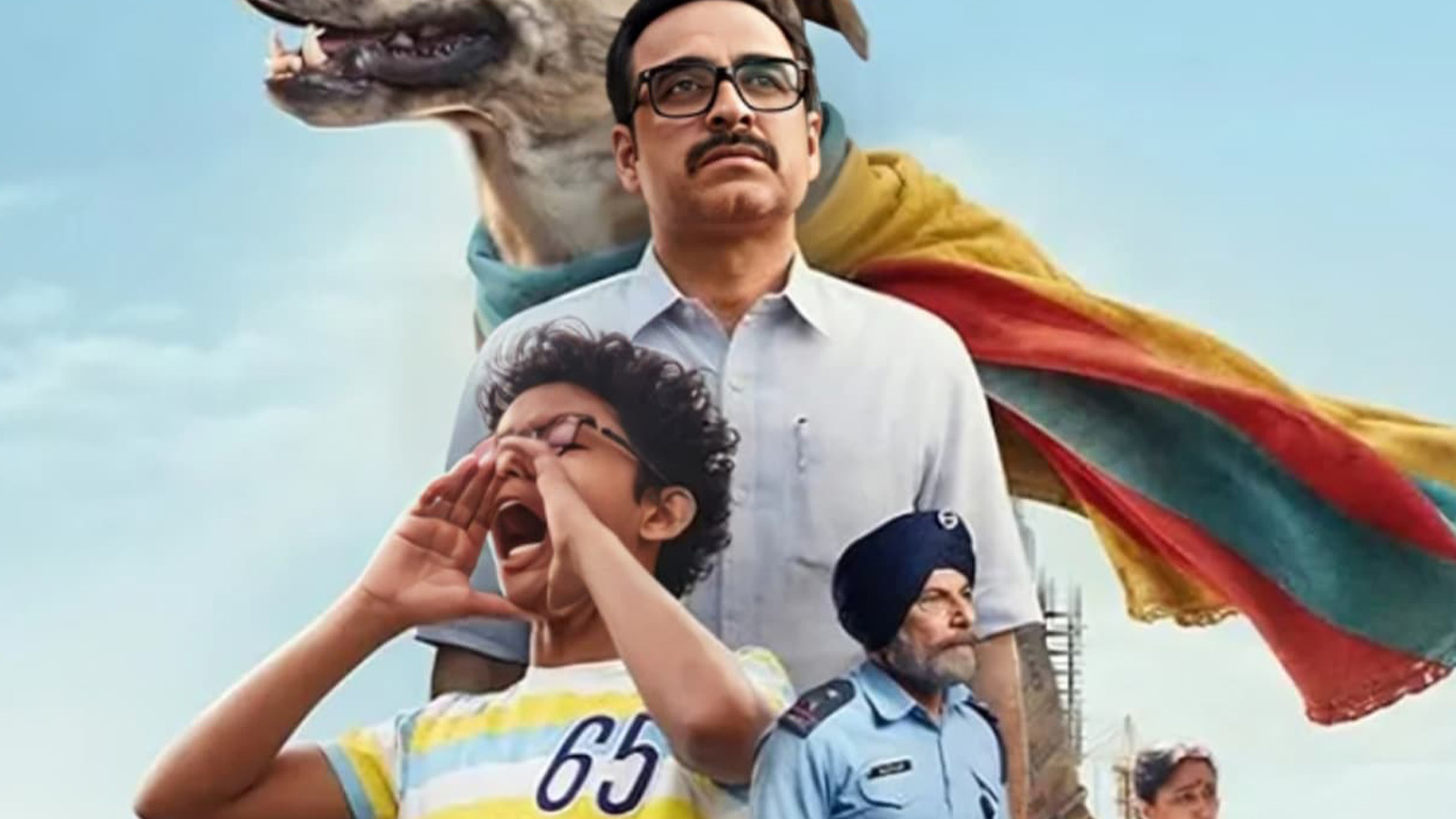
A boy named Apu, a portrait of filmmaker Satyajit Ray and a neat little glimpse of the 1971 Bengali film Sonar Kella (adaptation of Ray’s own eponymous novel centred around the experiences of his iconic detective Prodosh Mitter, better known as ‘Felu Da’) — writer-director Amit Rai spares no prizes for guessing the inspirations behind his latest release, Ohh My Dog.
The film is every bit an homage to the legendary polymath’s playful and adventurous spirit, featuring prodigious children, unconventional detectives and inexplicable yet tender bonds that are tested but never broken. Deadly criminal rackets are busted, unscrupulous cops are defeated and order is restored at the end of it all as Rai and his host of heroes bat for empathy and love for not just humanity, but every life form around us.
If Apu (Maahi Rai), the barely-ten whiz kid living in Assam’s Dibrugarh, holds one end of this amusing tale, the indie canine Oscar (played by Bruno) becomes his perfect counterpart as the two go about their individual ways to solve mysteries no one ever expected them to. Apu’s dog, Momo (another indie, funnily enough, named Oscar), goes missing while chasing his ball and it doesn’t take long for the boy to sense that something sinister is at play.
Similarly, when Oscar’s best friend — a construction labourer boy named Prince — disappears mysteriously somewhere in Bihar, the canine goes against all odds to save him from an evil nexus. The two tracks run in parallel all along the 150-minute duration and while Rai doesn’t break any mould with how he structures his film, he nevertheless makes a simple yet effective statement about how coexistence between humans and animals is deeply embedded in society’s DNA. In fact, beyond mere coexistence, he professes that sometimes it takes a member of a different species altogether to understand and love us unconditionally.
Child and dog carry the show
Ohh My Dog highlights this natural synergy or symbiosis through inventive sequences. In one, Apu manages to recreate exactly how Momo would have gotten away to kick-start his investigation, using nothing more than a tennis ball floating in gutter water.
Oscar does the same as he goes sniffing around town to pin down his buddy Prince’s whereabouts, relying on subtle clues such as the lingering smell of cow dung. The human adults are largely bystanders here — not because they are less competent, but because they don’t possess the heart that Apu and Oscar do. Only the two of them would walk through a dense forest in the middle of the night or face up to a gang of twenty-something men on their own.
Also read: Operation Safed Sagar review: Why new Netflix series on Kargil mission fails to touch the heart
Still, some of the adults do make an impression here. Pankaj Tripathi gladly gives away the limelight (after playing the lead in Rai’s previous film, Oh My God 2) to play Prince’s tuition teacher, who helps find the boy through a labyrinthine turn of events.
As in any ‘Felu Da’ story, the well-meaning adults end up surrendering to the innocence around them and Apu finds multiple partners for his quest in his private tutor ‘didi’, Krishna (played by Sulakhyana Baruah), his pious and equally innocent mother (Geeta Aggarwal Sharma) and the tough, grumpy RTO inspector Akaljeet Singh (Pawan Malhotra).
Rajesh Kumar and Vijay Vid Mishra, as the morally compromised cops, too, put on a fine show by tuning their villainy to a comic-book-like register.
Keeping it real
Ohh My Dog, though, really stands out with the realistic and highly unembellished look of its world. Bollywood has time and again splurged to create improbable and glamorous settings for such stories, but Amit Rai and his core technical crew (including Hungarian cinematographer Máté Herbai) firmly root their protagonists in the realities of their everyday lives. The Oscar-Prince thread, in particular, paints a striking picture of how migrant labourers arrive in big cities without a proper destination or the comfort of a traditional family life.
The underclass — which also includes Prince’s fellow underage but deeply caring labourers, rickshaw riders who sleep on footpaths and others — struggles to keep itself afloat in a society that’s constantly trying to manipulate it and this forms another important exploration of the film. Littered streets, grimy interiors, dingy alleys, pavements and tenements flooded with people, and all that’s part of the world that this story inhabits is shown as it is, without the usual neat packaging.
Also read: A lingering refrain: How the ghazal survived, evolved through the centuries
At the same time, Ohh My Dog refuses to challenge itself to the maximum and while it makes impassioned arguments about its subject matter, it still ends up treading a path that’s a bit too convenient. The investigation or the chase in the film doesn’t evoke as many highs as it ought to have and the second half in particular loses some of the steam; the Oscar part, especially, stops being as imaginative as it was in the first half.
Consequently, Rai’s film leaves behind its initial narrative tension in exchange for warmth and simplicity, trusting them to carry the story home. And for all its blips and hiccups, this story manages to weave its quiet magic and urges us to look beyond the confines of our own existence. Go Oscar!