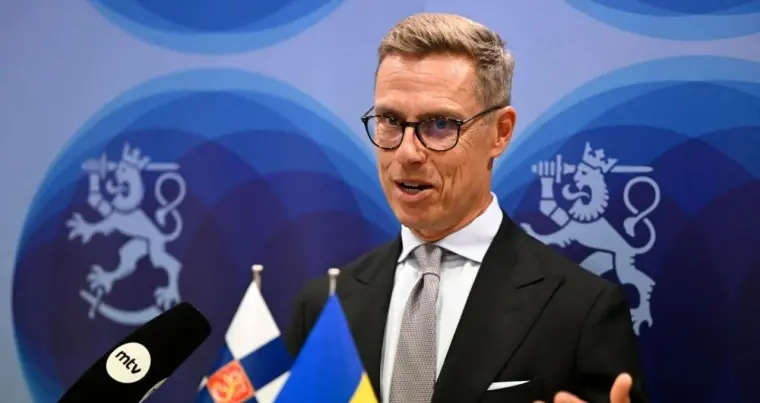
Finnish President Alexander Stubb has said that Russia would not risk attacking any NATO member state. According to him, the strength of the military alliance is so high that it would make no sense for Moscow to have a direct confrontation with it.
Helsinki: Finnish President Alexander Stubb has said he does not believe Russia would risk attacking a NATO member state. In an interview with German newspaper Bild, Stubb said that it would not be a wise move for Moscow to test the strength of the world’s most powerful military alliance.
This statement of President Stubb has come at a time when there is concern in European countries about possible military and hybrid activities of Russia. Western officials have warned of the growing threat of cyber attacks and other hybrid operations. It is feared that such activities may increase the risk of direct conflict between Russia and NATO in the future.
However, Stubb cast doubt on available estimates of the likelihood of a direct Russian attack on NATO, saying he did not see sufficient facts or evidence to support this claim.
Stubb dismisses fear of Russia’s attack on NATO
In an interview with German newspaper Bild, Stubb said that if someone could say with certainty that Russia would attack a NATO country in the future, he would have to have extraordinary information. He said that under the current circumstances he sees neither sufficient evidence nor concrete facts to support such a claim.
Stubb made clear that he did not believe that Russia would want to attack NATO, the world’s most powerful military alliance. According to him, considering the collective military capability of the alliance, such a step would be extremely risky for Russia.
The Finnish President also said that NATO should be prepared for every possible situation. However, there is a gap in preparedness and actual threat assessment. According to him, under the current circumstances it does not appear practical for Russia to wage war against NATO.
Said to be a major restriction on NATO’s military power
Stubb noted NATO’s conventional military capabilities, missiles and nuclear weapons, saying the alliance’s strength is a major deterrent to any potential aggressor.
According to him, it would not be logical for any power in the world to challenge NATO’s collective commitment and ability to respond. He said that if Russia attacks any NATO member, it may have to face the reaction not just from one country but from the entire military alliance.
Finland joined NATO in 2023. After Russia launched a massive military attack on Ukraine, Finland made a major change to its decades-old policy of military non-alignment and gained NATO membership.
Concern about Russia’s hybrid activities in Europe
There is continued concern in European countries about Russia’s alleged hybrid activities. According to Western officials, cyberattacks, disinformation and other non-traditional activities could pose a security challenge to European countries.
Concern about these activities is also important because the risk of retaliation and political tensions following a major cyber or hybrid attack could increase the risk of conflict between Russia and NATO.
Stubb believed that Russia is trying to create an atmosphere of fear and insecurity in Europe. However, he said he has doubts about Russia’s ability to launch a large-scale war against NATO given its current military position.
The loss of Russian soldiers was also mentioned
The President of Finland also mentioned the losses being suffered by the Russian army in the ongoing war between Russia and Ukraine. He claimed that Russia is losing around 30,000 to 35,000 soldiers every month, while its recruitment pace is around 27,000 soldiers per month.
According to Stubb, if this gap between losses and recruitment persists, it may be challenging for Russia to raise large numbers of additional troops.
He said that Russia already has a complex military situation in Ukraine. In such a situation, it will not be easy for it to suddenly gather such a large additional military capacity that it can fight an effective war on two different fronts simultaneously.
While giving this assessment, Stubb also talked about avoiding underestimating Russia’s military capability. He said that it is important for NATO to be prepared for any possible situation.
Assessment of Russia’s attack capability by 2029
Some German officials have assessed that Russia could be in a position to attack a NATO member state by 2029. Such assessments have intensified the debate about security and defense preparedness in Europe.
Stubb also expressed doubts about this deadline. He said it is not easy to make definitive predictions about the future and he does not see enough facts to support such a claim.
According to him, given Russia’s current military position, losses in the Ukraine war and NATO’s collective power, the option of direct military confrontation may prove to be very costly for Moscow.
Appeal to continue support to Ukraine
Stubb also appealed to European countries to continue their support for Ukraine. He said that Ukraine is currently in its strongest position since the beginning of the war.
According to him, Ukraine’s security for Europe is directly linked to its own security. Keeping Ukraine strong against Russia is vital to European security, he said, referring to both Germany and Finland.
Stubb argues that if Ukraine weakens or Russia achieves major success in the war, the impact will not be limited to Ukraine alone. This may also increase pressure on Europe’s broader security infrastructure.
‘Ukraine is the biggest guarantee of our security’
The President of Finland described Ukraine as important for the security of Europe. He said that Ukraine is playing the role of a major security barrier against Russia.
According to him, if Ukraine loses the war then the security situation of European countries may also weaken. Europe should therefore continue to provide military, economic and political support to Ukraine.
Stubb presented this support not as mere help to Ukraine, but as a long-term security interest of Europe.
Finland’s changed security policy
Finland’s accession to NATO was considered a major change in the European security system. Finland, which has long followed a policy of military non-alignment, made a historic change in its security policy after Russia’s invasion of Ukraine.
After joining NATO, Finland is now part of the collective defense system. This means that the alliance’s collective security commitment can be activated in the event of a serious military attack on a member state.
Stubb’s current statements come amid this broader European security debate. Their message is that Russia is well aware of the costs and risks of direct conflict with NATO.
The challenge before Europe is preparation and balance
Stubb’s statement reveals an important aspect of Europe’s current security strategy. On the one hand, NATO countries are taking the potential threat from Russia seriously and strengthening their defense capabilities, while on the other hand, efforts are also being made to avoid a direct war situation with Russia.
Finland’s stance reflects this balance. While Stubb considered the likelihood of a Russian attack on NATO currently low, he stressed the need for the alliance to be prepared for any situation.
He says that Europe should prepare its strategy based on facts and intelligence assessments rather than fear. At the same time, support for Ukraine must remain a key part of Europe’s security policy.
What next?
The debate over Europe’s security is likely to intensify in the future as the Russia-Ukraine war continues. NATO countries are strengthening their military capabilities and also increasing preparedness to deal with potential hybrid and cyber threats.
The latest assessment by Finnish President Stubb currently suggests that the likelihood of a direct war between Russia and NATO is low. However, he also made it clear that any potential threat should not be ignored.
His message is twofold—NATO must remain strong and prepared and must continue supporting Ukraine. According to Stubb, the situation in Ukraine is not just an issue of the Russia–Ukraine war, but is linked to the long-term security of Europe as a whole.