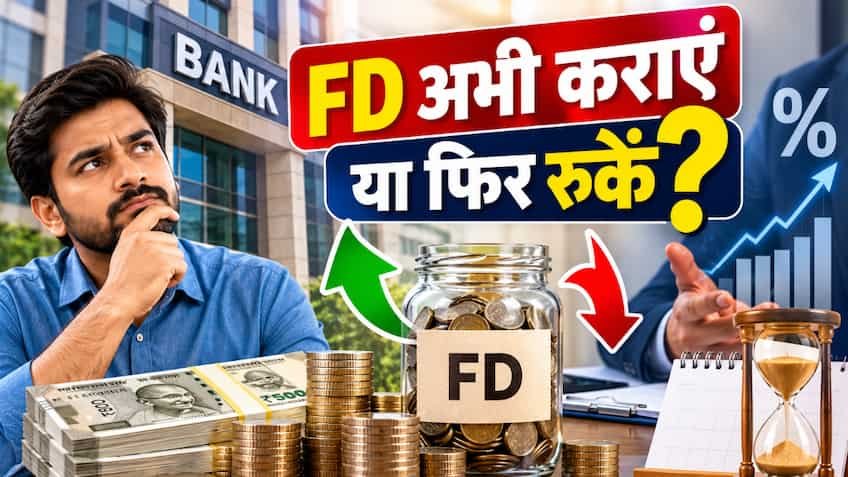
Fixed Deposit (FD) still remains the first choice among Indian families when it comes to savings and safe investments. No matter how attractive the returns in the stock market and mutual funds are, there is no comparison to bank FD in terms of guaranteed returns and capital security. However, in the current economic scenario, due to the monetary policy of the Reserve Bank and the liquidity needs of the banks, the biggest dilemma faced by the depositors is whether to lock their lump sum capital in FD now or wait for the interest rates to increase further in the future. These days, in the branches of major government and private banks located in Hazratganj and Gomti Nagar of Lucknow, everyone from senior citizens to young employees are asking the same question as to what strategy should be adopted to earn maximum profits. Financial experts are of the clear opinion that just by waiting, the interest earned gets lost, whereas a precise and tried and tested formula can give you the highest returns in every ups and downs of interest rates.
The interest rates offered by banks on fixed deposits directly depend on the repo rate of the Reserve Bank of India (RBI) and the cash position in the banking system. Banking experts and macroeconomic analysts have analyzed that the current interest rate cycle has reached very close to its peak cycle. When policy rates are anchored at high levels, there is limited scope for further large rate hikes by banks. If an investor leaves his money sitting in a normal savings account earning 2.7% to 3% interest in the hope that rates will rise by half a percentage point in the next few months, he is incurring a direct loss of potential additional interest of about 4 to 4.5% per month. Therefore, locking the capital for a long period at the current attractive rates rather than retaining the entire money is considered a safer move from financial point of view.
If you study the current interest rate charts of banks closely, you will find that banks are offering the highest interest on special tenures of 1 to 3 years rather than very long tenures of 5 or 10 years. In special schemes like 399 days, 444 days, 555 days or 666 days, major banks are offering annual interest ranging from 7.10% to 7.50% to general citizens and 7.60% to 8.00% to senior citizens. Banks require immediate deposits to meet their short-term and medium-term credit demands, so they set premium interest rates on these specific tenors. If you have funds that you are going to need in the next 2 to 3 years, it would make the most sense to invest immediately in these special tenor FDs.
Fixing the entire money in one bank and for the same period is considered to be the oldest and riskiest mistake of FD. Due to this, if money is needed in between, then the entire FD has to be broken pre-mature and a penalty of 0.5% to 1% has to be paid. To avoid this problem and get maximum returns, financial advisors recommend adopting 'FD Laddering' technique. Suppose you have a lump sum capital of Rs 5 lakh, then instead of depositing it together for 3 years, divide it into 5 parts of Rs 1 lakh each. Deposit the first part for 1 year, second for 2 years, third for 3 years, fourth for 4 years and fifth for 5 years. As soon as the FD of Rs 1 lakh matures in the first year, renew it for the next 5 years along with interest. With this strategy, you will have liquidity in your hands every year, there will be no need to break the entire FD in an emergency and you will get the biggest benefit from the average of interest rates.
While investing in FD, it is equally essential to understand the tax on interest earned. According to income tax rules, if the total interest received from FD from all bank branches combined in a financial year exceeds Rs 40,000 for general citizens and Rs 50,000 for senior citizens, then banks deduct 10% TDS as per rules. If the PAN card is not linked with the bank account, this TDS rate can directly reach up to 20%. If your total annual income is less than the basic tax exemption limit, do not forget to submit Form 15G (for general citizens) or Form 15H (for senior citizens) to the bank at the beginning of the financial year to avoid TDS deduction. Additionally, if you fall in the 30% tax bracket, the interest earned from FD will be added to your total income and will be taxable as per the same slab, which should be taken into account when calculating the actual post-tax return.
It is often seen that Small Finance Banks (SFBs) offer 0.50% to 1.00% higher interest on FD compared to big government and private banks. Many depositors remain skeptical about security. In this context, it is important to note that under the Deposit Insurance and Credit Guarantee Corporation (DICGC), wholly owned by the RBI, every account holder's deposits up to Rs 5 lakh (including principal and interest) in every scheduled bank—be it SBI, PNB or any small finance bank—are fully protected and insured. If you want to avail of higher returns, it would be wise to spread your capital within a limit of Rs 5 lakh across different scheduled banks rather than concentrating it in a single bank. With this, you will also get the benefit of maximum interest rate and 100% of your capital will also have the impenetrable shield of government insurance protection.
Keywords: fixed deposit interest rates 2026, best fd rates in india, fd laddering strategy, fixed deposit right time to invest, sbi fd interest rates, senior citizen fd rates, fd vs mutual fund return, rbi repo rate impact on fd, dicgc 5 lakh insurance rules, form 15g 15h for fd tds, short term fd vs long term fd, small finance bank fd interest, tax on bank fixed deposit, investment in fd Right Time, Bank FD Interest Rates 2026, FD Laddering Formula, Fixed Deposit Rules, Senior Citizen FD Interest, Bank FD Tax Rules, Form 15G TDS Savings, Small Finance Bank FD, 8 Percent Interest on FD, Safe Investment Option, Bank Deposit Insurance DICGC, Penalty on Breaking FD, Fixed Deposit Calculator