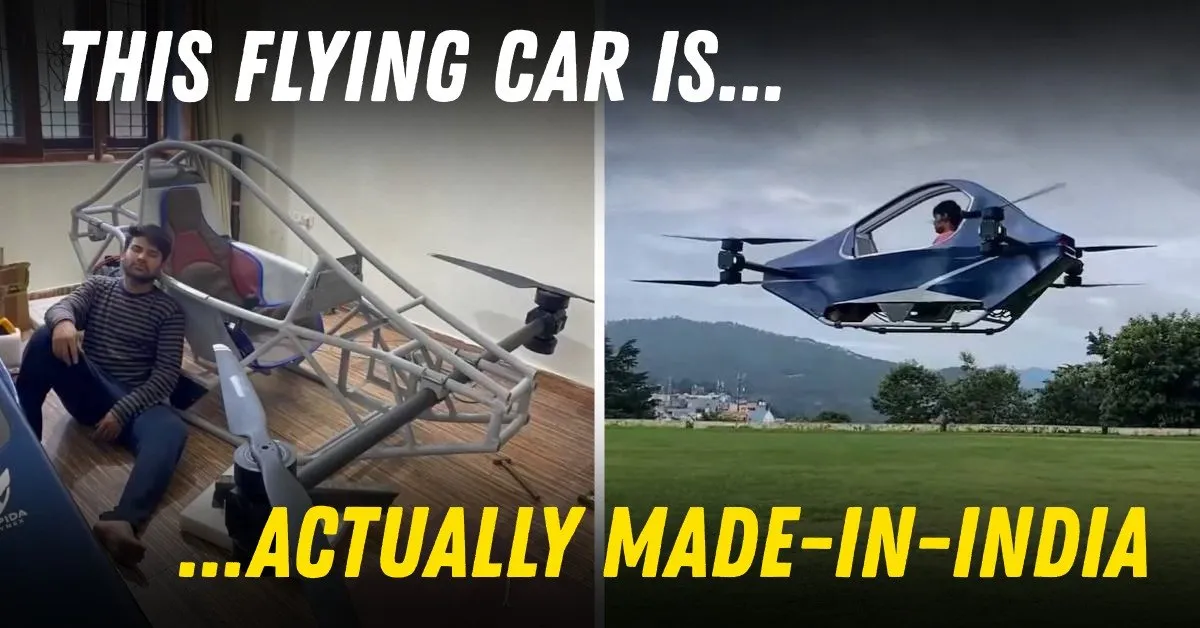
The video showing the behind-the-scenes of this flying vehicle’s build has been shared on X by Kumaon Jagran. In this short video, there are multiple images of how the SKYNeX was built by Ravi Tamta. This video is proof that this particular flying vehicle has not been imported from China. Recently, there have been a lot of rumours on social media that the vehicle was purchased from China.
However, it has to be mentioned that the idea of a compact single-seat electric flying vehicle is not unique to China. In fact, the overall layout closely resembles the Jetson One, which was launched a few years ago by the Swedish company Jetson. The lightweight tubular frame, single-seat cockpit, and multi-rotor configuration of flying vehicles so far have been copied by a lot of manufacturers.
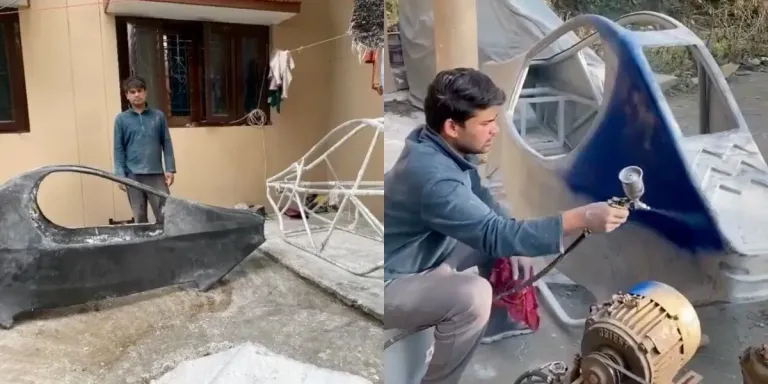
To show how the HAPIDA SKYNeX is a real vehicle, the video, which is the combination of multiple images, shows how this project started. It can be noted that it all started from a bare tubular frame which was built by hand at home. There was a small-scale model which was placed next to the frame for inspiration. After which, the images show Tamta sitting next to the frame and the fibreglass shell that has also been made by him.
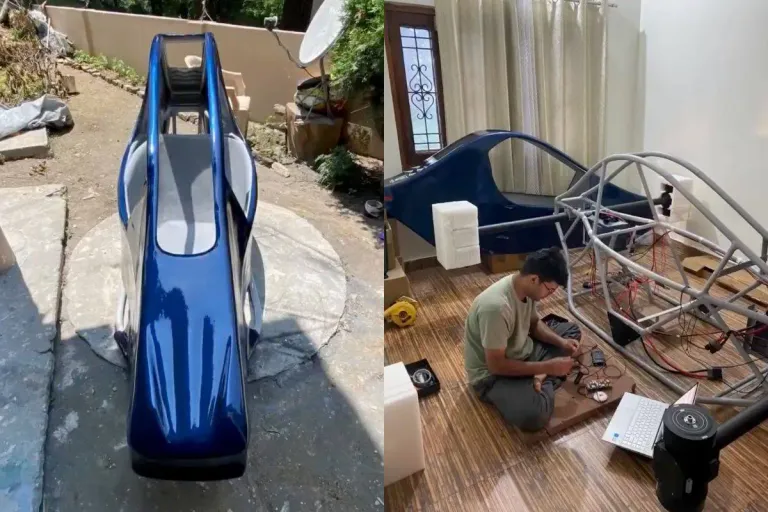
Moving ahead, the next stage of the build shows Tamta painting the fibreglass shell. After which, the seat design was finalized and was finished installing. The images then show the vehicle parked inside the house where Tamta was seen completing its electrical wiring and installing the rotor arms. The vehicle was then once again brought out for the final assembly, and at last, the video shows the first test flight in a stadium at night.
The main point of this video is that it proves that even if Ravi Tamta used existing international flying vehicles as reference, it does not mean that what he has made is not real. The automotive and aviation industries have a number of examples where manufacturers learn from successful products before developing their own versions.
A lot of Chinese manufacturers themselves have built many products inspired by established European, Japanese, and American designs. So, we have to apply the same logic in the case of Tamta as well. The HAPIDA SKYNeX borrows its idea from the Jetson One and other personal eVTOL aircraft.
However, building a functioning prototype still requires a lot of effort. Designing a chassis, manufacturing body panels, and installing electric motors. Also designing and installing a wiring and electrical system, and then also completing a successful test flight, is extremely difficult for any person. It is especially difficult for a person who lives in a small village in Uttarakhand.

Presently, there is only limited information about the HAPIDA SKYNeX which has been shared by Ravi Tamta and his team. It has been described as a single-seat electric flying vehicle which is based on modified drone technology. The SKYNeX, instead of using wings like a conventional aircraft, uses multiple electric rotors which generate lift, similar to large drones.
The vehicle has been designed as a personal mobility solution rather than a traditional aircraft. According to reports, Tamta came up with this idea after facing long travel times in the hilly regions of Uttarakhand. He has stated that a road journey of around 40 km between his village and nearby destinations takes close to 90 minutes.
However, with a flying vehicle like this, the same journey could be completed in around 10 to 15 minutes by travelling directly through the air. Now, it has to be noted that no detailed technical specifications have been officially revealed yet. Information such as battery capacity, flight range, maximum speed, payload capacity, charging time, and flight endurance is still unknown.

It also has to be noted that although the first successful flight has generated a lot of excitement on social media, it is important to keep in mind that this is still an early-stage prototype. There is a huge difference between building a working prototype and creating a product that can be commercially sold.
Also, before the SKYNeX becomes a real mode of transportation, it will have to go through a lot of testing. The vehicle’s structural strength, flight stability, battery reliability, and emergency systems have to be evaluated in detail. Apart from these, it will also require approvals from the relevant aviation authorities before such vehicles can be used by the general public.