
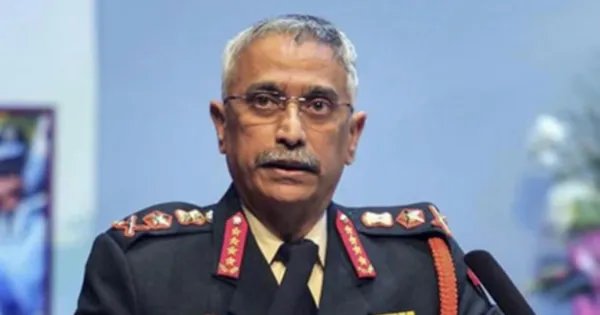
Former Army Chief Naravane said – It was not appropriate to cite me and drag me for an unpublished book.

New Delhi. Former Army chief General Manoj Naravane, in the context of the controversy earlier this year over his unpublished memoir ‘Four Stars of Destiny’, has said that it was “not fair” to unnecessarily reference him and bring him into the limelight for the book. General Naravane said that he has moved on from that controversy and has since written two books and the third book is coming soon.
He recently released his book ‘The Curious and the Classified: Unearthing Military Myths and Mysteries’. Naravane said in an interview with ‘PTI Video’, “The Defense Ministry had asked the publisher to keep the book on hold until it is inspected. As far as I am concerned, the matter ended there and I have moved on… so that chapter is closed. I feel that it was not appropriate to unnecessarily cite me and drag the unpublished book and indirectly me into the limelight.
Congress leader Rahul Gandhi was barred from mentioning excerpts from the memoir in the Lok Sabha in February this year as it is yet to be published. Naravane’s recent book ‘The Curious and the Classified: Unearthing Military Myths and Mysteries’ published by Rupa Publications contains anecdotes, stories and interesting aspects related to the Indian Army, Navy and Air Force.
Naravane has told in his book how the adoption of the military greeting ‘Jai Hind’ started. He said that ‘Jai Hind’ was first used by the Indian Air Force and later the Army and Navy also adopted it. He said the standard practice of saluting was originally to remain silent and different regiments added their own ways of saluting such as ‘Sat Shri Akal’ or ‘Ram Ram’.
Naravane said, “Initially the Air Force started saying ‘Jai Hind’ and now we follow it in all three services. We say ‘Jai Hind’ with the salute and also greet with ‘Jai Hind’ in lectures.” He said, “But where did this ‘Jai Hind’ come from? Its roots are very deep. This was a new information for me too. This was something about which even I was not aware, although I must have said ‘Jai Hind’ millions of times.
The former Army chief also mentioned the stories of Assam Regiment soldier Badluram and a military mule named Pedongi. Badluram was martyred in the Battle of Kohima in 1944, but even after his death, rations continued to be issued in his name, which helped the army surrounded by the enemy to survive in the war. Inspired by this story, British Indian Army officer Major MT Proctor wrote the rousing song “Badaluram Ka Badan”, which became the unofficial regimental anthem of the Assam Regiment and is sung at their functions.
Naravane said, “…its lyrics are, ‘Badaluram ka badan zamin ke neech hai, lekin uska rashan hum khate hain’ and it became a very famous song. This is a very upbeat song that you can dance to and it boosts morale. Many people have heard this song, but very few know that it has its roots in an actual battle that probably changed the course of Indian history.”
Talking about the mule named Pedongi, which was captured by Pakistan in 1971 and later returned to his unit through landmine areas, Naravane said the animal was retired with honor and served for 37 years. General Naravane said, “The Pakistanis had started using it to transport their goods.
One day when the mule was loaded with a machine gun and some ammunition, he decided to return home. He escaped from his captors, crossed dangerous terrain and landmines and returned to his unit using his instincts.” He said, ”In a way, this shows bravery, courage and loyalty. After this he was given many rewards and it was also decided that he would not carry any burden like other mules. He was virtually retired and died of natural causes after 37 years in Bareilly.”

Comments are closed.