

Shuangquan, the company’s 61-year-old chairman, and his younger brother Shunquan, 57, who serves as CEO, each hold stakes of roughly 15% in the firm.
Each has a net worth of $1.3 billion, based on Friday’s closing price, according to U.S. magazine Forbes.
The Wuhan-based company occupies a central role in China’s semiconductor supply chain as the country’s sole supplier covering the full range of chemical mechanical polishing, or CMP, a process that smooths silicon wafer surfaces so circuits can be printed and chips stacked.
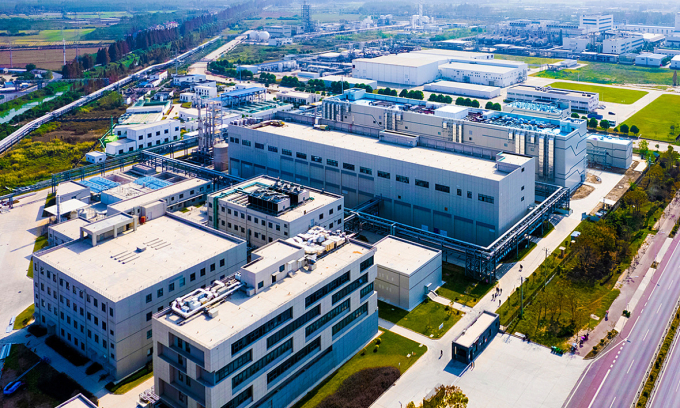
Dinglong (Qianjiang) Optoelectronic Semiconductor Materials Industrial Park. Photo courtesy of Hubei Dinglong |
Following U.S. chip-related export controls imposed on China in 2022, Dinglong broadened its scope into lithography materials, a critical bottleneck in China’s semiconductor independence where ultraviolet light is used to print circuits onto silicon wafers.
The company now produces photoresist, a chemical that captures circuit designs, though its most advanced products remain suited only to lower-end chip production.
The company has also moved into advanced semiconductor packaging materials, including a specialized adhesive that bonds silicon wafers to glass blocks so they can be thinned to less than the width of a human hair before being stacked into chips such as high-bandwidth memory.
Financial results have reflected the momentum. In the first quarter of 2026, Dinglong’s net profit jumped 78% year-on-year to 251 million yuan ($36.9 million), while revenue rose 24% to 1 billion yuan, driven primarily by its CMP materials business. The company noted its advanced packaging materials and photoresist operations remain in early stages, though they have entered “the stage of stable, small-batch supply.”
IN Marchhas announced the start of mass production of photoresists for advanced chips at what it describes as China’s first full-process manufacturing plant for the light-sensitive organic polymers, a development that marks a significant stride in the country’s push to make its semiconductor industry more self-reliant, according to Yicai Global.
The brothers’ entrepreneurial path began outside the private sector. Before founding Dinglong, Shuangquan managed state-owned enterprise Hubei International Economic and Foreign Trade, while Shunquan held a role at Hubei International Economic and Technical Cooperation.
In 2000, they launched Dinglong with an ambition to reduce China’s reliance on imports, starting with printer toner chemicals then dominated by Japanese and Western chemical companies. The venture grew into a major domestic supplier of color printing chemicals.
The company went public on the Shenzhen stock exchange’s tech-focused ChiNext board in a 458 million yuan IPO in 2010. Two years later, the brothers turned their attention to CMP materials, spotting an opportunity to challenge foreign incumbents much as they had in the printing segment.
In a February interview with state-owned newspaper Securities TimesShunquan said the expansion was triggered by the team’s realization that CMP materials share certain chemistry elements with toner materials.
In a 2019 interview with state-owned newspaper Changjiang DailyShuangquan reflected on what drove their early success. “In the early days of starting a business, aside from an idea, a burst of drive and an insight into a market or an innovative product opportunity, Chinese private enterprises had nothing. They relied solely on a ‘burn the boats’ spirit to get things moving,” he said.
“Dinglong will never lose this drive. There is a much larger world out there waiting for us to conquer.”
Comments are closed.