
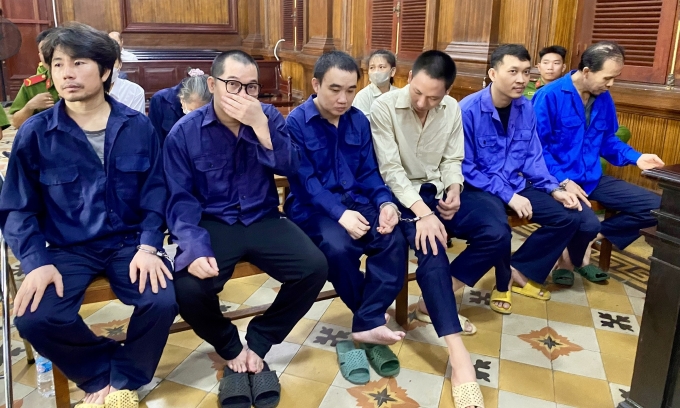

The Lao men, Thongchaleun Youkhanthone, 27; Syvongphet Saiykham; Sisoulath Vydavone; and Sivongxay Chok, were convicted of illegal drug transport.
Keobounmanh Heng, a Lao woman, received 20 years on the same charge.
Nguyen Lap Son, 39, and Nguyen Duc Thinh, 26, two Vietnamese drug dealers who ran the ring’s distribution hub from a rented house on the outskirts of the city, were sentenced to death for illegal drug trading.
Vo Ba Thinh, a third Vietnamese man who drove the final delivery received life, and Phan Thi Bich Tram, Son’s wife who was pregnant at the time of the offenses, received 20 years.
The split outcome traces to Vietnam’s revised Criminal Code, which took effect on July 1, 2025, and removed the death penalty for illegal drug transport. Drug trading remains one of 10 crimes still punishable by death.
According to the indictment, the Lao transporters were recruited by a woman identified only by the name Nat for US$6,000 and given a car with instructions to pose as tourists to evade scrutiny. They entered Vietnam through Lao Bao border gate in central Vietnam and, on reaching Da Nang, took possession of nine handbags and two sacks of narcotics on the instructions of a Vietnamese handler known as Thanh. The group drove south to Ho Chi Minh City, delivered most of the consignment to pre-arranged contacts in Hoc Mon District on the city’s northwestern edge, and turned back toward the border.
Defendants Nguyen Lap Son (3rd L, front row) and his co-defendants at a drug trial in Ho Chi Minh City, April 20, 2026. Photo by Read/Hai Duyen |
The police operation began before dawn on Dec. 25, 2023, when Ho Chi Minh City’s narcotics investigation unit raided Son and Tram’s rented home in Trung Chanh Commune in Hoc Mon.
Officers caught Thinh loading drugs into a vehicle after Tram opened the gate for him. Inside, investigators seized 30.8 kg of ketamine and 51.24 kg of methamphetamine. A follow-up search recovered nearly 12 kg ketamine, nearly 20 kg methamphetamine, and more than 4.5 kg of heroin concealed at multiple spots in the residence.
The Lao group was intercepted the following morning when police stopped their car in Quang Ngai Province in central Vietnam.
The indictment identifies Lam Thien Hiep, a Vietnamese man now at large, as the ring’s mastermind. Hiep recruited Son in October 2023, when Son was jobless with five prior convictions and unable to pay rent. Hiep paid him VND6 million ($228) a month plus VND5.5 million in rent for the use of the Hoc Mon house as a storage and distribution site, and supplied a phone preloaded with Telegram to run operations remotely.
In early December 2023, Hiep delivered roughly 50 to 60 kg of synthetic drugs and around 5 kg of heroin, which the two broke down and hid around the house. Couriers began arriving every two or three days to collect consignments, with Son paid per delivery.
In her final statement to the court, Tram wept and asked for leniency so she could return to care for her four children, who she said were now dependent on their maternal grandparents. The bench accepted her argument that she had been dependent on her husband and applied mitigating circumstances, sparing her the life term prosecutors had sought.
Hiep remains wanted, with his case separated from the main trial.
Thinh and Heng both disputed knowing the Laos-Vietnam shipment contained drugs, but the court ruled the evidence sufficient to convict.
Vietnam’s drug enforcement has intensified in recent years as the country has become an increasingly active corridor for methamphetamine and heroin moving out of the Golden Triangle region where Laos, Myanmar and Thailand meet.
The 2025 Penal Code reform narrowed the number of death-eligible offenses from 18 to 10 but left drug trading and illegal narcotics production among the crimes still carrying capital punishment.
Comments are closed.