
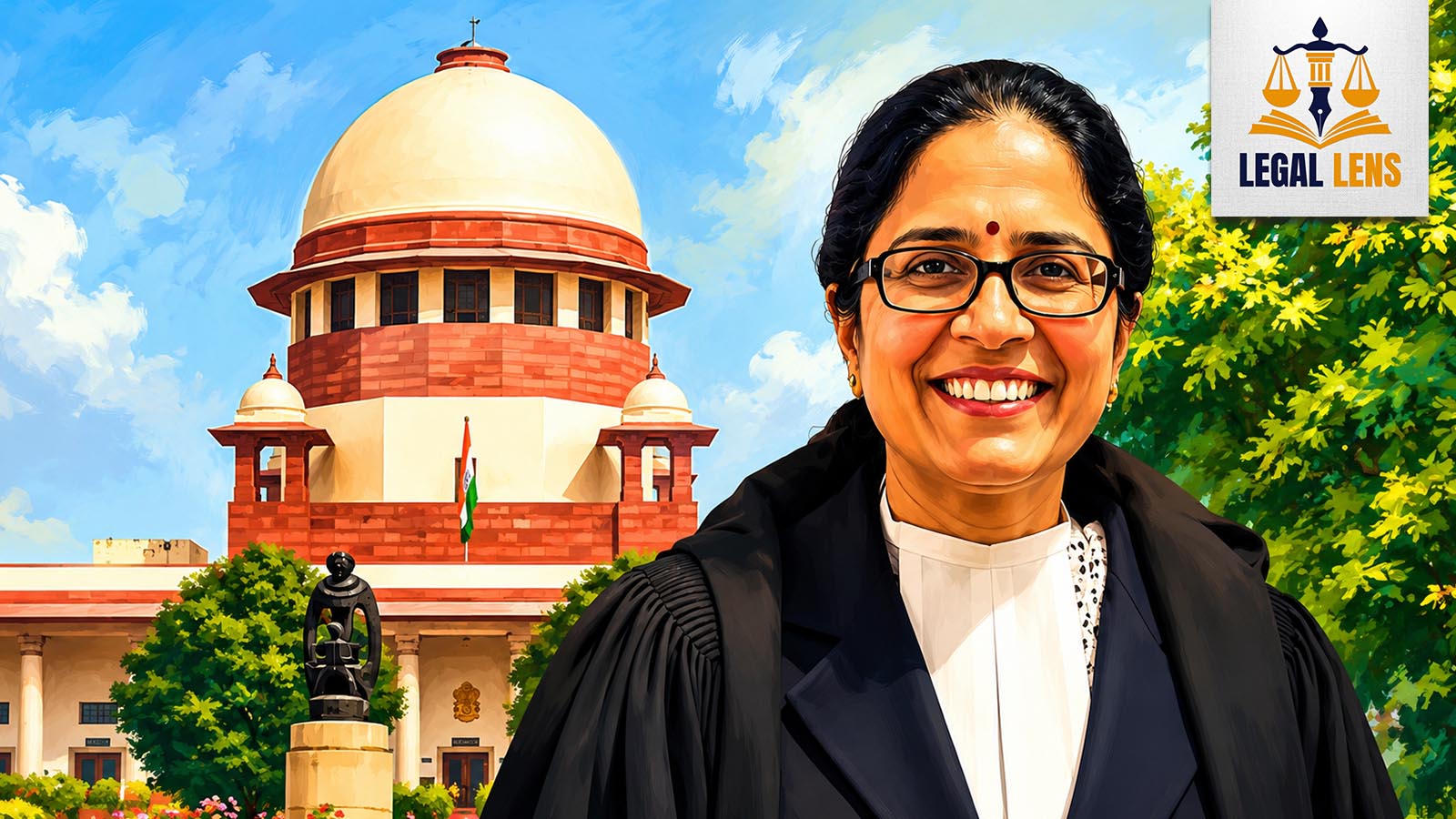

When the government notified her appointment on June 1, V Mohana became only the 11th person in Supreme Court history to be raised straight from the Bar, without first serving as a High Court judge. She is the second woman to make that leap, after Justice Indu Malhotra. She is the second from Tamil Nadu to reach the Court, after Justice R Banumathi. The bench, lately enlarged from 34 to 38 judges, now sits at 37 strong.
The headlines have fixed on her as the lawyer behind the armed forces gender-equality cases. That is true, but only partial. Her own account of her early years, and the judgments that record her arguments, sketch a more complicated figure.
The lone girl in the office
Mohana was a first-generation lawyer who credited her mother for the push toward law. She studied in the first batch, from 1983 to 1988, of the five-year integrated course at Coimbatore Law College. The college was then a young institution in rented rooms, with a small library and no hostel for women. She lived in a working women’s hostel under strict timings. She tutored schoolchildren to fill the hours.
In her final year, Mohana attached herself to civil trial lawyer M Panchapakesan. Her first task was to keep the office’s daily diary of cases, a discipline she says she has never given up. She learned to draft by copying out his dictated notices in a large, triple-spaced hand. She was the only woman in the chambers.
Also read: Know about TN’s Venkita Mohana, who was directly elevated to SC from Bar
The temper of the time surfaces in a story she tells. A senior lawyer, losing ground against her in an injunction matter, said women had no business raising their voices in court and belonged at home. She replied that the remark was “quite immaterial to the merits of the case.”
The judge took exception. She won.
Delhi, and the years of proving it
Mohana moved to Delhi in 1992, reluctantly, drawn by siblings already settled there. She joined the chambers of Indu Malhotra, then a busy advocate-on-record, the lawyer certified to file and run cases in the Supreme Court. A year later, she shifted to CS Vaidyanathan’s chambers to sharpen her research and argument.
Amid these career moves, Mohan got married and had a son in 1994. She cleared the advocate-on-record examination in 1996, with an infant at home.
Also read: How the anti-defection law lost its bite, and why Tamil Nadu will prove it
Independent practice followed across the Supreme Court, the Delhi High Court, the consumer commission, and a string of tribunals. For years, she sat on the Central government’s senior panel of counsel. She argued service, criminal, narcotics, corruption and constitutional matters for the State.
What Mohana fought for
Mohana also did quieter work that rarely makes news. She appeared pro bono in murder appeals. She was appointed friend of the courta lawyer a court asks to assist it impartially rather than to represent a side. She mediated the disputes the Court referred to her. The full court designated her a senior advocate in April 2015.
Her best-known cause is the long fight to secure permanent commissions for women officers. The 2020 verdict in Secretary, Ministry of Defence v. Babita Puniya established the right. A permanent commission lets an officer serve until retirement, while a short service commission caps a woman’s career well short of it.
Mohana’s recorded role came in enforcing the win. She appeared for a group of officers in 2021, when the Army was accused of defying the order. She argued for officers seeking promotions before the then Chief Justice of India, Justice DY Chandrachud, in 2022. She told the court that 1,200 junior male officers had been promoted while the women waited. She pressed the indignity of serving under one’s own juniors.
Diverse successes
Mohana’s record does not run along a single ideological line. A profile that reads counsel’s briefs as a map of a judge’s convictions would mislead.
In the Karnataka hijab case (Aishat Shifa v. State of Karnataka2022), decided by a split verdict in October 2022, Mohana appeared not for the Muslim students but for the teachers. She was on the side resisting the claim that the headscarf was an essential religious practice. Only such practices draw constitutional protection.
Also read: Nine judges to rule on where religious freedom ends and women’s rights begin
Earlier, by her own account, she was on the government’s team defending the National Judicial Appointments Commission. That body would have given politicians a formal hand in choosing judges. The Court struck it down in 2015.
Lawyer vs judge
A lawyer argues the client’s case, not her own. That is the reason her advocacy tells us less about the judge she will be than the headlines imply.
What, then, of the question we began with: where do the new judges lean? Four sitting Chief Justices were sworn in with her. They are Chief Justice Sheel Nagu of the Punjab and Haryana High Court, Chief Justice Shree Chandrashekhar of the Bombay High Court, Chief Justice Sanjeev Sachdeva of the Madhya Pradesh High Court, and Chief Justice Arun Palli of the Jammu and Kashmir and Ladakh High Court.
Also read: Why Justice Nagarathna, likely to be 1st woman CJI, may serve for just 36 days
Justice Nagu sat on the in-house committee that first inquired into the cash-at-residence allegations against Justice Yashwant Varma. Justice Shree Chandrashekhar, also in this batch, later sat on the statutory committee that inquired into the same matter. The four are career judges, with long records in tax, crime, service and commercial law. None of the five, by seniority, will rise to be Chief Justice of India.
From Bar to Bench
Reading leanings from a career record is as treacherous as reading them from a brief. Judges surprise the people who backed them. A bench reshapes a judge’s instincts.
And every case is unique. It is decided on its own facts, and the dispute that reaches a judge is seldom the one already settled.
What can be said with more confidence is not which way Mohana will lean, but what she brings to the bench. In Justice Mohana, and in the two Bar appointees already sitting (Justices PS Narasimha and KV Viswanathan), the Supreme Court gains a practitioner’s feel for how litigation actually behaves, earned over decades on her feet.
Also read: Why women are missing from India’s higher judiciary | Sudha Ramalingam interview
Justice Mohana retires in June 2031, a tenure of about five years. Whether her years for the women officers or for the teachers and the government will shape her judging is a question only her judgments can answer.
For now, the surer story is the one she tells about herself. She was the lone girl in a Coimbatore chambers who kept the case diary and never put it down.

Comments are closed.