Shares of SoftBank-backed Lenskart, which went public nine months ago, hit an all-time high of nearly 627 rupees (US$6.55) on the National Stock Exchange last week.
Bansal’s nearly 9% stake in the $11 billion market-cap company, combined with proceeds from shares he sold in the initial public offering, gives him an estimated net worth of $1 billion, according to Forbes.
The stock jumped after the company reported a four-fold increase in net profit to 2.28 billion rupees ($24 million) for the quarter ended June 30, amid surging sales in both domestic and overseas markets, Reuters reported.
Headquartered in the northern Indian city of Faridabad, Lenskart sells everything from glasses and sunglasses to eyewear accessories, both online and through a network of stores.
It has a presence in 16 countries, including Singapore, Japan and the United Arab Emirates, in addition to India, where it has 2,725 stores across 157 cities. It added 132 stores in the latest quarter, taking its total store count to 3,459.
Bansal, 42, started the business in 2010 with his sister Neha, who heads merchandising, and two other cofounders, Amit Chaudhari, the sourcing chief, and Sumeet Kapahi, who oversees the store network.
|
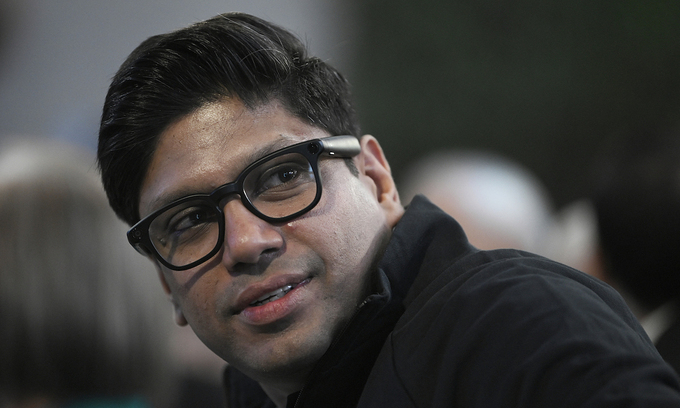
Peyush Bansal, Chief Executive Officer of Lenskart Solutions Limited, attends the Lenskart IPO listing ceremony in Mumbai, India, on November 10, 2025. Photo by NurPhoto via AFP |
The company initially operated as an online retailer offering customers a 3D feature to virtually try on glasses. It later expanded offline, opening its first store in New Delhi in 2013.
“Buying spectacles is not an easy decision,” says Arvind Singhal, chairman of Gurgaon-based retail consultancy The Knowledge Company.
“You want the opinion of a family member or a friend and you want to look at a wide assortment. It is good that Lenskart corrected course and opened physical stores,” he said, as quoted by Forbes.
Bansal took the company public in November 2025, raising $821 million in an IPO that was oversubscribed 28 times. However, the stock listed at a 3% discount to its issue price.
Japan’s SoftBank first invested in Lenskart in December 2019, leading a $275 million funding round that made Lenskart a unicorn.
The Japanese investor sold a small stake during the IPO but offloaded a larger 3.25% stake for $300 million in June after the mandatory six-month lock-in period ended. It remains the largest shareholder with a nearly 10% stake.
Bansal, who has an undergraduate degree in electrical engineering from Canada’s McGill University, started his career with Microsoft in Redmond, where he worked as a program manager for its MS Office product.
He quit within a year to return to India in 2007 and started Valyoo Technologies a year later. It operated a website aimed at helping students find campus housing, according to the Financial Express.
Reading an article about how India was an underserved market in eyecare and eyewear gave him a new direction: organized eyewear retailing was a ripe opportunity, as the market was dominated by scores of small opticians across the country. He worked at one such shop in Delhi to gain a better understanding of the business before taking the plunge.
An October 2025 report by Mumbai investment firm ICICI Direct pegs the size of the Indian eyewear market at $9.2 billion in fiscal 2025 and projects it will expand to $17.2 billion in fiscal 2030.
Lenskart’s main rival is Titan Eye+, the eyewear division of Titan Company, part of the Tata conglomerate, but its revenue of 9.16 billion rupees for fiscal 2026 and store count of less than 1,000 are both well behind Lenskart.
Other legacy retailers, such as Kolkata-based Himalaya Opticals and Delhi-based Bonton Opticians, compete in the luxury and premium niche.
Analysts say the eyewear market has enough room for all players. Financial services platform ICICI Direct estimates that as of 2020, 43% of the country’s population had weak eyes and that by 2030, nearly two-thirds of Indians will need eyeglasses.
Foreseeing this trend, Bansal has been ramping up Lenskart’s brick-and-mortar presence. The store count crossed 1,000 in 2022 and 2,000 in 2025. The overseas expansion began with the opening of a store in Singapore in 2019, which has since grown to 65 stores. Lenskart entered the UAE with a store in Dubai in 2022 and Saudi Arabia in 2023.
In June 2022, Bansal cast his gaze farther afield by acquiring a majority stake in Japanese eyewear brand Owndays for $400 million. Owndays now has 669 stores, up from 460 when Lenskart acquired it.
“Lenskart’s business model is one of a kind,” says Singhal. “Even Titan has not been able to do what the company has done in terms of the scale of manufacturing and the range that they offer.”