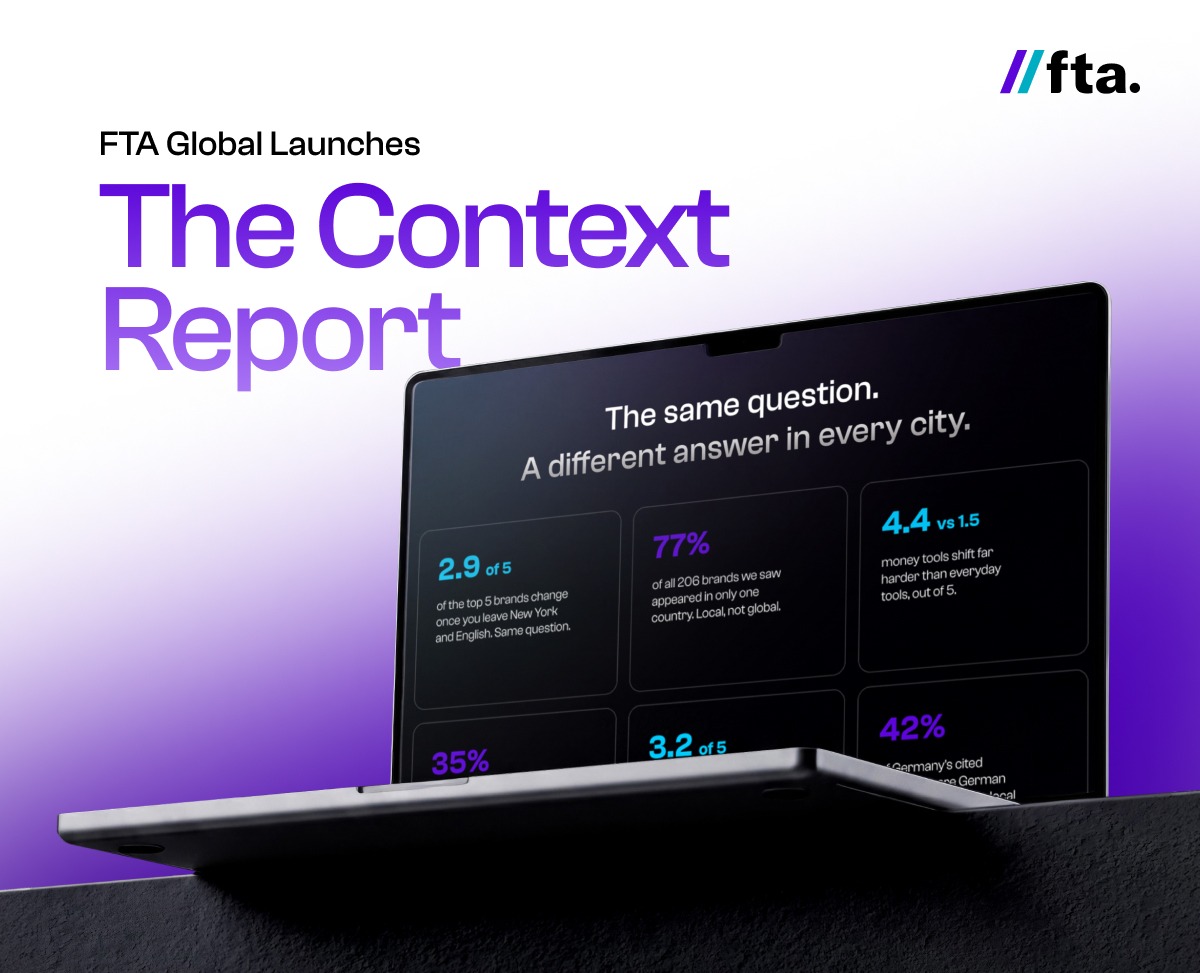
FTA Global has released “The Context Report”a study examining how AI chatbots recommend brands based on a buyer’s location, language and chosen AI platform.
The study analysed 1,200 AI-generated answers across 12 cities and seven languages. It tested ChatGPT and Gemini across 10 business categories.
The findings challenge the idea that brands can measure AI visibility through one global score.
According to FTA Global, AI recommendations can change significantly based on the context in which a buyer asks a question.
AI Recommendations Change Across Cities
The study used identical questions across different locations and languages.
Researchers changed only the buyer’s city and language. They then ran every question five times to measure changes in the responses.
Payment gateway recommendations provided one of the clearest examples.
When researchers asked about payment gateways in New York, ChatGPT and Gemini recommended brands such as Stripe, Square and PayPal.
The same question in Mumbai produced a different set of recommendations.
The AI platforms surfaced Indian brands including Razorpay, Cashfree and PayU.
The New York and Mumbai results had no brands in common. This highlights how location can influence AI-generated recommendations.
Nearly 8 in 10 Recommended Brands Appeared in One Country
The report found strong differences in AI recommendations across countries.
Out of 206 brands identified during the study, 159 appeared in only one country.
That means nearly eight in 10 brands appeared in just one national market within the study.
The finding suggests that AI platforms do not necessarily present one consistent global view of brand visibility.
FTA Global also found that recommendations changed when users moved away from New York and English.
Nearly three of the top five recommended brands changed when the location and language changed.
Financial Categories Show Greater Geographic Variation
The level of variation also differed between business categories.
Money-related categories showed the largest geographical differences in the study.
An average of 4.4 out of the top five brands changed across markets in these categories.
By comparison, everyday categories such as video conferencing and cloud storage recorded an average change of 1.5 brands among the top five.
The report also found a notable pattern in HR software.
None of the top US brands appeared in any other country tested for that category.
ChatGPT and Gemini Produce Different Recommendations
Location and language were not the only factors affecting AI recommendations.
The study also compared responses from ChatGPT and Gemini.
The two platforms shared only around 3.2 of the top five brands for the same question in the same city.
This indicates that different AI platforms can produce materially different recommendations from identical queries.
The study also found variation across repeated queries.
The same question generated a consistent top brand in only 35% of repeated tests.
The question, location and language remained unchanged during these tests.
Local Content Can Influence AI Answers
The report also examined the sources AI systems use when generating recommendations.
In Germany, 42% of sources cited by AI systems were German web pages.
FTA Global said this finding shows how local content can influence answers to local buying questions.
For brands targeting multiple markets, this creates another consideration.
Visibility within one market may not automatically translate into visibility across other locations and languages.
‘Discovery Does Not Happen the Same Way for Every Buyer’
Senthil Kumar Hariram, Founder and Managing Director, FTA Globalsaid AI is changing how customers discover brands. “AI is changing the way brands are discovered, but discovery does not happen the same way for every buyer.”
Hariram said brand recommendations can vary according to location, language and the AI platform. “The same question can lead to different brand recommendations depending on the buyer’s location, language, or the AI platform being used.”
He said the findings point towards a broader way of measuring AI visibility. “Brands need to move beyond asking how visible they are and start asking where, in what context, and how consistently they are being discovered.”
FTA Global Introduces Context Authority
Alongside the report, FTA Global has introduced Context Authority.
The company describes it as a metric for assessing how consistently a brand appears during buying moments.
The approach evaluates brand presence across cities, languages and AI environments.
It also considers repeated AI responses instead of treating visibility as one global measurement.
The metric reflects the report’s central finding.
A brand’s visibility in one AI response may not represent how customers discover it across different markets.
AI Search Is Changing Brand Discovery
FTA Global said the findings point to a wider shift in search and discovery.
AI assistants are becoming part of the research and consideration journey.
As this happens, brands need to understand how AI systems represent them across different customer contexts.
Being visible in one market or one AI response does not necessarily mean the same brand will appear elsewhere.
The report therefore places greater emphasis on contextual AI visibility rather than a single universal visibility score.
FTA Global’s Focus on AI and Search Visibility
FTA Global describes itself as a Search Engineering company focused on brand visibility across search engines, AI assistants and modern discovery systems.
Its offering includes Search Engineering, Demand Labs, Performance Labs, FTA Prime and Creative Labs.
The company said its proprietary, patent-pending visibility platform uses ICP-based persona modelling.
It tracks how brands appear across different AI environments.
FTA Global currently has more than 80 professionals across Mumbai, Bengaluru and Gurugram.
The release positions The Context Report as a study of an emerging challenge for brands.
As consumers increasingly use AI assistants during product research, companies may need to understand not just whether AI mentions them.
They may also need to examine where, how and how consistently those recommendations appear.
FTA Global’s complete The Context Report is available through its website.