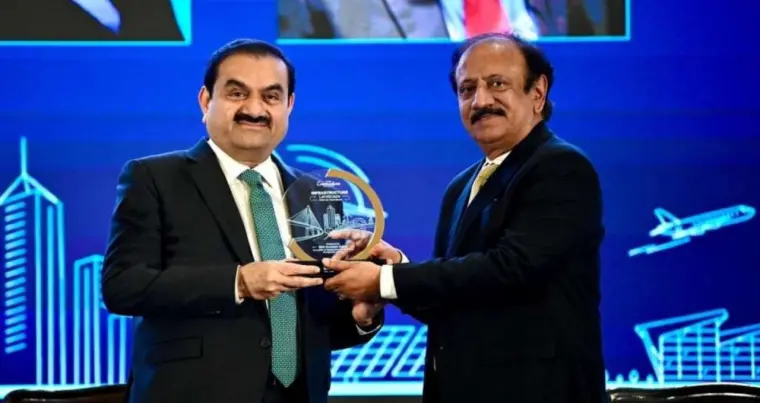
Veteran Indian businessman Gautam Adani shared his views regarding the vision of 'Developed India'. He attended the 'Infrastructure Landscape: Vision for Viksit Bharat' event of CareEdge Ratings held in Mumbai on 31 August as the chief guest.
Business News: Adani Group Chairman Gautam Adani shared his vision for India's infrastructure development and the goal of 'Developed India'. Adani, who was the chief guest at CareEdge Group's Infrastructure Landscape event, said India does not need lower credit standards but a more comprehensive and forward-looking approach to appraise infrastructure projects.
According to Adani, the impact of large infrastructure projects is not limited to their immediate financial performance. Many projects give rise to new industries, markets, jobs and business ecosystems. Therefore, when assessing their risk and economic potential, wider implications should be taken into account along with traditional financial parameters.
'No relaxation in rating standards, the scope of thinking should increase'
At the event held in Mumbai, Gautam Adani appealed to credit rating agencies to develop more comprehensive analytical models for evaluating infrastructure projects. He clarified that his suggestion is not to weaken the rating process or promote low quality projects. According to him, there is a need for a model with strong credit standards that can also understand the long-term economic and strategic potential arising from a project.
Adani suggested looking at infrastructure mainly in three categories—replacement infrastructure, growth infrastructure and platform infrastructure. According to him, traditional rating models can be largely effective for projects that replace existing assets. But the broader economic benefits of growth infrastructure and the new markets and industrial capabilities that platform infrastructure will create in the future should also be part of the assessment.
Example of Mundra Port
Giving the example of Mundra Port in Gujarat, Gautam Adani said that this project, which once started in a relatively less developed maritime area, later became a part of a larger ecosystem related to port, railways, logistics, energy and manufacturing. They argued that looking at such projects only through existing cash flows or standalone discounted-cash-flow models would not reveal their true potential.
He said that if India creates infrastructure only to meet today's demand, it may lag behind in taking advantage of opportunities that may arise in the future.
Vizhinjam and India's strategic potential
Adani also presented Kerala's Vizhinjam International Seaport as an example. He said that India has long been dependent on major ports of other countries for transshipment, while Vizhinjam's geographical location is important for global maritime trade routes. According to him, the strategic importance of a project is not always fully reflected in its initial financial projections. Therefore, future prospects and national capacity should also be included in the evaluation of infrastructure.
From Khavda to AI and Manufacturing
Citing the example of Khavra Renewable Energy Project in Kutch, Gujarat, Adani said that large-scale clean energy capacity can become the basis of many new industries in the future. He stressed the need for infrastructure like power, transmission, cooling and land for areas like AI, data centers and advanced manufacturing.
According to him, it is not enough to see Artificial Intelligence only as software, because strong physical infrastructure will also be necessary for its expansion.
New credit framework expected from India
Gautam Adani urged CareEdge to take the lead towards developing a comprehensive credit framework for Integrated Platform Infrastructure. He believes that such a model can be useful for other emerging markets besides India. He said the real value of infrastructure should not be measured only by immediate financial returns. The resulting economic activity, new capabilities and strategic benefits at the national level are also important.