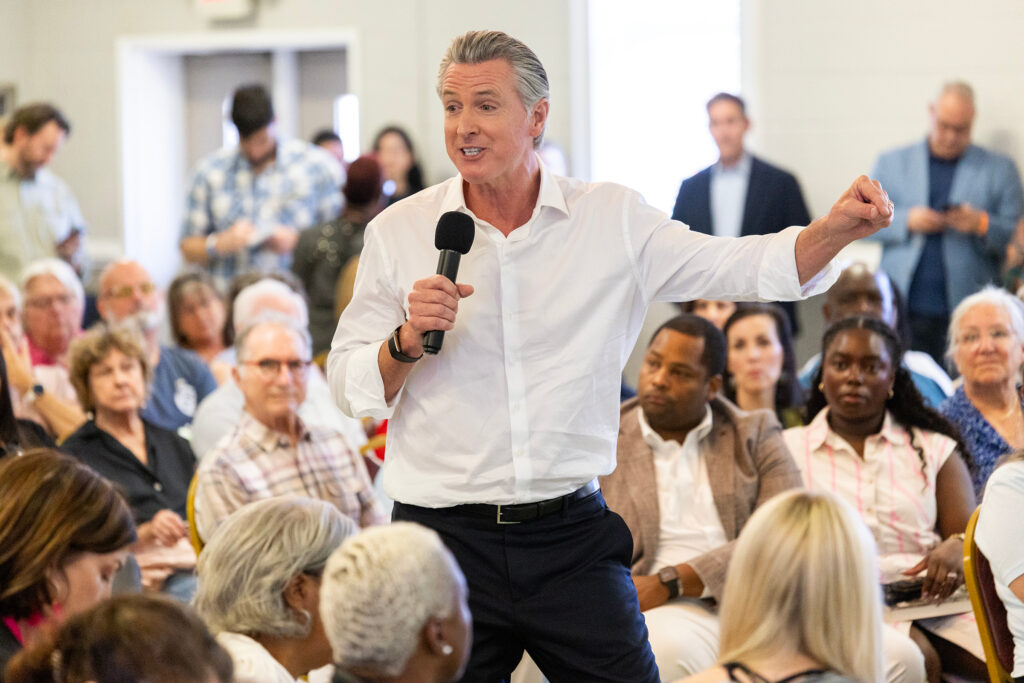
Gavin Newsom’s South Carolina Tour Fuels 2028 Presidential Speculation/ TezzBuzz/ WASHINGTON/ J. Mansour/ California Gov. Gavin Newsom is expanding his national political activity as he considers a possible campaign for the 2028 Democratic presidential nomination. During a campaign-style tour of South Carolina, Newsom promoted his record, attacked President Donald Trump and acknowledged that perceptions of California could become a liability. Supporters praised his willingness to confront Trump, while other voters questioned whether his California identity and progressive policies would appeal nationally.

Quick Look
- Newsom held eight public events during his South Carolina visit.
- “Gavin 2028” buttons were sold outside some appearances.
- South Carolina will hold the Democratic Party’s opening 2028 presidential primary.
- Newsom said he could decide whether to run before the end of 2026.
- His trip also included stops in Alabama and North Carolina.
- The governor focused heavily on criticizing Trump and supporting Democratic resistance.
- Some voters praised Newsom for appearing “not intimidated” by Trump.
- Others worried that California’s liberal image could limit his national appeal.
- Republican protesters used signs reading “Wrong Coast” and “Clean Up Your State First.”
- Newsom cited California’s economic size and progressive policies as evidence of his governing record.
- Other potential Democratic contenders have also begun visiting early primary states.


Deep Look
Newsom steps further into the 2028 conversation
SUMMERVILLE, S.C. — California Gov. Gavin Newsom is intensifying his national political activity as he weighs a possible campaign for the 2028 Democratic presidential nomination.
His intentions were a prominent topic during a multiday swing through South Carolina, where supporters sold “Gavin 2028” buttons and allies openly referenced his national ambitions.
Newsom held eight public events in the state, along with private engagements, during a schedule resembling an early presidential campaign. It was his third South Carolina visit of the 2026 midterm cycle.
South Carolina recently was selected to hold the Democratic Party’s first sanctioned presidential primary in 2028, followed by Nevada, New Hampshire, New Mexico, Michigan and Virginia.
Newsom leaves announcement timetable open
Newsom has not formally announced a presidential campaign. In an interview with The Associated Press, however, he left open the possibility of making a decision before the end of 2026.
“It’s the right question. Honestly, I don’t know,” Newsom said. “I think this thing’s happening. I mean, you already feel it, right?”
He pointed to signs that possible campaigns were beginning to interview state directors and predicted that organizing for the primary would accelerate.
Newsom is among several Democrats taking preliminary steps ahead of 2028. Other frequently discussed figures include Pennsylvania Gov. Josh Shapiro, former Transportation Secretary Pete Buttigieg, Kentucky Gov. Andy Beshear and Arizona Sen. Mark Kelly. None of that activity establishes how the eventual field will develop or how voters will respond.
California creates both opportunity and risk
Newsom’s political identity is closely tied to California, the country’s most populous state and one of its largest economic centers.
That association provides him with an extensive governing record but also connects him to a state frequently criticized by Republicans over taxes, homelessness, housing costs, regulation and progressive social policies.
Newsom’s advisers acknowledge what they call “California derangement syndrome”—a broad negative reaction to the state among some voters outside California.
Vera DeVito, a 78-year-old Democrat who attended a Newsom event in Summerville, said his home state alone could make supporting him “risky.”
“It’s going to be hard for him to appeal to the whole country,” she said. “Everybody thinks California is different—especially in the South. They’re not crazy about California.”
Other potential candidates represent competitive states
Newsom’s background contrasts with potential contenders associated with politically competitive states.
Shapiro governs Pennsylvania, while Buttigieg previously ran statewide in Michigan. If they enter the race, they may highlight their experience communicating with moderate and independent voters.
Newsom, by comparison, would need to explain how his record in heavily Democratic California relates to voters in less liberal regions.
California has produced several unsuccessful presidential candidates since former Gov. Ronald Reagan won the White Houseincluding former Gov. Pete Wilson, former Gov. Jerry Brown, businessman Tom Steyer and former Vice President Kamala Harris.
That history does not determine Newsom’s prospects, but it provides context for questions about how a California candidate could be received nationally.
Tour focuses on opposition to Trump
Newsom’s appearances were part of his “Take It Back” tour through Southern states. He argues that Trump and Republican officials are reversing civil rights protections and weakening democratic institutions.
The tour began in Alabama, concentrated heavily on South Carolina and concluded with two stops in North Carolina. South Carolina Democrats promoted the governor’s Sept. 3-4 appearances as part of their midterm organizing.
Newsom focused on Trump’s private business dealings, the deployment of National Guard forces to major cities, federal immigration enforcement operations and attempts to restrict mail voting.
“We cannot do business as usual. We need to fight fire with fire,” Newsom told approximately 150 people at a Lexington community center.
“We’ve got to meet this moment and recognize what we’re up against,” he added.
The White House did not respond to the AP’s request for comment.
Some voters value Newsom’s confrontational approach
Newsom’s willingness to criticize Trump appealed to some South Carolina Democrats.
“He has strong potential,” said Kirk Bovill, a former Los Angeles resident who now lives in Summerville. “The question is how he’s perceived outside of California. People might think he’s too Hollywood.”
“The one thing he does very well: He doesn’t have a problem standing up to Trump,” Bovill said. “He’s not intimidated.”
Newsom has spent years cultivating a national media presence. He regularly appears on Fox News, debated Florida Gov. Ron DeSantis in 2023 and served as a prominent surrogate for former President Joe Biden.
His team argues that those appearances have given him experience defending California policies before audiences that may be skeptical of the state.
Republicans make California the central attack
Republican protesters outside some of Newsom’s events focused their criticism on his governorship.
Signs included “Wrong Coast” and “Clean Up Your State First.”
CJ Westfall, chairman of the Dorchester County Republican Partydescribed Newsom as a “far-left extreme Democrat” and said, “We don’t want Gavin Newsom to California our South Carolina.”
Newsom responded by arguing that national criticism has often presented a distorted picture of the state.
He called California both a liability and “the greatest opportunity,” saying he would try to reframe its record if he sought the presidency.
“In a Democratic primary, in particular—we’ve got the receipts, things that the party is arguing for, we’ve delivered across a spectrum of issues,” Newsom said.
Newsom points to progressive policy record
California under Newsom has enacted policies that could appeal to Democratic primary constituencies while drawing strong Republican criticism.
Those measures include:
- Expanded healthcare coverage regardless of immigration status.
- Universal free meals in public schools.
- Expanded paid sick leave.
- A $20 minimum wage for many fast-food employees.
- Protections for patients traveling from other states for abortions.
- Gun-control and climate policies.
- A moratorium on executions.
Newsom also points to California’s economic scale. Federal data continue to identify it as the nation’s most populous state, while Bureau of Economic Analysis figures measure its output as the largest among U.S. states.
Critics counter with the state’s high taxes, housing costs and departures by some residents and businesses. Census data indicate California has recently received substantial international migration after its population declined during the COVID-19 era.
Voters offer mixed first impressions
Several attendees said Newsom’s celebrity and polished presentation attracted attention, even when they knew relatively little about his policies.
“We don’t get that many famous people here in Aiken. He’s pretty famous,” said Monty Fetterolf, who attended one of the governor’s events.
DeVito offered a more skeptical assessment after hearing Newsom speak.
“He’s a little slick—not a lot of meat,” she said. “But he’s good looking, which helps.”
Such reactions illustrate the challenge Newsom faces as he introduces himself outside California: establishing a detailed national identity while responding to entrenched perceptions of his state.
More on US News