
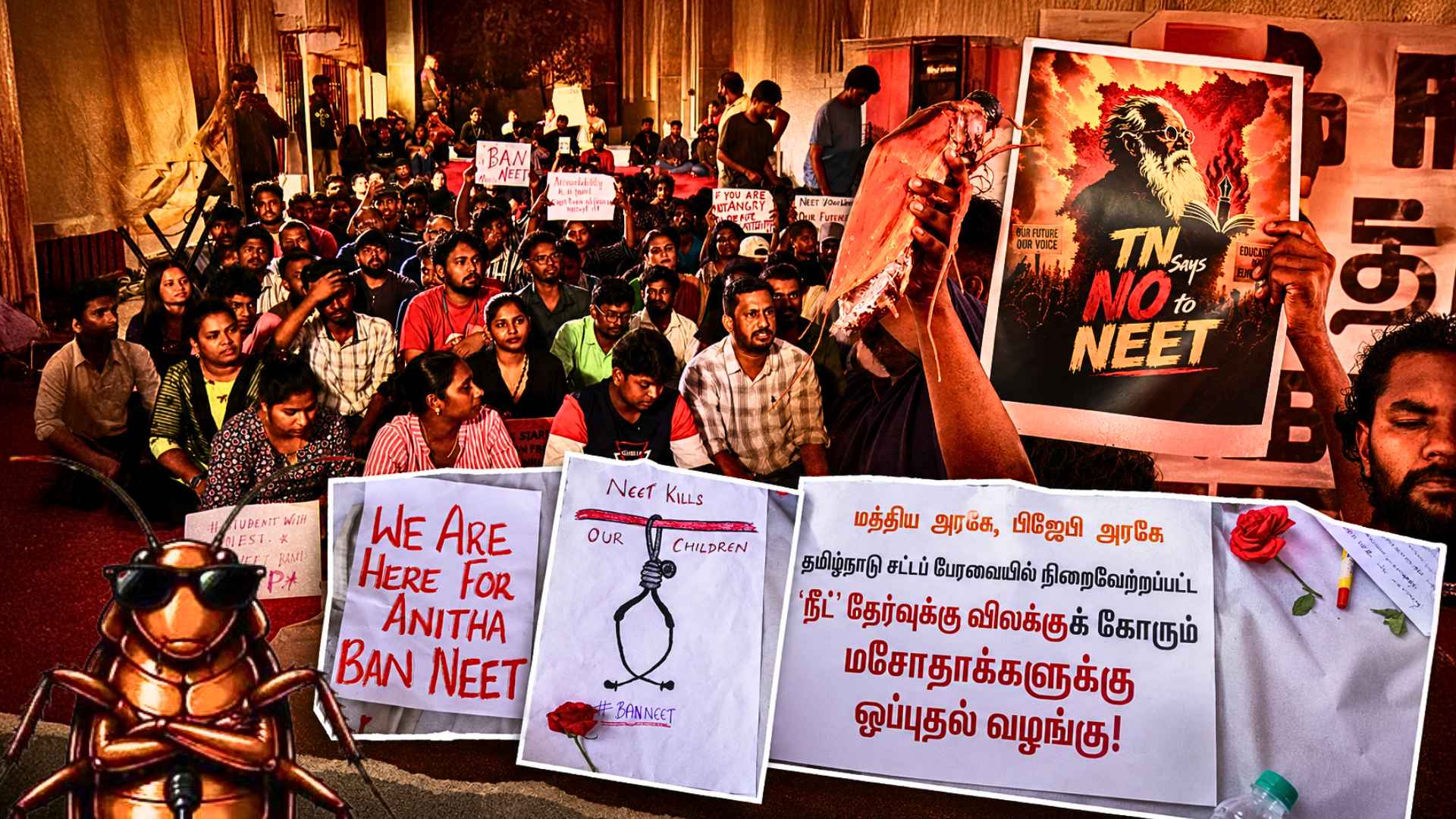

Inside Balan Illam, the Communist Party of India (CPI) state headquarters in Chennai recently, a fierce debate unfolded among young protesters, exposing a deep divide within Tamil Nadu’s student agitation over the National Eligibility-cum-Entrance Test (NEET).
What began as a unified demonstration quickly split into two distinct factions rooting for different visions for the cause.
For nearly 10 years, Tamil Nadu has been leading the fight against NEET, treating the entrance exam as a deeply emotional political issue. Major state political parties, including the ruling TVK, DMK, and AIADMK, oppose the exam on the grounds that it discriminates against rural and government school students who cannot afford expensive private coaching.
Also Read: Beyond NEET: Why NEP rollout is creating anxiety in Bengal’s classrooms
Over the years, successive state governments passed bills seeking exemptions from NEET to restore admissions based on school marks, but the Central government continuously rejected these measures. While other states accepted the national exam framework, resistance in Tamil Nadu remained steadfast.
Divergent activist demands
The recent protest in Chennai originally gained momentum following a Delhi Police crackdown on students protesting examination irregularities in the national capital. Members of the Cockroach Janta Party (CJP), along with various student groups and activists, gathered in Chennai to demonstrate solidarity and demand systemic educational reforms. However, as the demonstration progressed, the gathering fractured over its core objectives.
The first faction, primarily composed of Gen-Z youth aligned with the CJP, pushed for a “Fair NEET” framework focused on addressing paper leaks, seeking administrative accountability, and securing the resignation of Union Education Minister Dharmendra Pradhan. Believing their primary goals had been met after CJP leadership called off its nationwide agitation following the Minister’s resignation and the government’s assurances, this group concluded their protest at the venue.
“The Communist Party supported our demands and gave us this space at Balan Illam to protest for six days. Now that our demands have been met, we are ending the protest peacefully. It would be great if the students cooperate and disperse peacefully as well,” said a representative from the CJP faction.
Clashes over strategy
In contrast, the second faction, comprising Left-wing student organisations and local youth groups, advocated for the complete abolition of NEET and the return of education to the State List. Unlike the CJP supporters, this group refused to end their demonstration, insisting that a ministerial resignation alone did not address the root issue.
This ideological rift led to visible friction on the ground. Left-wing representatives pointed out that the “Fair NEET” protesters did not wear traditional black attire — a staple of Tamil Nadu’s historic political demonstrations — and argued that they lacked experience in sustained street agitation. They further noted that while the CJP faction utilised the shared platform, their placards and slogans did not align with the long-standing regional movement to scrap the exam entirely.
“If they had actually called for a ‘Fair NEET’ protest, no one in Tamil Nadu would have shown up. So, they started the protest under the title ‘Ban NEET,'” said a protester from the local student group.
“The CJP wants a ‘Fair NEET’, but there is no concept of ‘Fair NEET’ in Tamil Nadu. We have been fighting to ban NEET here for the past ten years. CJP used the ‘Ban NEET’ slogan just to gather a crowd here. This needs to be clarified,” added another student activist.
“They used us and the crowd that gathered here for their own agenda. By doing that, they ensured that CJP will never sustain itself in Tamil Nadu. CJP won’t stand a chance in Tamil Nadu,” said a local youth protester.
Public figures intervene
Actor Sanam Shetty, attending the event as a supporter of Chief Minister Vijay, publicly slammed individuals whom she accused of politicising the student cause, describing the gathering as agenda-driven.
“This is a protest by the students, for the students. It is my duty to support them. Those using this platform for their own political agenda are the jokers—not us. I am an ardent fan of Thalapathy, and I watched his movie first day, first show yesterday. Should I speak or stop? Now do you understand the agenda I was talking about?” said actor Sanam Shetty.
Her remarks drew sharp reactions from the crowd, resulting in her being booed off the platform before organisers stepped in to clarify that the venue remained open to all perspectives.
For decades, political protests in Tamil Nadu against centralised entrance examinations have maintained a distinct identity, often characterised by black attire, broad regional political consensus, and a singular demand for total exemption rather than central reform. The recent events at Balan Illam highlighted a unique convergence of traditional Dravidian politics, Left-wing activism, and an emerging, self-organised Gen-Z youth movement.

Comments are closed.