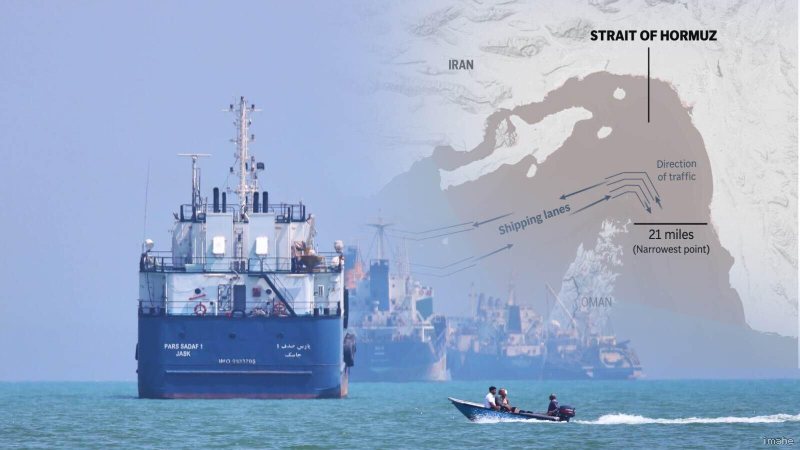
Iran's efforts to establish its dominance in the Strait of Hormuz, the most important and sensitive route of global maritime trade, and to collect heavy taxes or tolls on commercial ships passing through there, have received a severe setback at the international level. There has been strong opposition across the world to Tehran's plan to levy arbitrary fees on the unhindered movement of merchant ships in this major waterway connecting the Persian Gulf to the Gulf of Oman. A strong global manifesto has been prepared under the leadership of the European Union, in support of which more than 60 countries have made it clear that international waterways will not be allowed to be used by any country as a means of earning money or as a weapon for creating political pressure. Apart from America and European countries, many big trading countries like Australia, Japan, Britain, Canada and Singapore have joined this international blockade. All these nations, while supporting the clear resolution of 'No Fees, No Tolls', have reiterated that complete freedom of navigation on the high seas is a fundamental right of every country under international law. What is the entire crisis of the Strait of Hormuz and why did this geopolitical dispute heat up? The place of the Strait of Hormuz has always been extremely sensitive and strategic in the history of international sea corridors. This waterway is considered the backbone of the global energy market, especially the international supply of crude oil and natural gas (LNG). In recent months, amid increased military tensions in the Middle East, regional conflicts and the ongoing tough standoff with the US-Israel, Iran's Islamic Revolutionary Guard Corps (IRGC) had claimed to have strict control and authority over commercial ships passing through this route. A demand was made from Iran's side that all international ships, including the routes along the coast of Oman, will have to pay heavy service charges or tolls in exchange for using this route. Tehran argued that since it is in charge of the security, navigation management and infrastructure of this waterway, it has the right to collect this tax. However, the United States and its Western allies rejected this demand, calling it a flagrant violation of international maritime laws and illegal extortion. This new joint resolution of 60 countries has far-reaching diplomatic and economic consequences. This global initiative, announced through the EU High Representative and Foreign Policy Chief Kaja Kallas, has brought a new and decisive turn in international diplomacy. It is very clearly stated in this joint declaration that any unilateral action imposed by any nation imposing illegal duties, arbitrary tolls, discriminatory restrictions, pre-clearance bottlenecks or obstructions to navigation will be strongly opposed at the global level. Earlier, due to US-Iran tension, there was a huge decline in the number of oil tankers and cargo ships passing through this route and the operation of ships passing through it on a daily basis was being affected, now this global proposal has brought great relief to the global shipping industry, marine insurance companies and business houses. If Iran were successful in unilaterally imposing tolls or fees, logistics costs, freight, insurance premiums and fuel prices would skyrocket around the world. This collective failure and protest by 60 countries has increased the pressure on Iran manifold on the economic and diplomatic front, forcing it to reconsider its policies. Meaning of this strategic development for India and major Asian economies: From India's point of view, complete security of the Strait of Hormuz and uninterrupted and free movement there is very important for the country's energy security. India imports a large part of its total requirement of crude oil and natural gas from West Asia and the Gulf countries, which reaches Indian ports through this important waterway. If any additional duty or arbitrary toll were imposed by Iran in Hormuz, it would have a direct and deleterious impact on India's import bill, posing a huge risk of increasing prices of petrol, diesel, CNG and domestic LPG within the country. Apart from India, other big energy consuming countries of the Asian continent like China, South Korea, Taiwan and Japan are also completely dependent on the safe operation of this waterway. This united front of 60 powerful countries of the world has worked to ensure that international maritime rules and agreements remain intact and no single country gets the opportunity to forcibly take over or arbitrarily take over this important lifeline of the global economy.