
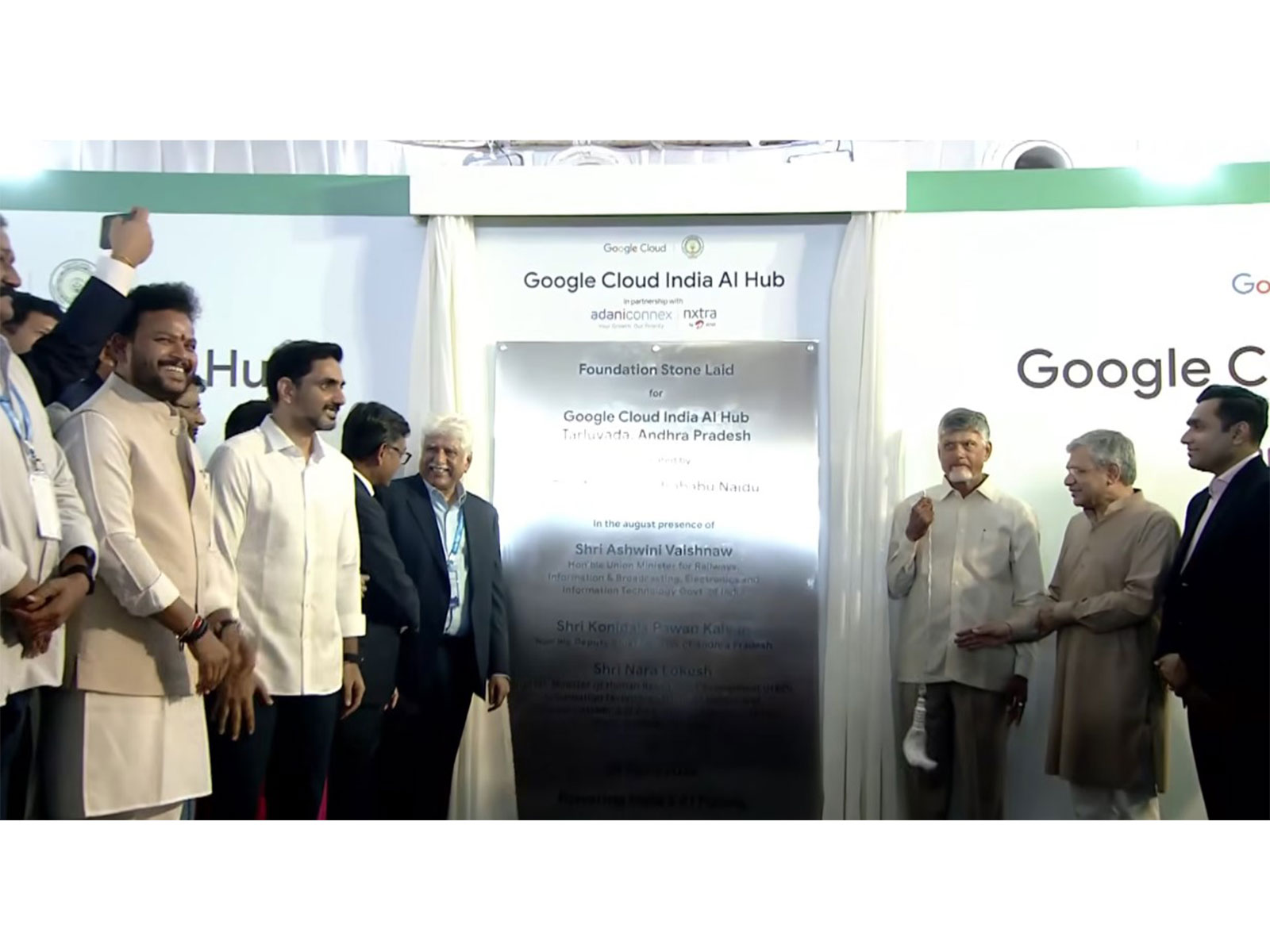

Tarluvada, a small coastal village in Anandapuram mandal on the outskirts of Visakhapatnam, made history on April 28, 2026. Andhra Pradesh Chief Minister N. Chandrababu Naidu and Union Minister for Electronics and Information Technology Ashwini Vaishnaw broke ground on the Google Cloud India AI Hub, a $15 billion, gigawatt-scale AI infrastructure project being constructed by Airtel in addition with AdaniConneX and Nxtra. The event marked the formal start of work on what is believed to be Asia’s largest AI and data center hub, as well as the largest facility Google has built outside of the United States.
The ceremony at Tarluvada was attended by key figures such as Union Minister Ram Mohan Naidu, Andhra Pradesh IT Minister Nara Lokesh, Bikash Koley, Vice President of Google Global Infrastructure, Karan Adani and Jeet Adani of the Adani Group, and Rakesh Mittal, Vice Chairman of Bharti Enterprises. Together, they constitute a rare convergence of government ambition and private sector finance on a project with strategic effects far beyond the state of Andhra Pradesh.
“Foundation stone laid for Google Cloud India AI Hub at Visakhapatnam in Andhra Pradesh in presence of Union Minister Ashwini Vaishnaw and Chief Minister N Chandrababu Naidu.” ~All India Radio News
The Scale And Structure Of The Project:
The numbers behind this project are difficult to overstate. The investment of $15 billion spread across five years from 2026 through 2030 makes it one of the largest Foreign Direct Investments in India’s history. The facility will span approximately 601 acres across three campuses, covering the villages of Tarluvada, Adavivaram, and Rambilli. Three separate Special Purpose Vehicles have been formed to manage the different components of the project, with Adani Infrastructure serving as the primary implementation partner on the ground.
In partnership with AdaniConneX and Nxtra by Airtel, the project creates a gigawatt-scale AI ecosystem by implementing a full stack of data centers backed by next-generation cable landing stations and pan-India ultra-low latency fiber. In addition to being a major contribution in and of itself, that cable landing station would establish Visakhapatnam as a new international subsea gateway, linking India to worldwide data networks and providing the city a vital role in the global backbone of digital infrastructure.
With three campuses, 601 acres allocated, and a 1 GW combined capacity expected to be commissioned by July 2028, when operational, the Vizag cluster is expected to be Asia’s largest data centre hub.
“#WATCH | Visakhapatnam, Andhra Pradesh: At the groundbreaking ceremony of Google Cloud India AI Hub, Electronics & IT Minister Ashwini Vaishnaw says, ‘…CM built Cyberabad, part of Hyderabad, that cyber tower which became the journey of our IT services and today he is building…’”~YEARS
A Full-Stack AI Ecosystem Not Just A Data Centre:
The scope of what Google is implementing here sets this project apart from a typical hyperscale data center construction. To power India’s most demanding AI workloads, the investment includes gigawatt-scale data center operations backed by sustainable energy and a strong subsea cable network. The infrastructure is specifically designed to run Google Gemini and Google Search at scale, which are AI workloads that need the kind of network bandwidth and compute density that can only be provided by facilities with a specific purpose.
The project also builds on both companies’ commitment to sustainability, with co-investment in new transmission lines, clean energy generation, and innovative energy storage systems in Andhra Pradesh. AdaniConneX is specifically responsible for the hyperscale data centre campus itself, while Airtel’s Nxtra brings fibre and connectivity infrastructure to the partnership.
Google Cloud CEO Thomas Kurian framed the Vizag hub as a deliberate effort to bring the full weight of Google’s AI capabilities to Indian enterprises and users not a partial deployment but a complete, integrated AI stack operating from Indian soil.
“We are excited to announce our largest-ever investment in India: $15 billion to establish our first full-stack AI Hub in India. The multi-faceted investment in Visakhapatnam will deploy cutting-edge infrastructure, establish a new international subsea gateway, and deliver gigawatt-scale compute to power services globally.”~Google India
Andhra Pradesh’s Speed Of Execution And What Comes Next
The speed at which Andhra Pradesh transitioned from an agreement to real groundbreaking is one feature of this project that has generated almost as much discussion as the investment itself. Construction has already started even though the Memorandum of Understanding between Google and the Andhra Pradesh government was signed less than six months ago. This is in stark contrast to how long similar projects usually take to get forward in India.
In the past, Chief Minister Chandrababu Naidu has referred to the hub as the starting point for India’s first AI City, a more comprehensive idea of a technological district that includes research institutes, startups, and talent development initiatives centered on the facility in addition to data storage and computing. For a city that was previously more well-known for its port and steel mill than its digital infrastructure, Naidu’s statement that Visakhapatnam would serve as the largest AI and data hub outside of the United States carries a great deal of ambition.
“Andhra converting MoU signings into actual ground-breakings at speed. Google kicks off its $15 billion data centre hub near Visakhapatnam on April 28 with three campuses, 601 acres allocated, Adani Infra as implementation partner, three SPVs formed, submarine cables and metro fibre infrastructure planned, and a 1 GW combined capacity expected to be commissioned by July 2028.”~Prasanna Viswanathan
Google’s $15 billion pledge is part of a larger trend of hyperscaler investments in India’s digital infrastructure. AWS has committed $12.7 billion, Microsoft has committed $17.5 billion, and Meta has announced large capacity expansions in the nation. When taken as a whole, these investments show that India is quickly evolving into a destination for the physical infrastructure that drives the global AI economy, rather than just a market for international technology firms.

Comments are closed.