
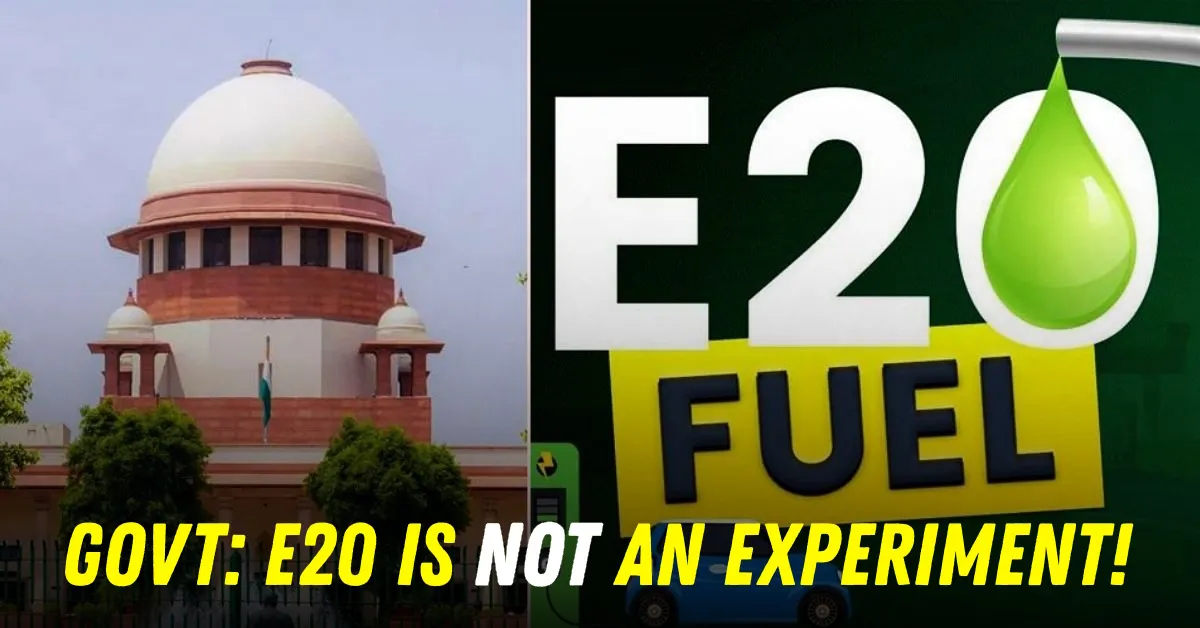

You must have heard in the last few days that a number of media reports claimed that the Government of India had described the country’s E20 (20 percent ethanol-blended petrol) programme as an “ongoing experiment” before the Supreme Court. As a result of this, a lot of confusion was created amongst the public, especially after recent misinformation regarding E20 fuel compatibility. However, the Government of India has now officially rejected these claims and clarified that the reports are completely false.
According to the Ministry of Law and Justice, the Attorney General never described the E20 programme as an experiment. Additionally, it has been mentioned that the court proceedings were related only to ethanol allocation and not the E20 policy itself.
The Ministry of Law and Justice has stated that at no stage did Attorney General R. Venkataramani tell the Supreme Court that the Ethanol Blended Petrol (EBP) Programme or the E20 blending programme was an experiment.
Apart from this, the ministry has also added that media reports which claim that the government said the impact of E20 would only become clear next year are incorrect. This is different from the submissions made before the court.
The clarification was also issued by the Office of the Attorney General, which stated that reports published after the Supreme Court hearing had misrepresented what was actually argued in court. The government has reiterated that E20 is a national policy initiative and not a trial programme.
Now, for those who are still confused about the current ongoing case at the Supreme Court, it is not about whether E20 fuel should continue or whether it is safe. Instead, it is related to the allocation of ethanol to Oil Marketing Companies (OMCs) for the current Ethanol Supply Year (ESY) 2025-26.
The dispute started after the Karnataka High Court directed BPCL, HPCL, and IOCL to consider a distillery’s request for higher ethanol allocation before finalising supply contracts. BPCL challenged this order in the Supreme Court by arguing that ethanol allocations had already been finalised in October 2025 and changing them now could disrupt the nationwide E20 blending programme.
According to the government, allocations for 378 suppliers covering around 1,050 crore litres of ethanol had already been completed, and nearly 680 crore litres had already been supplied by June 18. So, increasing allocation for one supplier could encourage similar demands from others. Hence, this could lead to prolonged litigation and delays in ethanol procurement.
Interestingly, the current problem is not a shortage of ethanol but an oversupply. When the government announced its ambitious E20 target a few years ago, it encouraged private companies to invest heavily in ethanol production by offering easier loans, faster environmental clearances, and various financial incentives.
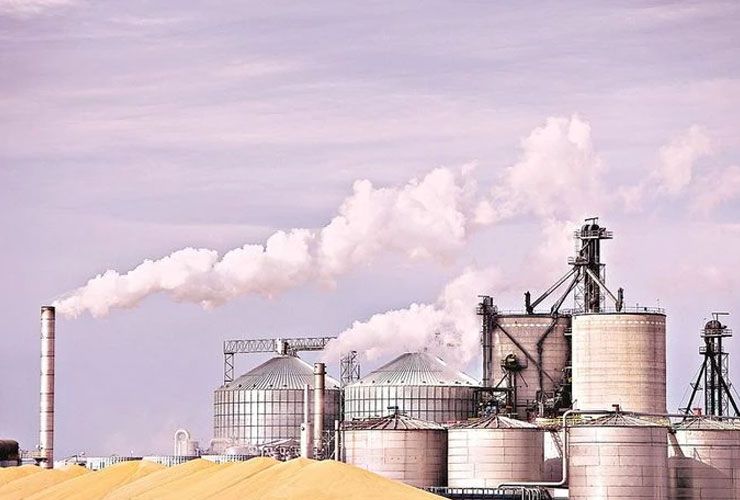
These measures then helped India to achieve its target of 20 percent ethanol blending five years ahead of schedule. However, this has now also resulted in significantly higher production capacity. Oil marketing companies only require enough ethanol to maintain E20 blending. So, presently, many dedicated ethanol plants are unable to sell their surplus production elsewhere.
As a result, there are multiple legal disputes over allocation. The Centre has now requested the Supreme Court to transfer all similar cases which are pending in different High Courts so that they can be heard together. The Supreme Court has directed all parties to maintain the status quo for the current Ethanol Supply Year while the matter continues.

Despite the ongoing case, the government has made it clear that the E20 programme remains unchanged. Attorney General R. Venkataramani reportedly clarified after the hearing that 20 percent ethanol blending is a policy decision that is not likely to change. The only issue under consideration is how available ethanol should be allocated among suppliers.
India successfully achieved nationwide E20 rollout in 2025, five years ahead of its original target. The government has stated that the programme has helped in reducing crude oil imports, saving foreign exchange, and improving energy security, along with lowering carbon emissions.
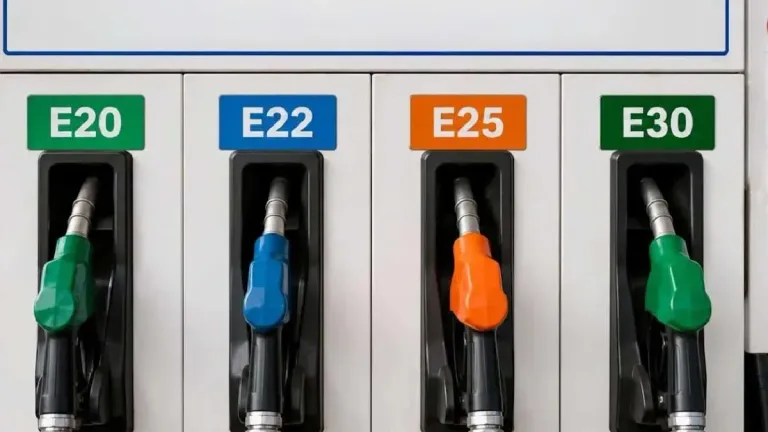
It has also set a new target of increasing ethanol blending to 30 percent by 2030. Now, in order to address the current oversupply of ethanol, higher ethanol blends such as E22, E30, E85, and E100 are already being tested and could play an important role in increasing future demand.
At the moment, it has been clarified that the current court case relates only to ethanol allocation, and it has no impact on the availability or validity of E20 fuel across the country.
Source
Comments are closed.