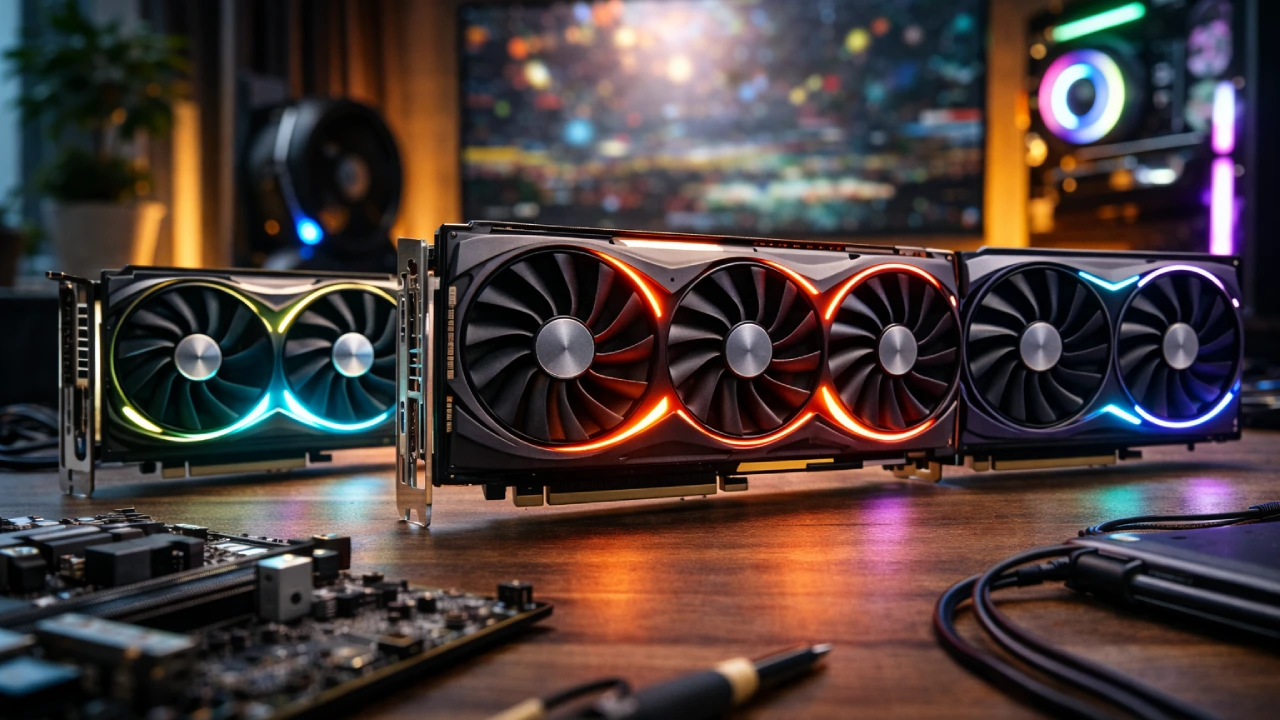
GPU Infrastructure: Artificial intelligence has moved beyond the experimentation phase. Companies are incorporating large language models, computer vision, recommendation systems, generative AI, and AI agents in their customer-facing and internal processes. However, transitioning an AI model from the notebook to the production environment needs much more than a mere trained model. At the center of that transition is infrastructure.
Many modern AI applications need GPUs for the amount of computation needed by training and inference processes. However, simply buying more GPUs won’t be sufficient as the team expands. Decisions about how GPUs will be managed, scheduled, shared, monitored, and scaled must be made. Infrastructure for production AI needs a GPU strategy to match the computational resources to the workload.
Why GPUs Matter for Production AI
Parallel Computing Changes the Economics of AI
Traditional CPUs are designed to handle a broad range of sequential and general-purpose workloads. GPUs, by contrast, are designed to execute large numbers of operations in parallel, making them particularly suitable for the matrix and tensor calculations common in machine learning. This matters during both training and inference.
Training large models can involve processing enormous datasets and adjusting billions of parameters. Inference—the process of generating predictions or responses from an already-trained model can also become computationally intensive when thousands or millions of requests arrive.
NVIDIA’s production infrastructure documentation emphasizes the importance of direct access to GPUs, networking, and storage for demanding multi-node AI workloads. In other words, production performance depends not only on the accelerator itself but also on the infrastructure surrounding it.
Inference Is Becoming an Infrastructure Problem
AI teams once focused primarily on training. Today, production inference can become the larger operational challenge. An AI application may need to respond within milliseconds or seconds while handling highly variable traffic. A chatbot, recommendation engine, or AI coding assistant may experience significant demand during particular periods and relatively little demand at other times.
That creates a fundamental infrastructure challenge: the organization needs enough GPU capacity for peaks without paying continuously for large amounts of unused capacity. GPU infrastructure provides the foundation for solving that problem through workload scheduling, autoscaling, model optimization, and resource sharing.
The Real Cost of Cloud GPUs
GPU Compute Is Only One Part of the Bill
Cloud GPUs provide flexibility, but they can be expensive. The price varies substantially depending on the accelerator, instance configuration, region, purchasing model, and workload.
For example, current Google Cloud pricing lists configurations ranging from smaller GPU instances to multi-GPU systems containing eight high-end accelerators. Its published Flex-start pricing includes an eight-GPU A3 configuration at more than $38 per hour and an eight-GPU A4 configuration at more than $64 per hour. AWS likewise publishes substantially different prices across GPU generations. Its Capacity Blocks pricing currently lists an eight-GPU P6-B200 instance at $98.84 per hour, while an eight-GPU P5 H100 configuration is listed at $41.528 per hour in several regions.
These figures illustrate why production AI economics cannot be reduced to the question, “Which GPU is fastest?” The more useful question is: How much useful AI work does the infrastructure produce for every dollar spent?
Utilization Matters
A powerful GPU that spends much of its time idle can be less economical than a less powerful accelerator that is consistently utilized. This is particularly important for organizations with multiple AI teams. One team may need GPUs for model training in the morning, another may require inference capacity during business hours, while experimentation workloads may appear unpredictably throughout the day.
Pooling these resources can increase overall utilization. NVIDIA’s Run documentation, for example, describes dynamic GPU allocation and workload orchestration as methods for matching GPU resources to changing demand. The goal is therefore not simply to purchase or rent more GPUs. It is to build infrastructure that keeps expensive accelerators productive.
Scaling AI Workloads Without Creating Operational Chaos
Kubernetes as the Production Control Plane
As AI applications grow, teams need an orchestration layer capable of managing containers, workloads, and specialized hardware.
Kubernetes provides native mechanisms for scheduling GPU workloads through device plugins. Teams can expose GPUs as schedulable resources and request them for individual workloads.

This creates a standardized infrastructure model: developers can package an AI service as a container, specify its GPU requirements, and allow the platform to schedule it onto suitable infrastructure. Kubernetes also supports workload autoscaling, allowing applications to increase or decrease replicas according to demand. For production AI, that distinction is crucial. Scaling should not mean permanently running the maximum number of GPUs. Instead, infrastructure should respond to workload demand wherever the application’s latency and availability requirements allow it.
Multi-GPU and Multi-Node Scaling
Some AI workloads cannot fit comfortably onto a single GPU. Larger models may require multiple accelerators, while training workloads may distribute computation across many machines.
At this scale, networking becomes just as important as raw GPU performance. NVIDIA’s infrastructure documentation notes that multi-node AI workloads require efficient access to networking, GPUs, and storage, while technologies such as high-bandwidth GPU interconnects help accelerate communication between GPUs. This means that buying individual GPU instances without considering the surrounding architecture can create bottlenecks.
Building a GPU Strategy Around Workloads
Training, Inference and Experimentation Have Different Needs
A production GPU strategy should begin with workload classification. Training workloads may need large amounts of GPU capacity for relatively limited periods. These workloads can sometimes benefit from scheduled capacity or discounted purchasing models.
Inference workloads are different. They may run continuously and require predictable latency. Here, GPU utilization, batching, model size, and response-time requirements become important cost factors. Development and experimentation workloads may be intermittent. Shared GPU infrastructure can prevent every developer or research team from requiring dedicated hardware. Consequently, organizations should avoid designing infrastructure around a single “standard” GPU configuration.
Measure Cost Per Useful Output
GPU utilization is useful, but it is not the ultimate business metric. For generative AI, organizations can examine metrics such as cost per million tokens, tokens per second, latency, and requests served per GPU-hour. NVIDIA’s inference analysis similarly emphasizes cost per token as a more meaningful infrastructure metric than GPU cost alone (7).
The same principle applies outside language models. Computer-vision teams might measure cost per image processed, while recommendation systems could track cost per thousand predictions.
These measurements connect infrastructure spending to actual application output.
When Should Teams Scale?
Start With Elastic Capacity
In organizations at an initial stage of using artificial intelligence, the use of cloud GPUs can help save on heavy initial hardware costs. Organizations can also try different types of accelerators as workloads develop and grow.
Furthermore, cloud computing infrastructure can give organizations the opportunity to use new-generation GPUs without having to build their own data centers.
Move Toward Dedicated Capacity When Demand Stabilizes
As GPU workloads become predictable, organizations can evaluate longer-term reservations, dedicated infrastructure, or hybrid environments.
The decision should consider utilization, workload stability, data requirements, latency, capital expenditure, operational expertise, and cloud pricing. There is no universal threshold at which an organization should move from cloud GPUs to owned hardware. The appropriate architecture depends on the workload’s utilization and business requirements.
The Production AI Infrastructure Stack
A mature AI environment ultimately involves several interconnected layers:
Compute: GPUs and CPU resources provide the raw processing capacity.
Storage: Model weights, datasets, checkpoints, logs, and other artifacts need reliable storage.
Networking: High-throughput, low-latency communication becomes critical for distributed AI.
Orchestration: Kubernetes or specialized AI schedulers manage workloads and GPU allocation.

Observability: Teams need visibility into GPU utilization, latency, errors, capacity, and spending.
Optimization: Quantization, batching, caching, and model-selection strategies can reduce the amount of compute required.
Together, these layers turn GPU hardware into an operational AI platform.
Conclusion: GPUs Are Infrastructure, Not Just Hardware
The future development of enterprise AI will not be defined only by which company has access to the most powerful model and GPU.
In terms of production efficiency, what matters is how well the company can leverage computing power in order to generate AI. GPUs are indeed the accelerators that many AI systems need to operate, but the actual problem comes from making good use of those GPUs. Inefficient use costs too much in cloud computing fees; unstable usage makes static capacities unattractive; and increasing complexity requires better management through networking, scheduling, and orchestration.
For AI teams, the strategic objective should therefore be broader than acquiring GPUs. It should be building an infrastructure layer that can allocate the right accelerator to the right workload at the right time—and scale that capacity as production demand changes. In production AI, GPU infrastructure is not merely the engine underneath the application. It is part of the application strategy itself.
(Source)