
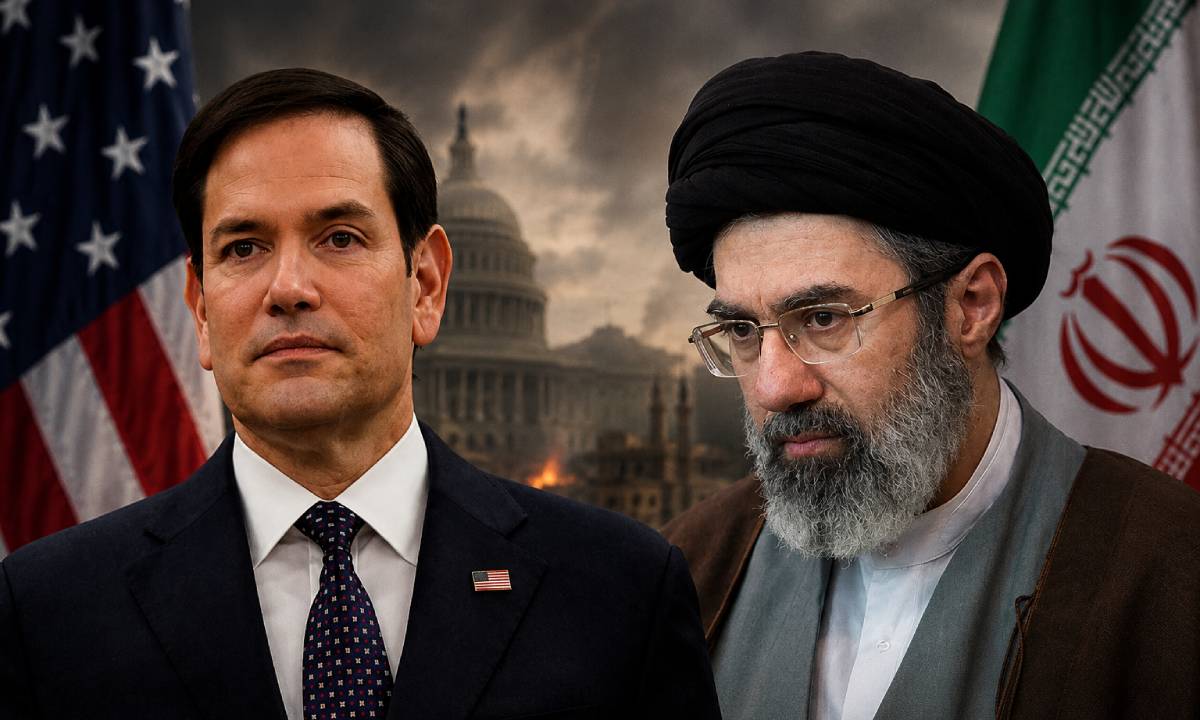

With initial steps being taken towards a possible long-term agreement between America and Iran, a big question has become a topic of discussion in the Gulf countries. The question is that if this agreement is successful, how much benefit can Iran get? It is believed that the same question will be raised again and again before US Secretary of State Marco Rubio during his three-day visit to the Middle East this week.
Marco Rubio will meet the leaders of United Arab Emirates, Kuwait and Bahrain. During this time, he will try to assure America’s close allies that any agreement between the Donald Trump administration and Tehran will not be at the cost of their interests.
Why are the Gulf countries worried?
The Gulf countries are not worried about diplomacy. Most Gulf countries have welcomed efforts to prevent conflict between America, Israel and Iran. However, their concern is about what Iran will get in return if the talks are successful and whether this agreement will be able to resolve long-standing concerns about Iran’s military ambitions.
The biggest discussion is about a possible reconstruction package of up to $300 billion. According to the Memorandum of Understanding (MoU), the US, along with regional partners, promises to prepare a plan worth at least $300 billion for the reconstruction and economic development of Iran. Arrangements to implement this scheme will be decided within 60 days under the final agreement.
Many officials of Gulf countries fear that such a huge amount could help Iran become strong again after the recent conflict. Besides, it can also increase its military capability and regional influence. Many countries are also concerned that there is no direct mention of Iran’s ballistic missile program in the MoU.
Which countries are more worried?
This concern is greater in countries where American military bases are present. Saudi Arabia, United Arab Emirates, Kuwait, Bahrain and Qatar play an important role in America’s regional security system. During the conflict with Iran, these countries also had to face missile and drone attacks, in which civilian infrastructure was also damaged.
Rubio’s visit is taking place at a time when regional leaders are supporting efforts to avoid another war, but they also want to know what the US is offering Iran and what are its expectations from Iran in return.
Will Gulf countries help Iran?
Although reconstruction of Iran is being discussed, but till now no Gulf country has said that it is ready to provide financial assistance for this plan. This issue has become even more sensitive after the war, because Tehran is also demanding compensation from America. Just before the talks in Switzerland, Donald Trump had said that Iran would not get “even ten cents” from the US.
Iran-US talks: What other issues are being debated?
One of the most complex issues in the talks is Iran’s frozen assets. After talks in Switzerland, US Vice President JD Vance gave information about a proposal that can decide how Iran’s frozen assets worth billions of dollars will be used if there is relief in sanctions. JD Vance said the United States wants to ensure that if Iranian assets are ever freed, the money is used to help the Iranian people, not to finance terrorism.
According to the proposal, the use of some of the freed up funds will be monitored by both the US and Qatar. Vance said that Jared Kushner has suggested an arrangement with Qatar, under which if any frozen asset of Iran is freed, then both America and Qatar will have to approve its use.
He said that that money can be used to buy American corn and wheat, so that the Iranian people can benefit from it. Under this arrangement, Iran will get access to some of its funds, but spending will be limited to humanitarian and agricultural needs.
What does Iran want on the issue of freezing properties?
Although this proposal has come forward, the matter is still not completely resolved. Iran has indicated that it wants its own control over the use of its assets. According to the governor of Iran’s central bank, decisions regarding frozen assets should ultimately be taken by Iranian authorities.
How many properties of Iran have been frozen?
The amount involved is also quite huge. Initial talks focused on frozen assets ranging from $6 billion to $25 billion. However, it is estimated that due to sanctions, Iran’s assets worth 100 billion to 120 billion dollars are stuck around the world.
Will there be discussion only on money?
Marco Rubio’s talks will not be limited to economic issues only. A large part of his tour will focus on Hormuz. It is one of the most important sea routes in the world, through which a large part of the global oil and gas supply passes. This waterway became a center of tension during the conflict and even now the movement of ships here has not reached normal levels.
Under the current MoU, Iran is barred from imposing transit fees during the 60-day negotiation period. However, Iranian officials have indicated that imposing such tariffs may be considered after this period expires.

Comments are closed.