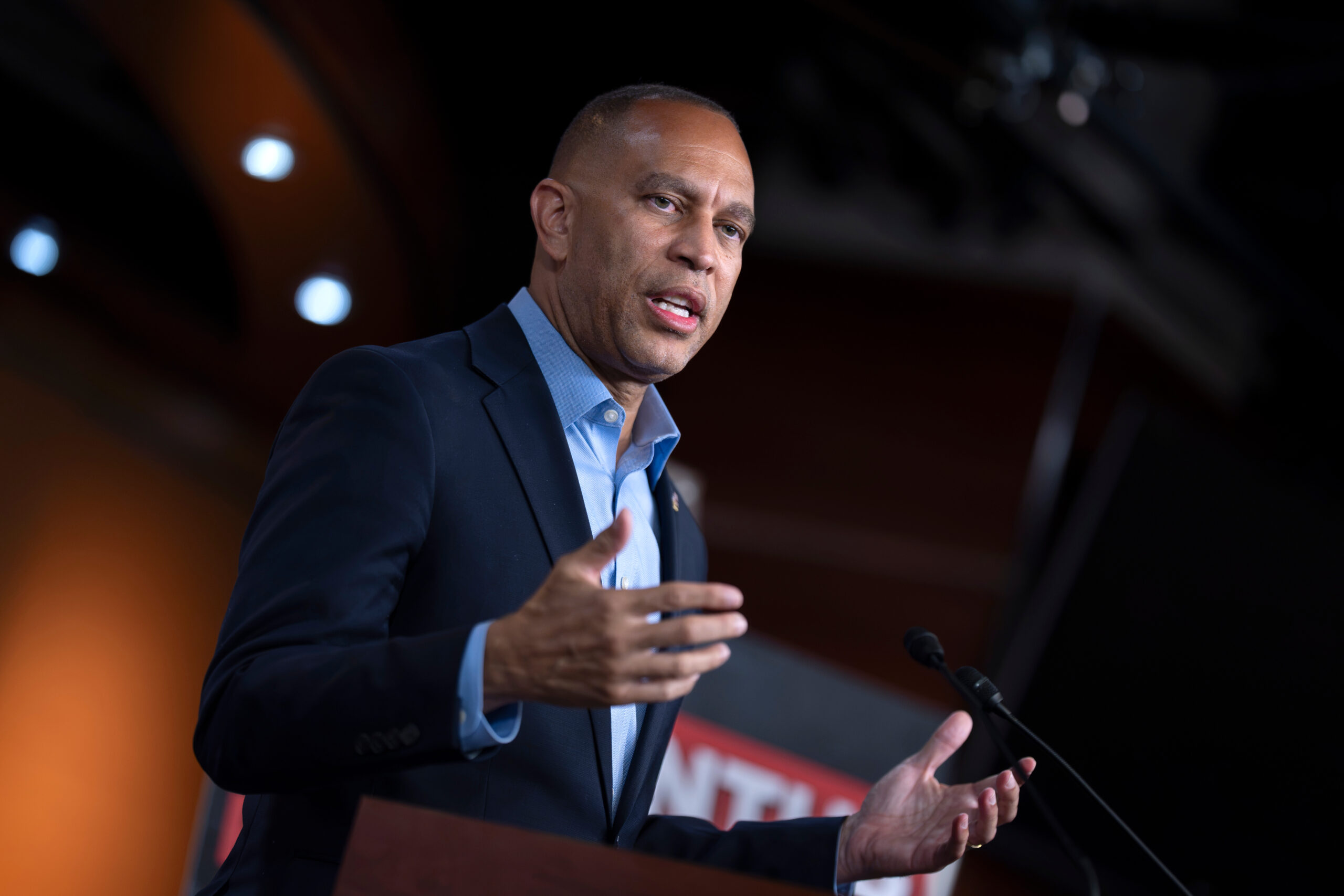
Hakeem Jeffries Confronts Democratic Rebellion as House Majority Hangs in Balance/ TezzBuzz/ WASHINGTON/ J. Mansour/ House Democrats are outlining an ambitious affordability and oversight agenda as they seek to regain the majority in the midterm elections. A procedural vote in which two centrist Democrats sided with Republicans exposed tensions that could complicate governing with a narrow majority. Hakeem Jeffries must balance progressives, moderates and a new generation of candidates if he becomes House speaker.
Quick Look
- Democrats hope to take control of the House in November.
- Jeffries is positioned to become speaker if his party wins the majority.
- Democrats plan investigations of the Trump administration.
- Their proposed agenda focuses heavily on the cost of living.
- Five working groups are addressing housing, healthcare, child care, groceries, gas and utilities.
- Reps. Jared Golden and Marie Gluesenkamp Perez broke with Democrats on a procedural vote.
- Their votes helped Republicans advance the House agenda.
- A narrow majority could give individual lawmakers significant leverage.
- Progressives recently criticized Jeffries for meeting with Jared Kushner.
- Democratic priorities include reversing Medicaid cuts and repealing Trump’s tariffs.
- Jeffries also wants to restore expanded Affordable Care Act tax credits and end the Iran war.
Deep Look
Democrats Prepare an Ambitious House Agenda
House Democrats are promising aggressive oversight of President Donald Trump’s administration and legislation targeting the high cost of living if they capture the chamber in November’s midterm elections.
Beginning on the first day of a Democratic majority, House Democratic leader Hakeem Jeffries has promised to “hold the crooks accountable.”
The New York Democrat is positioned to become speaker if his party wins control, making him the first Democratic leader to hold the gavel since Nancy Pelosi. Before pursuing that agenda, however, Jeffries must prove he can manage a politically diverse caucus that includes progressives, centrists and lawmakers representing districts won by Trump.
“His greatest challenge will be governing,” said Ashley Etienne, a former senior aide to Pelosi.
Narrow Majority Could Magnify Democratic Divisions
Control of the House is expected to be determined by a small number of competitive districts. Whichever party wins may hold only a narrow advantage, giving individual lawmakers considerable power over legislation and procedural votes.
Republicans have struggled repeatedly with that dynamic during their recent House majorities. Conservative members have blocked party priorities, while former Speaker Kevin McCarthy became the first speaker removed from office after a small group of Republicans joined Democrats to oust him.
Jeffries could face similar instability if Democrats win only a few more seats than Republicans.
The party is also undergoing an ideological and generational transition. New candidates, including some associated with the Democratic Socialists of America, are pressing leaders to embrace substantial changes in policy and strategy.
Two Centrists Break With Their Party
Democratic concerns intensified this week when Reps. Jared Golden of Maine and Marie Gluesenkamp Perez of Washington sided with Republicans during a procedural vote.
Such votes establish the rules governing debate on legislation. Traditionally, members of the majority support them while the minority votes against them, regardless of the underlying bills.
Conservative Republicans have increasingly violated that convention by using procedural votes to block their own leadership’s agenda. On Tuesday, another Republican rebellion appeared capable of defeating a rule backed by Speaker Mike Johnson.
Golden and Gluesenkamp Perez instead voted with Republicans, ensuring the measure’s passage and preserving the week’s legislative schedule.
Golden, who is retiring, was seeking passage of his legislation involving the lobster industry. Gluesenkamp Perez, another member of the centrist Blue Dog Coalition, joined him. She represents a district Trump carried.
Democratic Leaders Respond to Defections
The two votes angered Democratic lawmakers and prompted calls for disciplinary action. Party leaders responded quickly, signaling that they do not intend to accept the internal disruptions that have repeatedly undermined House Republicans.
“It was disappointing,” said Rep. Jim McGovern of Massachusetts, the ranking Democrat on the Rules Committee. “It makes us look as bad as them.”
The episode revived Pelosi’s familiar declaration that “Unity is our strength” and reflected pressure from Democratic voters who want their elected representatives to remain united against Trump.
Rep. John Larson of Connecticut, a former member of the Democratic leadership who recently lost his reelection primary, said narrow margins make party discipline particularly important.
“The challenge is, that if you don’t have the numbers, all of a sudden a few people can be very decisive,” Larson said.
“You can never ask people to vote against their own interest,” he added. “But you also have to emphasize the camaraderie and concept of working together as a team.”
Jeffries’ Cautious Style Faces a Changing Party
Jeffries is known for a measured leadership style and frequently says he chooses calm over chaos. That approach can conflict with demands from Democrats who want faster and more confrontational responses to the Trump administration.
First elected to Congress in 2012, Jeffries has concentrated much of his effort on regaining the House majority. At the same time, he is trying to hold together one of the most politically, racially and geographically diverse caucuses in congressional history.
“We’re fighting to make healthcare affordable for every single American,” Jeffries said. “And we certainly will fight to hold the crooks accountable who have unleashed unprecedented corruption on the American people.”
Kushner Meeting Drew Progressive Criticism
Jeffries also faced criticism from progressives after meeting with Jared Kushner, Trump’s son-in-law and an outside White House adviser.
Jeffries and Kushner, both New Yorkers, had known each other and collaborated on legislation during Trump’s first administration. White House chief of staff Susie Wiles suggested that Kushner contact the Democratic leader.
Some liberals nevertheless questioned why Jeffries would agree to meet with a member of Trump’s inner circle.
“He asked for a meeting, and I took it,” Jeffries said in a video responding to the criticism.
The dispute illustrated Jeffries’ challenge in balancing practical engagement with demands from activists and progressive lawmakers for firm opposition to the administration.
Affordability at Center of Democratic Plans
Democrats have created five working groups to develop policies addressing household costs. Their areas of focus are housing, healthcare, child care, groceries, and gas and utility expenses.
The ranking Democrats on the House Oversight and Judiciary committees are also preparing investigations into alleged corruption within the Trump administration.
Jeffries has identified several broad legislative priorities for a potential Democratic majority. They include repealing Republican reductions to Medicaid, restoring expanded tax credits under the Affordable Care Act, eliminating Trump’s tariffs and ending the U.S. war with Iran.
“These are issues that we know unite Democrats,” Jeffries said. “But I don’t want to get out ahead of the caucus, because there are a whole host of things that need to be worked on.”
The procedural dispute demonstrated why reaching an agreement across the caucus may prove difficult. Even if Democrats win the House, their ability to implement that agenda could depend on whether Jeffries can maintain unity when almost every vote matters.
More on US News