There’s a particular template of cinema that Rajkumar Santoshi and Sunny Deol have perfected together. The righteous fury of the underdog, a raised fist and bruised conscience that translates into a vendetta for justice, wrapped in a massy spectacle. Ghayal, Ghatak, Damini — these weren’t just hits; they were a signature, one that made “Santoshi–Deol” shorthand for vigilante cinema.
Meanwhile, Deol’s bravado and zealous nationalism in films like Gadar and Border made him the standard-bearer of cinematic patriotism.
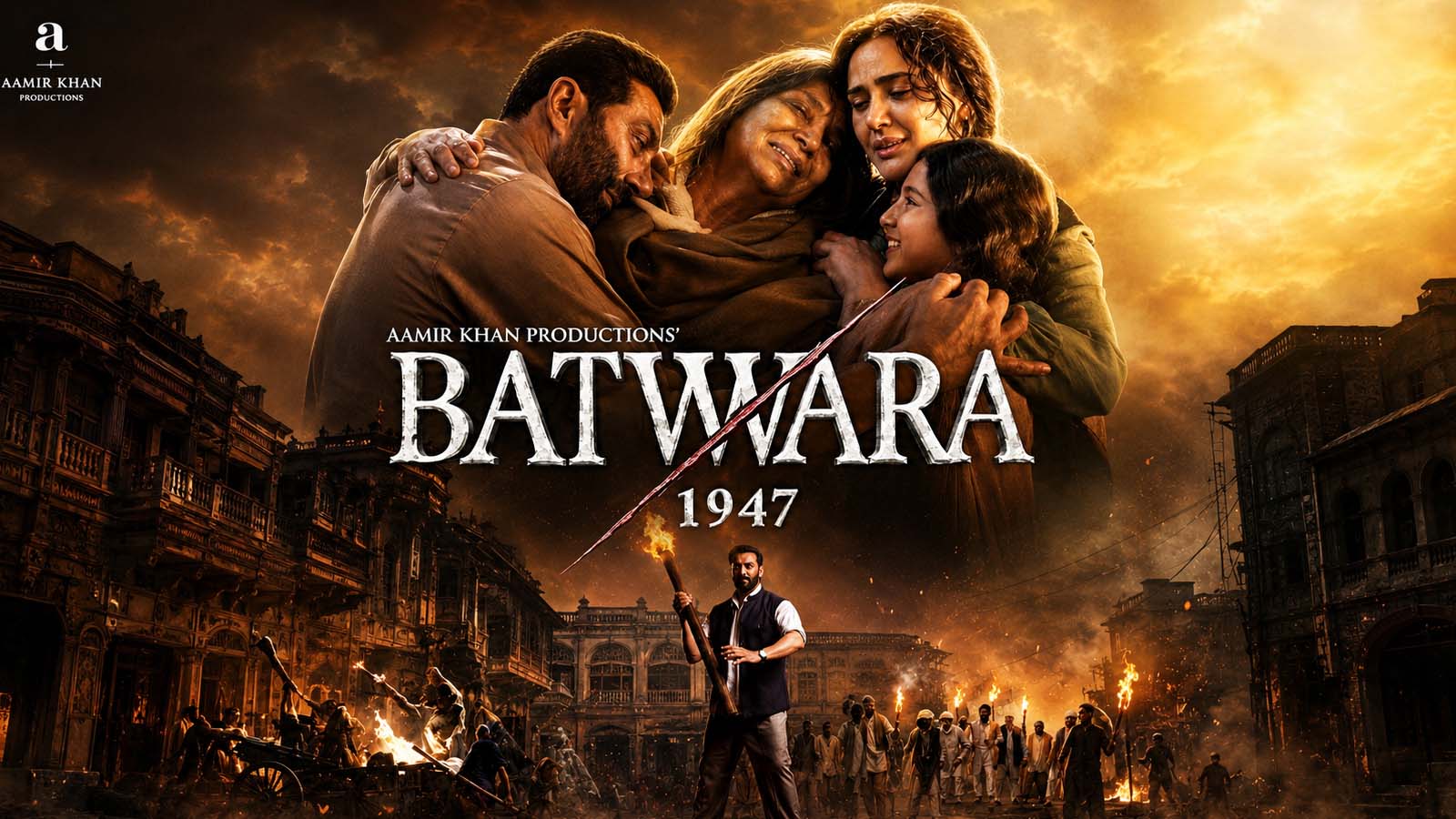
So the audience can’t really be blamed if they are expecting just that when they walk into Batwara 1947, which marks the reunion of Santoshi and Deol after nearly three decades. And well, the fury of the past does reunite and that old fire is unmistakably present — only now it is turned towards one of the subcontinent’s deepest wounds rather than a single man’s vendetta or a single border, the Partition of India in 1947, when identity was reduced to religion. Set against this fractured landscape, Batwara 1947 is an adaptation of playwright and author Asghar Wajahat’s play titled ‘Jis Lahore Nai Vekheya, O Jamya E Nai’.
MS Sathyu’s Garam Hawa (1973), the heartrending tale of a Muslim family reduced to being strangers in their own country, was lauded for looking the devil of separatism and communalism in the eye. Santoshi takes a leaf from the same book, showing how innocents, irrespective of faith or religion, paid the price of factionalism.
When hostility gives way to humanity
Sunny Deol’s Sikander Mirza is a proud Indian Muslim who, when coaxed by people to leave Lucknow, makes it clear that he will not leave his country, Hindustan, for Pakistan. “Batware ki aag mein kuch log rotiyan sekh rahe hain” — a few are making the most of the fire of Partition.
However, when coerced by the wave of dissent and violence, he and his wife Hamida, played by Preity Zinta, are forced to flee. But their son Javed, played by Sunny Deol’s real-life son Karan Deol, is missing.
In Lahore, a different narrative pans out. The once secular Mirza family is now coloured by the wave of communalism. After weeks spent in refugee camps, they are allotted a home, Durga Niwas, a house that once belonged to a Hindu family. The only person left behind is ‘Mai’ (Shabana Azmi), the matriarch waiting for her family to return. She refuses to vacate but is welcoming towards the Mirza family. However, the Mirzas, engulfed by resentment of what they have been through at the hands of Hindus, want to throw the old woman out.
Also read: Mourinho review: Netflix series celebrates Portuguese football manager’s wins, glosses over losses
The return of Javed only amplifies that hatred. He regards all Hindus as enemies and complicit in the destruction of Muslims. Having been witness to the carnage during the partition riots, he colludes with the local goon played by Abhimanyu Singh to throw the old lady out of the home that once belonged to her family. Javed’s transformation from a missing son into an antagonist is perhaps the film’s most telling illustration of how hatred can consume even those who once stood on the other side of it.
Yet, against this backdrop of growing hostility, something more humane begins to emerge. The two families, despite being vilified by their respective communities, gradually embrace each other. As suspicion and hostility slowly give way to understanding, compassion and finally a sense of shared belonging. In a film about a country torn apart by religion, this relationship becomes its most powerful counterpoint: humanity finds a way to survive even when everything around it is determined to divide people.
But Santoshi and Wajahat, who is also co-writer, remind us how hatred fuelled by politics and religion consumed basic human conscience.
An end to hatred
Departing from the usual rhetoric on what defines patriotism, Batwara 1947 asks a more fundamental question: what happens when religion and politics are allowed to erase humanity?
As Deol’s Sikander throws out some of the punchiest one-liners, threatening to draw his fists, it is once again a pointed challenge to the politicians and rabble-rousers who light the fire of hatred but leave ordinary people to fight their battles.
At its heart, Batwara 1947 throws up the question of how hatred never ends hatred, and how no religion propagates violence. “Siyasat aur mazhab ko na milao” — don’t mix politics with religion — becomes a telling message in times when nations and communities remain deeply polarised. As Ali Fazal’s poet character questions, what makes a Hindu different from a Muslim other than the faith they were born into.
The film showcases Sunny Deol in a different light. The man who has so often portrayed the valiant Hindu patriot is now a Muslim and the shift allows the film to make its larger point: human beings do not choose the religion they are born into. The film blends his star persona — the man who believes in monologues and whose flaring eyes can silence naysayers — with a story that demands something more restrained and human from him.
Sikander is the angry young man, but his rage is restrained, simmering beneath the surface rather than erupting at every provocation. But when it does erupt, you see flashes of the Sunny Deol we know — the flaring eyes, the thunderous voice and that unmistakable physicality. The difference is that here the anger feels less like a weapon and more like the eruption of a man pushed beyond his limits.
Shabana Azmi as Mai is outstanding, once again proving what a great actor she is. She has lost everything — her home, her family and the world she knew — yet there is no bitterness in her. Instead, she remains generous in embracing the very family that has been given her home.
Also read: A lingering refrain: How the ghazal survived, evolved through the centuries
The reunion of Santoshi and Deol is interesting because the director once used Deol’s rage to take on corrupt systems and individual villains. Here, he turns that same cinematic rage towards the larger villain of communal hatred.
The treatment, at times, feels more like a stage production translated onto screen, with some amateurish acting and an uneven dramatic rhythm. Adding to the familiar Bollywood tropes is Javed’s romantic track with the sister of the villain of the plot, a predictable detour that feels somewhat at odds with the film’s otherwise serious subject
Despite its flaws, the film’s heart is in the right place, with Santoshi leaning into a distinctly massy flavour. Its strongest point is also its simplest: when political and religious identities become more important than humanity, everyone loses.