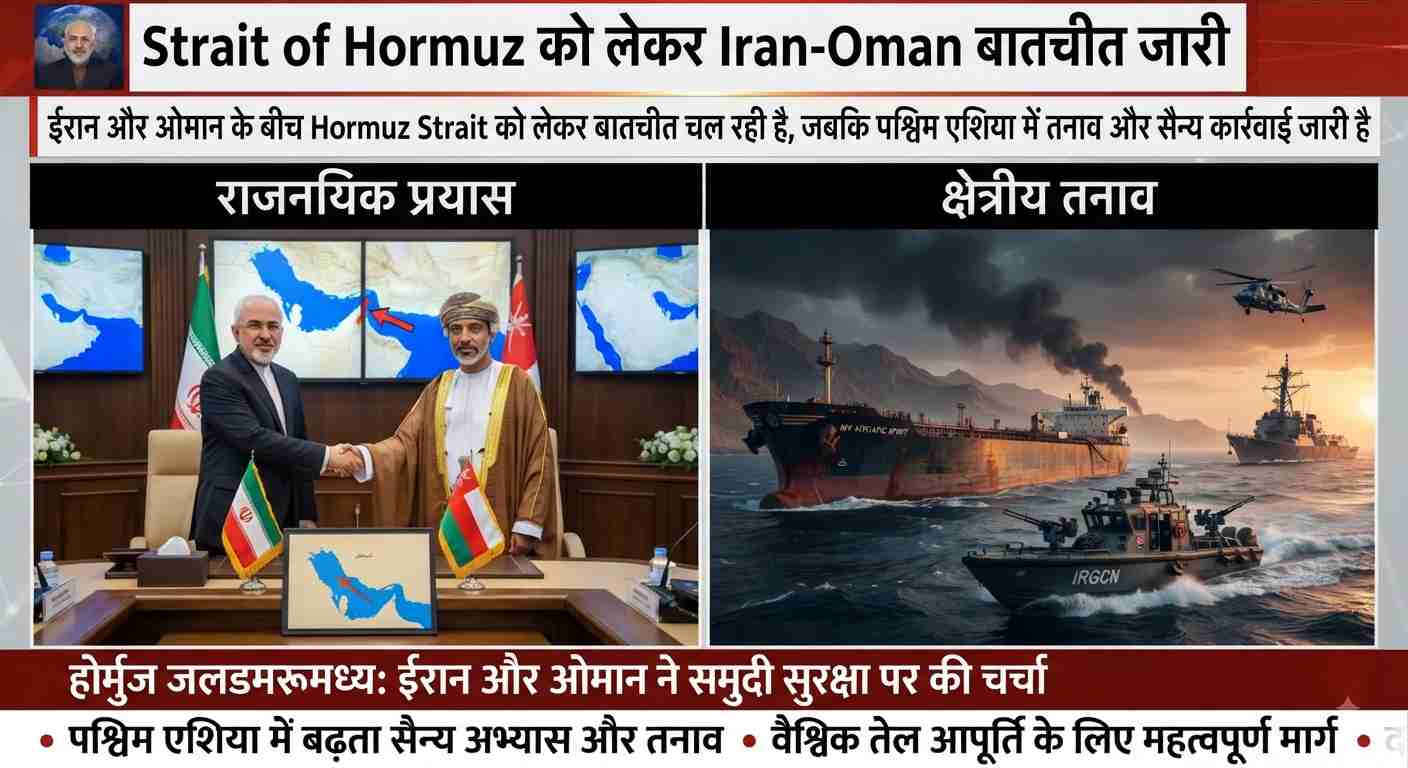
Amidst the ongoing heavy military conflict in West Asia and geopolitical tension that has been going on for almost six months, a major diplomatic and strategic success has emerged regarding the 'Strait of Hormuz', which is called the global energy lifeline. The two coastal countries of this strategic waterway—Iran and Oman—have reached a historic agreement on a new 'shipping route map' for the safe movement of ships after weeks of intense technical and diplomatic negotiations. Iranian Foreign Ministry spokesman Ismail Baghai officially confirmed that the three-month talks that began under the Memorandum of Understanding (MoU) signed on June 18 have now reached a concrete technical outcome. However, despite the two countries agreeing on a new navigational map, the major hurdle of military confrontation and blockade with the US still remains in the way of full resumption of commercial traffic through this waterway. What is the 'Shipping Route Map' agreement between Iran and Oman? The Strait of Hormuz, connecting the Persian Gulf and the Gulf of Oman, is the world's most important oil chokepoint. Its northern part falls in the coastal waters of Iran and the southern part comes under the jurisdiction of Musandam Peninsula of Oman. In view of the attacks on ships during the war, the threat of sea mines and obstacles to navigation, both countries have created an independent security system. The main technical features of this new agreement are as follows: Safe Navigation Channels: Separate specific sea corridors (Traffic Separation Channels) have been set up for ships entering the Gulf and going out to the open sea (Arabian Sea). Inter-departmental coordination: The technical plan has been finalized by defence, national security and environment officials under the leadership of Iran's Foreign Ministry in collaboration with Omani counterparts. Balancing sovereignty and security: According to the Iranian spokesperson, this is an independent agreement between the two coastal countries, which aims to provide safe transit to international merchant ships while protecting the territorial sovereignty of both countries. Pending issues and joint statement: Intensive brainstorming on toll tax and navigation safety Although the technical outline of the shipping route map has been agreed upon, diplomats from Tehran and Muscat are still continuing negotiations on some remaining and pending issues. Both countries are working on the terminology and legal format to issue an official joint bilateral statement. The most sensitive issue in this conversation is whether any security fee or 'transit toll' will be collected from foreign ships passing through this new route and what mechanism will be activated on-ground for the security of the ships. Iranian officials have clarified that dialogue between the two countries will continue until all legal and procedural formalities are completed. Iran's conditions for full opening of the waterway: Ball in America's court Iran has made it clear that preparing the route map with Oman is only the first step, but the final decision to fully open Hormuz and restore the operation of normal commercial vessels depends on America's stance. The Iranian leadership has alleged that America has continuously created obstacles in this negotiation process. Tehran has put forward clear conditions to Washington for the full operation of the waterway: End of the US naval blockade: The blockade and military activities maintained by the US Navy around the Persian Gulf and Iranian coasts should be ended with immediate effect. Prohibition of military threats: A complete halt to any direct or indirect military action against Iranian sovereignty and institutions. Compensation for violation of commitments: Tehran has demanded that necessary compensation be given for the agreements and commitments that America has violated during the last two months. The Iranian side says that this entire conversation was part of the framework decided in June, under which Iran and Oman were to prepare a navigation framework, and now the ball is in Washington's court as to how it fulfills its responsibilities. Ongoing military conflict in the Persian Gulf: Attacks and worrying IMO figures Despite progress at the diplomatic negotiating table, the ground and maritime reality remains extremely tense. According to official figures released by the International Maritime Organization (IMO), there have been more than 65 confirmed attacks on merchant vessels in the Strait of Hormuz and wider Middle East waters during the ongoing conflict, which has so far claimed the lives of 17 innocent seafarers. Even in recent days, the series of attacks has not stopped. The United Kingdom Maritime Trade Operations (UKMTO) has reported an unidentified missile or drone hit a bulk carrier ship. Apart from this, there have also been reports of ships of Abu Dhabi National Oil Company (ADNOC) being targeted. This continued insecurity has caused major international insurance companies to drastically increase the war-risk premium for ships passing through the region, causing global logistics costs to skyrocket. Global energy markets and impact on India: Oil supplies and diplomatic balance Before the war, about 20 to 25 per cent of the world's seaborne crude oil trade and 20 per cent of total LNG passed through the Strait of Hormuz alone. Due to disruption of this corridor, the prices of Brent crude have increased rapidly in the international market and in the recent week they have seen a huge jump of about 6 percent. This development has direct and profound implications for India: Challenge of energy security: India imports about 85% of its crude oil and 60% of LPG requirement, a major part of which comes from the Gulf region. Expected relief in supply: If safe transit of even a limited number of tankers starts under the Iran-Oman agreement, then Asian countries like India, China, Japan and South Korea may get major relief in oil and LNG supplies. Control on domestic inflation: Due to smooth supply of crude oil, global prices will moderate, which will reduce the import bill and domestic fuel prices will remain stable. Oman's mediation and the way forward: Can lasting peace be restored in Hormuz? In this entire crisis, the Gulf country Oman is once again proving its impartial and peacemaking role at the center of international diplomacy. Muscat has made this route map possible by maintaining constant indirect communication and technical coordination between the two sides. However, the real challenge in the coming days will be to see whether the administration of US President Donald Trump agrees to reduce its naval aggression by accepting this new navigation map. The international shipping industry and the United Nations are now eyeing the upcoming joint statement from Tehran and Muscat, which will decide whether this will usher in a new era of peace on the world's most sensitive oil route or whether this dangerous show of force will push the global economy deeper into crisis.