
HCMC has outlined five major growth zones in its proposed 2025–2050 master plan, with a 100-year vision: an international financial center, an eastern technology hub, a northern industrial and logistics zone, a southern maritime gateway, and a western healthcare and education center.
Nguyen Manh Cuong, Vice Chairman of the HCMC People’s Committee, presented the plan at a municipal People’s Council meeting on Oct. 29.
Following its merger with the former provinces of Binh Duong and Ba Ria–Vung Tau, HCMC covers nearly 6,800 square kilometers and has a population of around 14 million.
The proposed development structure links the urban core with industrial zones, seaports and coastal tourism destinations.
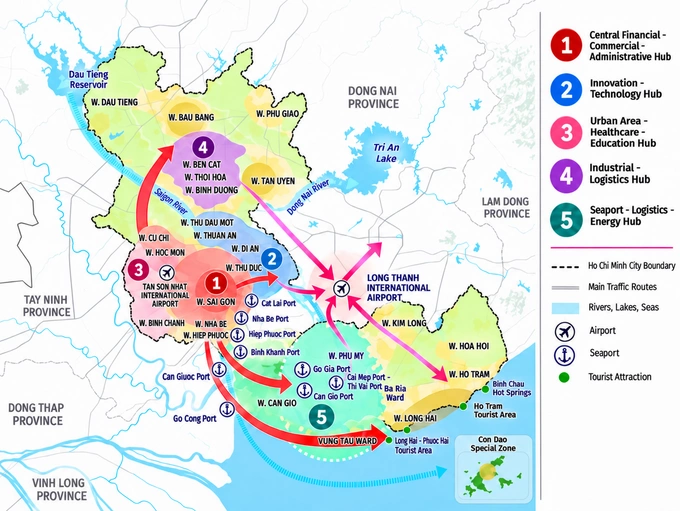
The international central core includes Saigon, Cho Lon, Thu Thiem and areas along both banks of the Saigon River. It will serve as the city’s administrative and financial center, concentrating international financial services, high-end services, the knowledge economy and creative industries.
The eastern innovation zone covers Thu Duc, Thuan An, Di An and Thu Dau Mot, with connections to Long Thanh. Its priorities include artificial intelligence (AI), semiconductors, research and development, universities, startups and high technology. The city aims to develop it into Southeast Asia’s “innovation valley.”
|
HCMC Vice Chairman Nguyen Manh Cuong presents a summary of the city’s master plan on Oct. 29, 2026. Photo by Read/An Phuong |
The western healthcare and education zone focuses on Vinh Loc, Binh Loi and Binh Chanh. It will combine medical and educational facilities with ecological urban development, creating a center for research, healthcare and education.
The northern industrial and logistics zone covers areas including Binh Duong, Ben Cat and Bau Bang. It will focus on advanced manufacturing, high-tech industries, logistics and regional distribution centers.
The southern seaport, free trade and energy zone stretches from Chau Duc to Vung Tau, Cai Mep, Phu My and Can Gio. Its planned functions include international transshipment ports, free trade zones, global logistics, maritime industries and energy development, positioning the area as a gateway for Vietnam’s international trade.
Beyond the five growth zones, the plan identifies five satellite centers: Con Dao, Long Hai–Ho Tram, Hoc Mon–Cu Chi, Bau Bang and Tan Uyen. They are designated for island and coastal tourism, ecological urban development, high-tech manufacturing and industrial services.
 |
|
The five major growth zones identified in HCMC’s proposed 100-year master plan. Graphic courtesy of the planning consultant |
The plan also divides the expanded city into 10 development management zones to guide the distribution of population, jobs, infrastructure and resources according to local functions and natural conditions.
The zones comprise the urban, financial and heritage core; the eastern innovation zone; the western and southwestern gateway; the Binh Duong industrial and service urban zone; an ecological and future development reserve; the Nha Be–Hiep Phuoc port urban zone; the Can Gio coastal ecological zone; the Cai Mep–Thi Vai seaport, logistics and energy cluster; the Vung Tau–Long Hai–Ho Tram coastal tourism zone; and the Con Dao special administrative zone.
The Saigon and Dong Nai rivers, along with Can Gio, are identified as key ecological and landscape assets to be protected during urban development.
Expanding regional transport connectivity
Transport infrastructure is a major component of the plan.
HCMC proposes 18 urban railway lines totaling about 961 kilometers, along with around 450 kilometers of light rail and surface tram systems. It aims to raise public transport’s share of passenger travel to 55–60%.
Multimodal transport hubs are planned at railway stations, airports, seaports and urban centers. The city will prioritize transit-oriented development (TOD), integrating urban expansion with public transport.
The plan also calls for connecting waterways with seaports, river ports, inland waterway terminals and logistics networks. Flood prevention and land subsidence measures will be tailored to individual river basins, alongside the development of underground infrastructure, elevated urban spaces and digital infrastructure.
 |
|
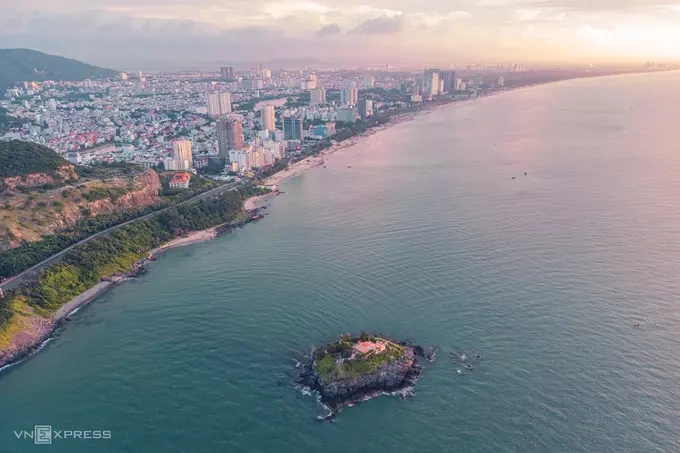
Following the administrative merger, Can Gio and Vung Tau form a coastal development corridor within HCMC. Photo by Read/Truong Ha |
For coastal and maritime development, the city plans to integrate seaports, logistics, high-tech industries, energy and island tourism. It will also study potential sites for offshore wind power projects.
HCMC aims to become a modern, smart city and a leading urban center in Southeast Asia by 2030.
By 2045, it seeks to become an Asian center for economic activity, culture, science, technology and innovation. From 2075 onward, its goal is to develop into a modern, smart global city.
Proposed growth drivers include an international financial center, free trade zones linked to global logistics, high-tech parks, data centers, and AI and innovation hubs. The city will also study the possibility of establishing a special coastal economic zone.
To implement the plan, HCMC intends to use public investment to attract private capital, including through public-private partnerships. It also plans to capture increases in land value generated by infrastructure investment and urban redevelopment.
Major projects will be prioritized based on their importance, with responsibilities, schedules and monitoring mechanisms specified.
Cuong said the planning documents had been finalized after consultations with government agencies, local authorities, experts, business associations and residents.
The proposal was submitted to the municipal People’s Council for consideration at a special session. If endorsed, it will be approved by the chairman of the HCMC People’s Committee under the applicable authority.