The city’s Department of Education and Training is collecting feedback on the criteria, quality assurance conditions and education services for the new type of school, set out in a draft decision for the municipal People’s Committee.
A high-quality school is defined as one that is academically strong, with better staff and educational results than any existing model. Preschool teachers, for example, normally need only a college diploma, but at high-quality preschools 70% would need a university degree or higher.
The differences are clearest at secondary and high schools, where every teacher would be able to communicate in English and at least 30% would reach level 4 or above on Vietnam’s six-level framework, equivalent to B2 on the Common European Framework of Reference for Languages.
At least 85% of secondary school teachers and 60% of high school teachers would hold a master’s or doctorate, where a bachelor’s degree is normally enough.
Secondary school students would have to reach B1 English and high school students B2, while most universities in Vietnam currently require B1 English for graduation.
All secondary school students would also be expected to win places at public high schools or international schools, and all high school students to enter a university or college in Vietnam or study abroad. Regular schools face none of these requirements.
High-quality preschools would have to be recognized as meeting national standards at level 2 or higher and have rooms equipped with modern technology.
Children would be introduced to English through an integrated program, in an English-speaking environment with cultural exchanges, performances, reading and music in English.
|
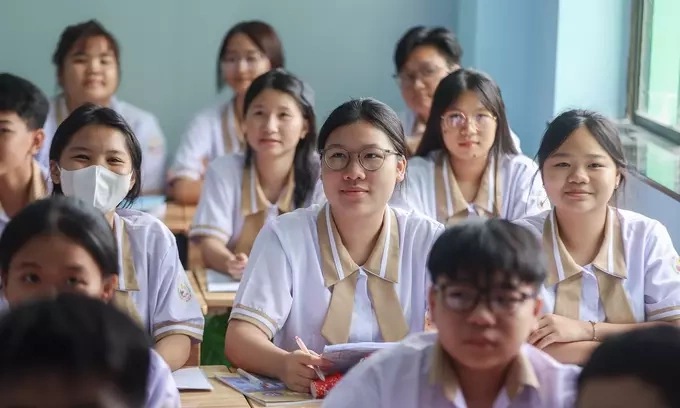
Students at Le Thi Rieng Primary, Secondary and High School in Ho Chi Minh City’s Thoi An Ward in September. Photo by Read/Quynh Tran |
High-quality primary schools would have classes of 35 students and separate rooms for music, art, foreign languages and computer science.
All their teachers would hold a university degree, with half qualified above that level. All would speak English fluently, and 30% would be able to teach in it.
Primary teachers in integrated programs would need a B2 English certificate, and those teaching subjects in English a C1 certificate or higher.
At least 80% of pupils would be taught to swim safely, and at least 60% would meet international standards or earn international certificates in English and computer science.
At secondary and high schools, classes would have 30 students attending two sessions a day, and every teacher would be digitally proficient.
All students there would be taught to swim safely and prevent drowning, and half would hold international English certificates.
The department said there is currently no set of criteria for assessing high-quality schools, while residents expect more from their schools and want students equipped with foreign language, digital and AI skills, STEM education and skills for international integration.
It said a growing share of parents are willing to pay for supplementary and advanced education services for their children, but gave no figures.
Besides its mainstream public schools, Ho Chi Minh City, Vietnam’s most populous city with more than 14 million people, already has more than 80 schools from preschool to high school running an advanced, regional and international integration model.
Those schools charge more than VND1.7 million (US$66) per student a month.