The municipal People’s Council approved the financing mechanisms at a special session on Oct. 30, allowing the city to diversify funding sources.
Under the proposal submitted by the municipal People’s Committee, HCMC can issue municipal and project bonds through the VIFC, denominated and settled in Vietnamese dong or freely convertible foreign currencies.
For foreign currency-denominated bonds, the city must consult the State Bank of Vietnam and relevant authorities on cash flow management, accounts, settlement, registration, reporting and risk management.
Foreign investors can purchase the bonds, while foreign-affiliated organizations may provide underwriting, advisory and other financial services. Offerings can be made publicly or privately through underwriting, auctions, agents or direct sales.
The financial center’s infrastructure will handle bond registration, custody, settlement, transfer, listing and trading.
Proceeds must be centrally managed and used for designated projects in the city’s medium-term public investment plan that have completed required investment procedures. The municipal budget will guarantee timely repayment of principal, interest and other legally incurred expenses.
|
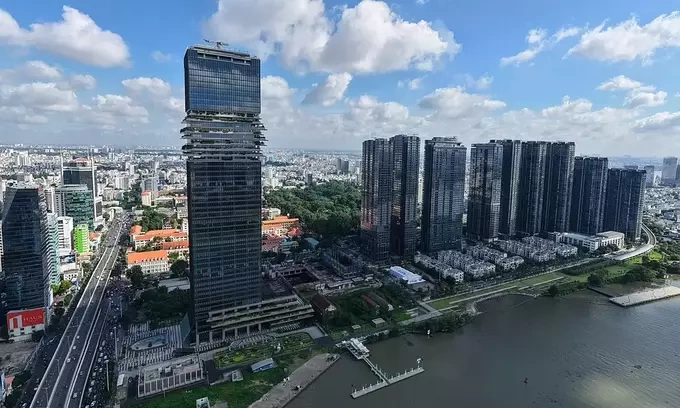
A view of downtown Ho Chi Minh City in July 2026. Photo by Read/Thanh Tung |
Alongside VIFC bond issuance, the People’s Council authorized the city to raise domestic capital through five types of bonds: local government, project, infrastructure construction, municipal and green bonds. It can also borrow from domestic financial institutions.
Local government bonds must be denominated in dong and have maturities of at least one year. They can be issued through auctions or underwriting, with interest rates set in line with the Ministry of Finance’s framework and market conditions.
Funds raised through these channels will go into the municipal budget. The People’s Committee will allocate money for debt servicing and report on issuance, use of proceeds and repayments to the People’s Council and Ministry of Finance.
HCMC expects to borrow up to VND49.291 trillion (US$1.9 billion) between 2026 and 2030 to finance its budget deficit. Domestic borrowing, primarily through local government bonds, is expected to account for VND31.732 trillion, with the remainder coming from loans on-lent by the central government.
Separately, the city’s priority list for public-private partnership (PPP) investment in 2026–2031 includes 90 projects with an estimated total investment of VND1.27 quadrillion. They cover transport, urban railways, urban redevelopment, environmental protection, flood control, digital transformation, energy, logistics and social infrastructure.
The two financing channels are expected to give the city more flexibility in choosing funding instruments, markets and maturities, while reducing reliance on budget allocations and bank credit. Green bonds could also fund environmental projects, emissions reductions and climate adaptation.
Nguyen Huu Huan, vice chairman of the executive agency of VIFC-HCMC, said international fundraising required coordinated planning, financial discipline, project preparation and a functioning legal framework, not just individual transactions or the efforts of one agency.
The newly adopted resolution provides a legal basis for the city to prepare its first bond issuance through the VIFC, he said. Although the initial offering could face challenges, it would be important in establishing HCMC’s credibility in international capital markets and paving the way for future issuances.
A successful first offering could also encourage businesses to raise funds through the center, he added.
HCMC plans to select several pilot projects for bond issuance through the VIFC in the initial phase. The center and relevant municipal agencies are identifying projects suitable for this financing method.
The offerings will target international investors and members of the financial center.