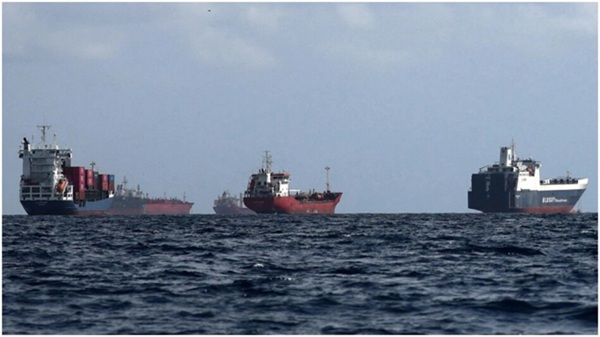
New Delhi. The increasing tension in the Strait of Hormuz has increased the concern for the global economy. The movement of ships through this important sea route has once again almost come to a standstill. The UAE has accused Iran of targeting two of its ships, while the US has indicated that the naval blockade on Iran could be continued indefinitely. Meanwhile, a committee of the Iranian Parliament has approved a plan to stop ships of America, Israel and other 'enemy' countries from passing through Hormuz.
This crisis is affecting crude oil prices and global supply. India's dependence on Russian crude oil also reached a record level in July. Global economists fear that if the conflict prolongs, the pace of economic growth may slow down and a recession may occur in some areas.
Trump warns of making Hormuz an American territory
US President Donald Trump said on Friday that after defeating Iran, America can soon declare the Strait of Hormuz as American territory. The Strait of Hormuz is one of the world's most important sea routes and before the war, about one-fifth of the world's oil and gas passed through it.
Trump's statement has further increased the tension with Iran. Iran has been rejecting this claim of America and says that this waterway will not be opened until its conditions are met.
Accused of attack on two UAE ships
According to Abu Dhabi National Oil Company, two of its ships passing through Hormuz were attacked on Thursday evening. The UAE government has blamed Iran for this. However, there has been no reaction from Iran on this allegation yet.
According to an Iranian official, there has been no progress in talks to extend the agreement reached in June. Since the June ceasefire broke down, Iran has been attacking ships that try to pass through the waterway without its permission.
Only two ships passed in a day
According to ship tracking company Kpler, only two ships passed through the Strait of Hormuz on Friday. Of these, one ship carrying grain entered Iranian waters, while the other empty ship went in the opposite direction. An empty oil tanker was also seen heading towards the Gulf.
There was no movement of any crude oil ship on Friday. Nine ships passed through the route Thursday, up from five on Wednesday, but down from the August average of 12 ships a day.
However, some ships may also travel with transponders turned off, so actual numbers may differ. Despite this, the current movement is much less than before the war started. At that time more than 130 ships passed through this waterway every day.
America said – the blockade can continue for a long time
US Defense Secretary Pete Hegseth said that the US military is fully capable of maintaining its presence in the region and enforcing the blockade on Iran. According to him, the US Navy can continue this blockade for a long time by changing ships.
US Treasury Secretary Scott Besant has also indicated to increase economic pressure on Iran. He said that such steps will be announced next week, which will go further than the steps taken so far by America to economically isolate a country.
Impact of expensive petrol on Trump's popularity
Domestic pressure regarding this war is also increasing in America. Rising petrol prices are affecting Trump's popularity. It is also expected to affect the Republican Party's position in Parliament in the midterm elections to be held in November.
The prices of Brent crude and American crude have increased marginally to around $ 87 and $ 81 per barrel respectively. India's dependence on Russian crude oil remained at a record level in July. At the same time, refineries in Asia have also purchased American crude this week to ensure future supply.
Iran's demand – sanctions should be lifted, seized property should be returned
Iran demands that the economic sanctions imposed on it be lifted and its seized assets be returned. On Thursday, an Iranian parliamentary committee approved the plan, which provides for blocking ships and equipment of the US, Israel and other enemy countries from passing through Hormuz.
The US lifted the blockade on Iran for a month in mid-June, but later reimposed it. Due to this, Iran's main source of earning foreign exchange has been affected. The economy has also been weakened by attacks on its energy infrastructure during the earlier war.
The US has previously said the blockade would be lifted only if Iran and Oman agree to resume commercial shipping.
Houthi attack increases fear of regional war
Trump has warned to intensify military action against Iran. However, they have so far refrained from sending ground troops, capturing strategic islands or attacking desalination plants. Earlier this week he had indicated that he would give priority to economic pressure rather than military action.
The US has also tightened sanctions on Iran and those people and entities accused of helping Iran obtain weapons. However, despite these pressures, Iran has not yet returned to the negotiating table.
Meanwhile, on Thursday, Iran-backed Houthi rebels targeted a Saudi Aramco refinery with a drone. Due to this, the possibility of the conflict spreading to other countries has increased again.
If the crisis continues for a long time, it will affect the global economy.
Large volumes of oil and LNG pass through the Strait of Hormuz. In such a situation, due to long-term disruption of ship movement here, pressure on energy supply and prices may increase. Global economists have warned that if the war does not end soon, there could be a sharp decline in the pace of world economic growth and even recession in some areas.