
American tanks have improved in terms of weapons, armor, mobility, and technology since the conclusion of World War II. The M4 Sherman tank offered strengths and weaknesses, but ultimately was quite an asset on the battlefield against the Axis powers. It featured a standard 75 mm cannon that could rotate a full 360 degrees and a line-of-sight thickness of 3.7 inches on its angled frontal plate.
The Pershing tank was set to replace the M4, but the M46 Patton ended up succeeding both of them. Running a more powerful V12 engine and sporting a 90 mm main cannon, the M46 had more horses under the hood and greater firepower over its predecessors. What followed was a series of tanks referred to as “Patton” tanks, which includes the M47, M48, and finally the M60, which offered up to 10 inches of frontal armor. The Cold War era saw heavy and medium classifications of tanks combined into the main battle tank (MBT) concept along with a switch from gasoline to diesel engines.
In addition to a 105 mm gun and weight reduction with the use of aluminum track wheels, the M60 MBT also received notable technology upgrades. It included coincidence rangefinders, which essentially used an early form of computer (mechanical analog) to calculate more accurate fire. Infrared searchlights were also added for enhanced visibility at night. Of course, this is just the tip of the iceberg; in the case of the M60, upgrades continued for decades, making the final iteration a far different tank from the original.
The M1 Abrams
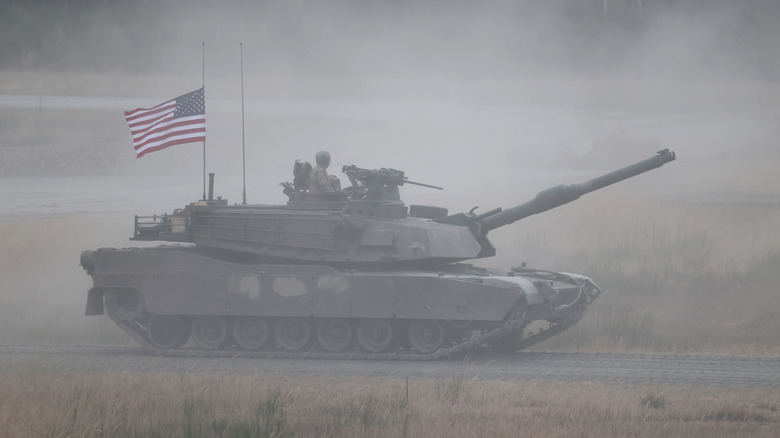
The M1 entered service in 1980, equipped with Honeywell’s AGT1500 gas turbine engine. The reason the U.S. chose turbines over diesel engines in the M1 is a story in itself. In terms of maneuverability, the M1 can go from 0 to 20 mph in 6 seconds and achieve speeds up to 45 mph. It only takes approximately 9 seconds to rotate the turret completely around. Utilizing Chobham armor, the details of which still remain largely classified, reportedly includes ceramic, steel, and elastic layers to combat anti-tank weapons.
Technology also sees a significant boost with the M1 Abrams, as it receives a digital upgrade with fire-control computers. This new system automatically calculated a number of variables using data from a laser rangefinder, including the direction and speed the tank itself was moving, and could provide accurate targeting parameters that updated 30 times each second. Enemy targets could no longer reliably hide behind smoke or the cover of darkness with the M1’s cutting-edge thermal imaging system.
This was just the first iteration of the M1, which would see successive upgrades like the M1A1, M1A2, and M1A2 SEP, and today’s M1A2 SEP version 3. Since the M1 was introduced, it’s received a host of upgrades and additional protection measures, such as those against chemical weapons. The newest M1 includes the Trophy Active Protection System. While the Chobham armor can help protect hull integrity when an anti-tank munition strikes, the Trophy Active Protection System detects and fires at incoming threats, working to destroy them in the air.