
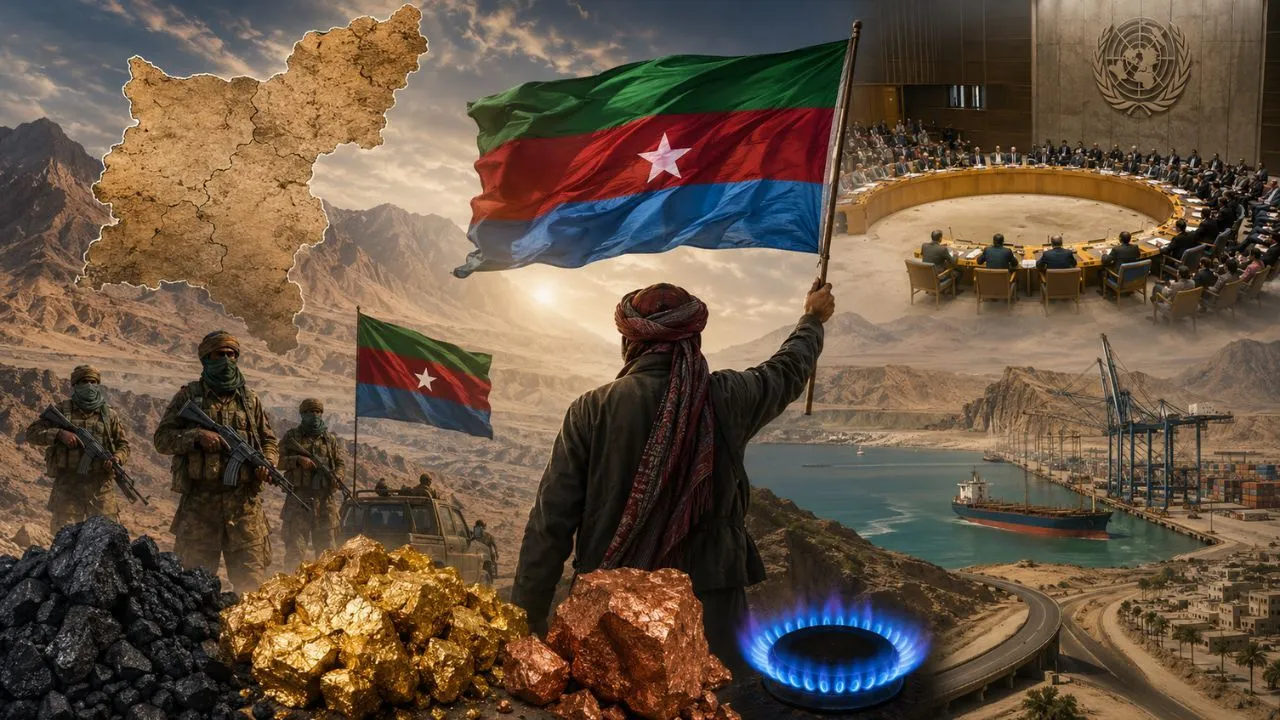
Explainer: Is a new country created just by making a declaration? Know the whole truth of Balochistan’s claim of independence

Balochistan Declared Independence From Pakistan: Balochistan, Pakistan’s largest province, has recently declared itself an independent country. After this a new debate has started regarding this. Mir Yar Baloch, who describes himself as the representative of Balochistan on social media platform X, has claimed that Balochistan is no longer a part of Pakistan.
Mir Yar Baloch said that the Defense and Security Forces of the Republic of Balochistan have gained control over about 85 percent of the province. He sang the new country’s national anthem, national flag and “Balochi phallus” Also announced the issuance of a new currency named Rs. Also appealed to the countries of the world to recognize Balochistan as an independent nation. In such a situation, the question arises whether one becomes a country just by making a declaration? What is necessary to become a country? And does India recognize Balochistan as a country?
Is a country made just by declaration?
It is not enough for an area to declare itself independent. In international law, many conditions have to be fulfilled for a new country to be recognized. Therefore, merely issuing a flag, national anthem or new currency does not automatically make a territory a sovereign nation. The Montevideo Convention of 1933 is considered very important in international law.
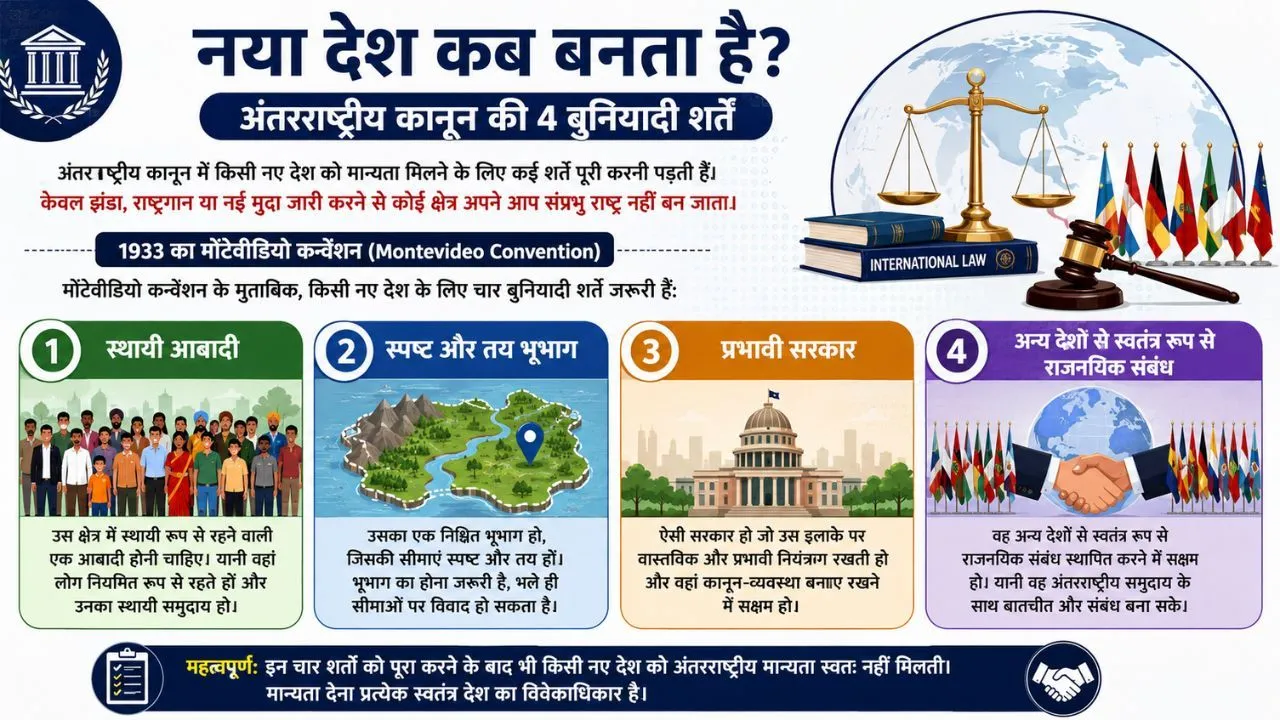
Four conditions must be fulfilled to be recognized as a country (AI generated image)
According to this, four basic conditions are necessary for any new country. First, there should be a permanent population. Second, it should have a clear and definite territory. Third, there must be a government that exercises actual control over that area. Fourth, it could freely establish diplomatic relations with other countries.
To what extent does Balochistan meet these conditions?
Mir Yar Baloch claims that his organization controls 85 percent of the area. But this claim has not been confirmed by any independent agency. On the other hand, Pakistan’s government and army still claim to have control over the entire Balochistan. Government administration is also working there.
BREAKING NEWS 🚨➡️✈️
The Republic of Balochistan’s Defense and Security Forces Have Secured 85% of Balochistan’s Territory13 July, 2026
Balochistan has declared its independence, adopted its national anthem, “Ma Chukain Balochani, introduced its national flag, established… pic.twitter.com/sCUm7rSlye
— Mir Yar Baloch (@miryar_baloch) July 13, 2026
The international community does not accept the claims of any new country on the basis of statements alone. He sees who actually controls that area. Is the government maintaining law and order there? Are the administration and security system in his hands? Unless clear answers to these questions are found, the claim of becoming a new country is considered weak.
Difference between declaratory theory and constitutive theory
According to the declaratory theory in international law, if a territory fulfills all the conditions to become a new country, then it can automatically be considered a country. Recognition of other countries is only a formal process of accepting that status. That is, recognition is definitely necessary, but it is not the only basis for becoming a country.
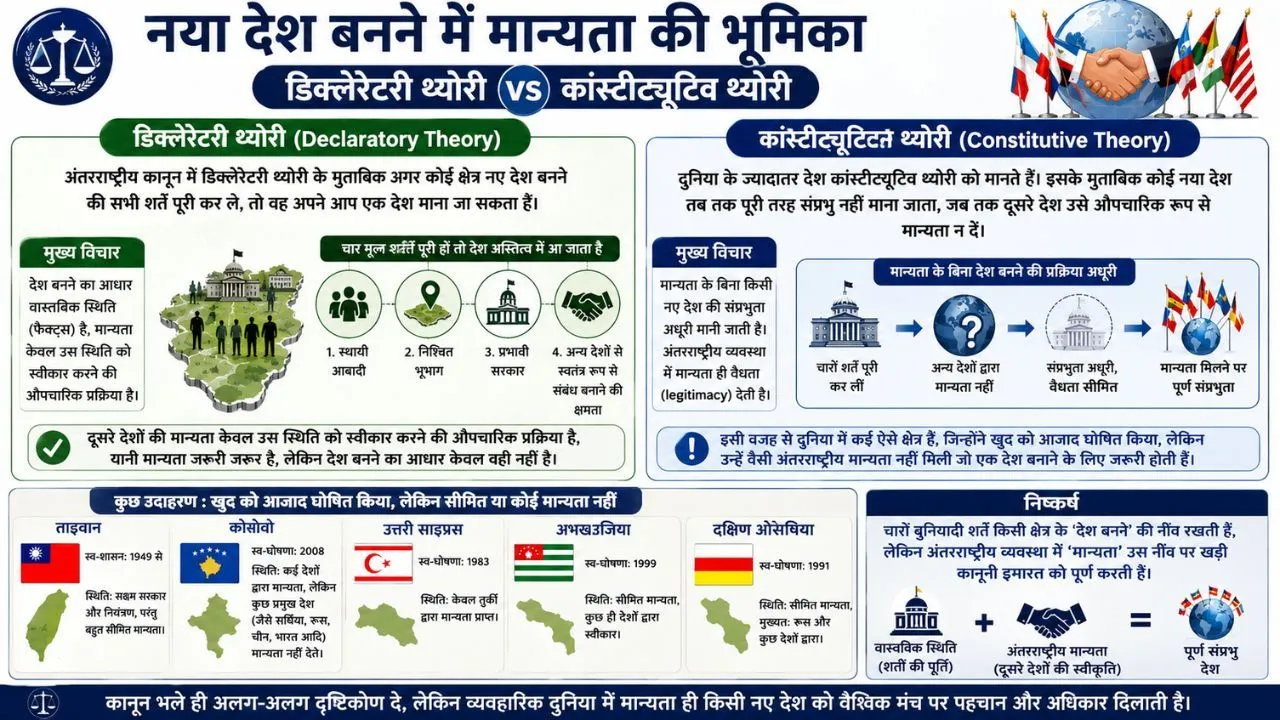
Difference between Declaratory Theory and Constitutive Theory (AI Generated Image)
However, most of the countries of the world believe in the Constitutional Theory. According to this, a new country is not considered completely sovereign until other countries formally recognize it. For this reason, there are many areas in the world which have declared themselves independent, but have not received the international recognition that is necessary to create a country.
Will India recognize Balochistan?
Legally, India can recognize any new country if it wants. This is the right of every sovereign country. But such a decision is not taken only on the basis of law. In this, foreign policy, security, strategic interests and relations with other countries are also taken into account.
India recognized Bangladesh in 1971 when a separate government was formed there and it also had effective control over the land. After India’s recognition, many other countries also Bangladesh was recognised. However, the situation in Balochistan is currently considered to be different from this. Therefore, before recognizing Balochistan, India will consider every aspect and then take a decision.
How do countries get membership of the United Nations?
If a new country wants full international recognition, it has to try to obtain membership of the United Nations. For this one has to apply first. The matter then goes to the United Nations Security Council, where the support of at least 9 out of 15 members is required. Also, none of the five permanent member countries can impose a veto.
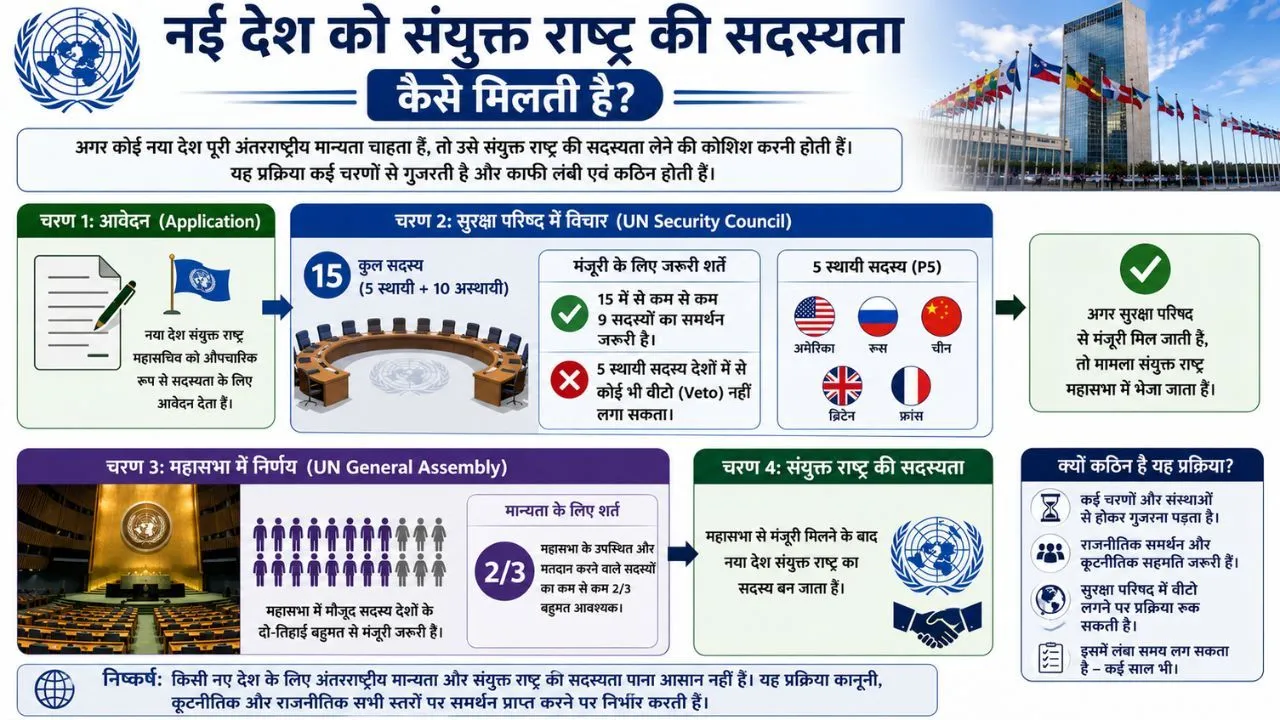
The process of becoming a member of UN is long and complex (AI generated image)
If approval is received from the Security Council, the matter goes to the United Nations General Assembly. A new country can become a member of the United Nations only after getting approval from two-thirds majority of the member countries present there. Therefore, the process of getting international recognition is quite long and difficult.
Why is Balochistan so important for Pakistan?
Balochistan accounts for about 44 percent of Pakistan’s total area, but only about 6 percent of the country’s population lives here. Despite this, it is considered to be the most resource rich area of Pakistan. Large reserves of natural gas, gold, copper and coal are present here.
Also read- Kuwait Drone Attack: Kuwaiti Army’s big statement, direct confrontation with Iran’s drones in the sky, Gulf countries shaken
Gwadar port situated on the banks of the Arabian Sea is in Balochistan. China considers it the most important center of its China-Pakistan Economic Corridor (CPEC). This is why the issue of Balochistan is not limited to Pakistan only. This may also impact the strategy of China, India, America and the entire Indo-Pacific region.

Comments are closed.