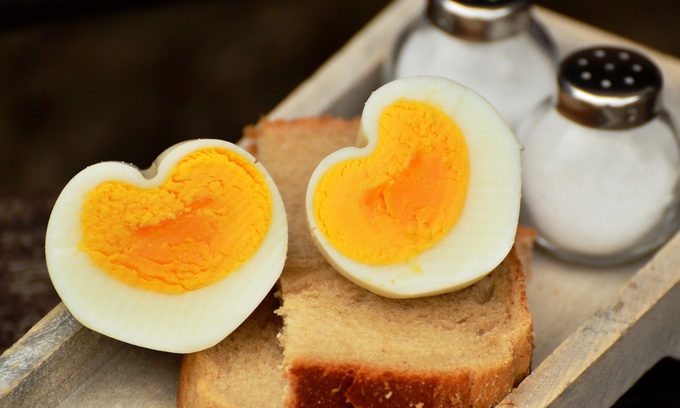
The secret lies in the fact that an egg’s two primary components cook at entirely different temperatures. Egg white consists mostly of ovalbumin protein, which starts setting at 62°C and hardens completely at 80°C. The yolk, meanwhile, begins thickening at 65°C and sets firm at 70°C.
Vu Nhat Thong, a chef at the Eric Vu Cooking Class Center, says since the heat must travel through the white before reaching the center, cooks must time the process so the white sets just as the yolk reaches the desired texture.
The unsightly greenish-gray ring around overcooked yolks is iron sulfide, created when sulfur in the white reacts with iron in the yolk under excessive heat.
Achieving the perfect doneness is easy once a few standard variables are controlled. Let medium chicken eggs weighing 55-60 grams rest at room temperature for 30 minutes. Then, gently lower them into simmering water, and start the timer immediately.
|
Level |
Time |
Egg texture |
Culinary Application |
|
1 |
5 minutes |
White is barely set and soft; yolk is fully liquid and glossy. |
Onsen-style egg, eaten with hot rice drizzled with soy sauce. |
|
2 |
6 mins 30 secs |
Outer rim of yolk is set; inner core is soft, moist, and deep orange. |
Ramen noodles, standard soft-boiled egg. |
|
3 |
8 minutes |
Yolk is fully set but still moist, bright yellow, fine texture. |
Sandwich filling, mixed with salads. |
|
4 |
9 mins 30 secs |
Yolk is fully set but still moist, bright yellow, fine texture. |
Soy-sauce marinated eggs, braised eggs. |
|
5 |
11 minutes |
Fully cooked, yolk is dry, green ring has not yet appeared. |
Making egg salad, mashed eggs. |
|
6 |
Over 13 minutes |
Yolk is dry and crumbly, greenish-gray ring appears, slight sulfur smell. |
Overcooked, should be avoided. |
To stop the cooking process immediately, transfer eggs into a bowl of ice water for at least five minutes right after pulling them from the heat. Skipping this step allows residual heat to continue cooking the core, turning a level 1 egg into a level 2.
Difficulty peeling eggs is usually a characteristic of egg age rather than flawed technique. Very fresh eggs have a lower pH level in the white, causing the membrane to cling tightly to the inner shell. Storing eggs in the refrigerator for five to seven days increases their pH, allowing the membrane to detach naturally for easy peeling.
For cleaner peeling, always lower eggs into boiling water rather than starting them in cold water. Once cooked, gently tap the wider end of the egg first, as cracking the shell right where the air pocket resides makes it much easier to slip off.
Adding salt or vinegar to the water speeds up how fast the white sets, which helps seal off leaks if a shell cracks, but it has no effect on how easily the shell peels away.
Avoid dropping cold eggs directly from the refrigerator into boiling water, as the rapid temperature shock can crack the shell and add up to a minute and a half to standard cooking times.
Overcrowding the pot also causes the water temperature to plunge, throwing off accurate timing. A good rule of thumb is to cook no more than four eggs per liter of water.