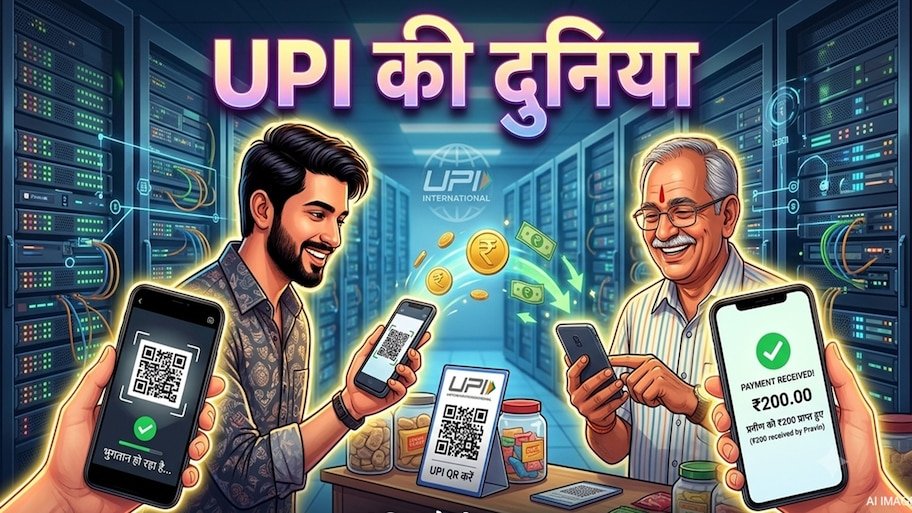
In everyday transactions, when you pay ₹100 through UPI (like Google Pay, PhonePe, Paytm, BHIM) directly linked to your bank account, you and the merchant both have to pay ₹0 (zero charges).
-
Common Users (P2P and P2M): Exactly ₹100 is deducted from the customer’s account and the entire ₹100 is credited to the shopkeeper’s account.
-
Zero MDR Policy: No merchant charges are levied on bank-to-bank normal UPI transactions under the ‘Zero Merchant Discount Rate’ (Zero MDR) policy of the Government of India and National Payments Corporation of India (NPCI).
-
Exception for Wallet/PPI Interchange: If the payment is made through a prepaid wallet (like Paytm Wallet) for more than ₹2,000, an interchange fee is applicable at the merchant, but for a normal bank-to-bank payment of ₹100, it is completely free.
What is hidden in QR code that money goes directly from phone to bank account?
QR Code (Quick Response Code) looks like a simple matrix of black-and-white dots and square boxes, but technically it is a Encoded Deep Link (URI) It happens.
When you scan the merchant’s UPI QR code with the camera, the phone’s scanner decodes the hidden text string, which is something like this:
upi://pay?pa=merchant@bank&pn=MerchantName&mc=5411&tr=12345&cu=INR
Mainly four pieces of information are hidden in this code:
-
pa (Payee Address): Unique Virtual Payment Address (VPA/UPI ID) of the merchant.
-
pn (Payee Name): Registered name of the account holder or shop.
-
mc (Merchant Category Code): Type of business (grocery, petrol pump etc.).
-
cu & am (Currency & Amount): Fixed amount depending on currency (INR) and dynamic QR code.
How the transaction is completed in 2 to 3 seconds: Working of the backend
-
Scan and Input: The app reads the QR code and sends a signal to NPCI’s server.
-
UPI PIN and Authentication: As soon as you enter your 4 or 6 digit secret UPI PIN, the data gets encrypted and reaches your bank’s servers directly.
-
NPCI Switching: NPCI’s central switch creates a real-time link between your bank (Remitter Bank) and the shopkeeper’s bank (Beneficiary Bank).
-
IMPS based settlement: ₹100 is debited from your account and credited to the merchant’s account instantly.
From vegetable stall to mall: How India became a ‘silent hero’
The success story of UPI is not just a technology but also a story of change in the lives of common people:
-
Freedom from the hassle of POS machines and cards: Small shopkeepers did not need to purchase expensive swipe machines or pay monthly rent; Just a QR code printed on a paper became a bank counter.
-
End of change problem: The issue of coins or change on purchases of ₹5, ₹10 or ₹100 was completely eliminated.
-
Soundbox Revolution: As soon as the payment was made, the trust of small traders in digital payment increased manifold due to the sound being heard in native languages.
-
Global Identity: India’s UPI is today accessible to Indian travelers in many countries like France, UAE, Singapore and Sri Lanka.