
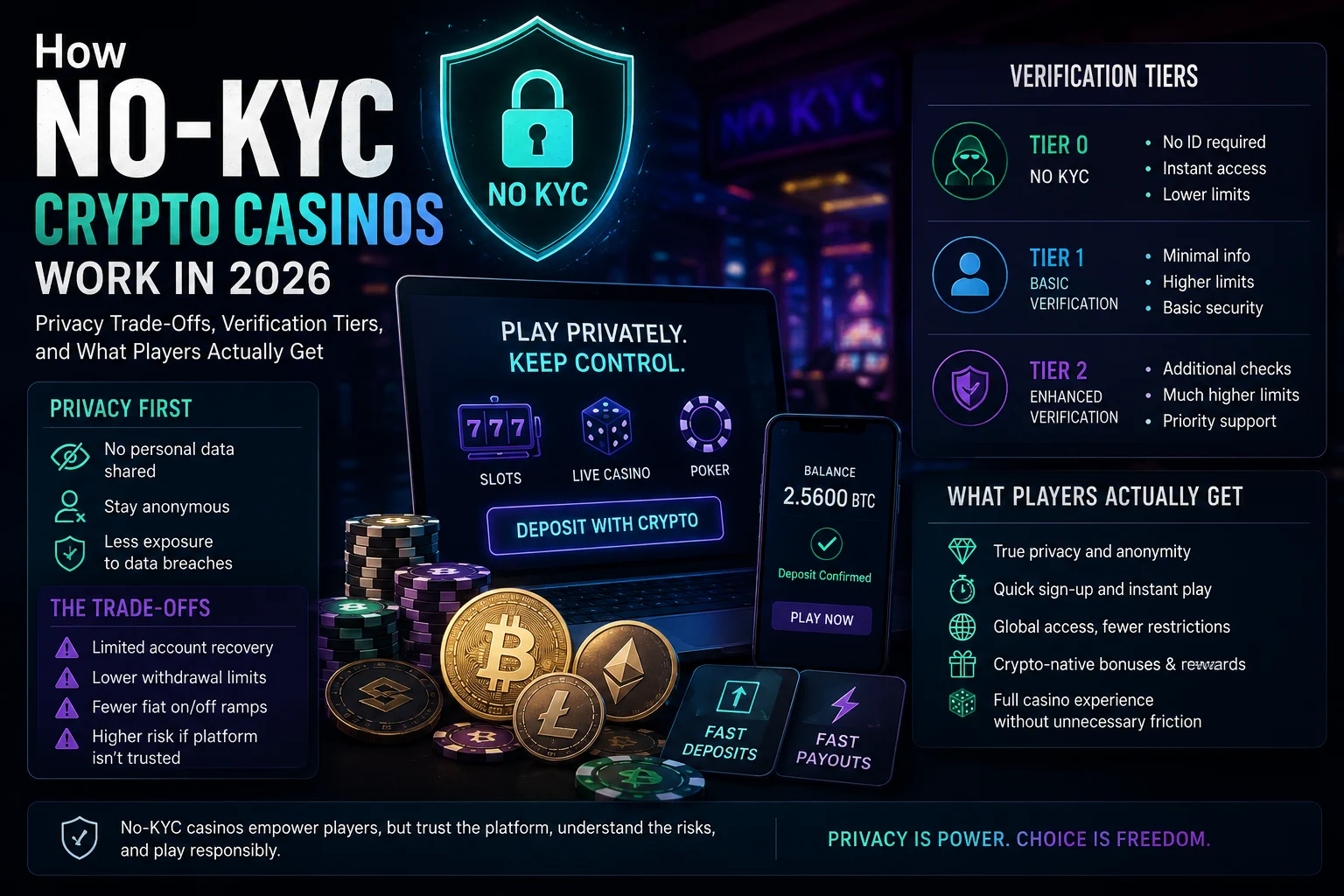
How No-KYC Crypto Casinos Work in 2026: Privacy Trade-Offs, Verification Tiers, and What Players Actually Get

The term “no-KYC crypto casino” gets used loosely across crypto and gambling coverage, and the loose usage hides more than it explains. Some platforms calling themselves no-KYC require ID verification before any withdrawal exceeds a threshold. Others require nothing until law enforcement asks. A handful actually run end-to-end without ever requesting identity documents, though that subset is smaller in 2026 than it was even two years ago.
For players, the practical question is not the marketing label – it is the actual verification trigger. When does the operator switch from anonymous to identified? What happens to funds if a player refuses verification at that moment? And what are the realistic privacy guarantees of a platform that processes deposits and withdrawals on a public blockchain?
This piece breaks down how the no-KYC segment actually works in 2026, the verification tiers operators use, and the trade-offs players accept when they choose a platform from this category. Resources like no KYC crypto casinos maintain reviewed lists of operators in this segment, and understanding the underlying mechanics matters more than picking a name from any single list.
The goal here is not advocacy or warning. It is a clear, working description of what the segment actually is – and what it is not.
The Three Real Verification Tiers
Despite the marketing, there are really three distinct verification models in the crypto casino space in 2026, not two. Most coverage frames it as “KYC vs no-KYC,” which misses the middle category that most of the active market actually occupies.
Tier 1: Full KYC at registration. The traditional model. Government ID, proof of address, sometimes selfie verification, before the first deposit. Used by EU-licensed operators, US-licensed operators, and most platforms that hold gambling licenses in regulated jurisdictions. Players accepting this tier get full legal protection from the licensing authority in exchange for full identity disclosure.
Tier 2: KYC at withdrawal threshold. The middle category. Players can deposit and play without ID verification, but verification triggers when a withdrawal request crosses a specific threshold – usually 1 BTC, 2,000 USDT, or local-currency equivalent. This is the model used by most platforms self-identifying as “no-KYC” in 2026, and it accounts for the majority of the segment’s volume.
Tier 3: No KYC across all flows. The narrowest category. Operators that genuinely run without verification at any tier. This typically requires operating from jurisdictions with minimal licensing requirements, restricting player geos, and maintaining smaller per-player limits. The Tier 3 operators are real but they are not as common as the marketing in 2024 suggested.
Most “no-KYC” lists conflate Tier 2 and Tier 3. From a player perspective, the distinction matters: Tier 2 means you can play anonymously up to a limit; Tier 3 means truly anonymous play including withdrawals.
The Privacy Reality of Public Blockchains
The single largest misunderstanding in the no-KYC space is what crypto deposits and withdrawals actually do for player privacy.
Bitcoin, Ethereum, and most other major chains are public ledgers. Every transaction is recorded permanently and is queryable by anyone. The casino does not need your real name to know which wallet address sent the deposit. Chain analysis firms – Chainalysis, Elliptic, TRM Labs – sell tools that can frequently link wallet addresses to identifiable entities through exchange interactions, address clustering, and other heuristics.
The practical implication for a no-KYC player is this: not requesting ID at the casino level does not equal privacy. It means the casino did not collect your ID. It does not mean the transaction trail is anonymous. A player who deposits from a centralized exchange wallet has effectively given the casino access to a trail that leads back to a verified exchange identity.
The exceptions are players who use:
- Mixers or tumblers, which jurisdictionally vary in legality and are increasingly sanctioned.
- Privacy coins like Monero, which most major casinos do not accept due to liquidity and compliance issues.
- Layer-2 networks with built-in privacy features, which are still maturing technically.
- Stablecoins on emerging privacy-focused chains, which exist but are operationally complex for casual players.
For most players choosing no-KYC casinos, the realistic privacy gain over a KYC platform is moderate – not absolute. The marketing usually overstates it.
What Operators Actually Need from “No-KYC” Players
Even operators in Tier 2 or Tier 3 are not running without compliance entirely. Most maintain internal AML monitoring that flags patterns – unusual deposit sizes, rapid deposit-withdrawal cycles, betting patterns inconsistent with declared player behavior, and connections to sanctioned wallet addresses.
What changes in the no-KYC model is the response. A KYC-required casino freezes the account and requests documentation. A Tier 2 casino freezes the withdrawal and requests verification. A Tier 3 casino typically restricts the account, retains funds, and provides limited recourse to the player.
This is the practical risk no-KYC players accept. The trade-off is not just privacy for convenience. It is privacy for reduced recourse if something goes wrong on the operator side. Anonymous play means the player has limited identity to leverage if a dispute arises.
The well-run platforms in this segment compensate by publishing transparent house policies, maintaining public dispute records, and using third-party arbitration. The poorly run ones do not, and that gap is the single biggest quality signal players should screen on.
Where the Segment Is Going in 2026-2027
The no-KYC crypto casino segment is under more regulatory pressure than at any point in its history, and the pressure is not going away.
The EU’s MiCA regulation, which came into force in 2024 and tightened progressively through 2025, makes it operationally difficult for crypto casinos to maintain banking and exchange relationships without some form of player identification protocol. The US Treasury’s expanded sanctions framework around mixers and privacy services has cut off several previously common privacy tools for crypto gambling. The UK Gambling Commission’s 2025 review tightened licensing requirements in ways that effectively pushed no-KYC operators out of the regulated UK market.
What this means for 2026-2027 is consolidation. The Tier 3 operators that survive will be the ones that establish stable banking relationships in friendly jurisdictions and maintain rigorous internal AML practices, even without external KYC requirements. The Tier 2 operators will likely become the dominant model, offering a middle ground between full anonymity and full disclosure.
For players, the practical implication is that the menu of true no-KYC options is shrinking, even as the marketing language stays the same. The operators that genuinely deliver Tier 3 anonymous play in 2027 will be a smaller, more selective group than they were in 2024.
The Practical Checklist for Choosing a No-KYC Platform
For a player who has decided this segment fits their preferences, the screening criteria that actually matter in 2026 are:
- Verification tier disclosure. Does the operator publish their verification triggers in plain language, or hide them in terms of service? Transparent triggers are a quality signal.
- Jurisdiction and license. Even no-KYC operators have a jurisdiction. Curacao, Anjouan, Costa Rica, and a handful of others dominate the segment. The licensing quality varies significantly.
- Withdrawal speed at the no-verification tier. The number that matters is time from withdrawal request to wallet receipt for amounts below the verification threshold. Above 24 hours is a red flag.
- Dispute resolution path. Public arbitration partner, published dispute history, and a track record of paying out contested withdrawals. The absence of these signals operator-side risk that anonymity makes worse, not better.
- Game library and provider mix. Major game providers – Evolution, Pragmatic Play, NetEnt – have their own compliance standards that effectively pull operators away from Tier 3 over time. A diverse provider mix suggests an operator that meets multiple compliance bars rather than one that maintains anonymity by excluding compliance entirely.
The no-KYC crypto casino segment in 2026 is real, operational, and serving a meaningful slice of crypto-native players. It is also more nuanced than the marketing suggests, more pressured by regulation than it was two years ago, and more dependent on individual operator quality than the segment label suggests.
Players who understand the verification tier they are actually getting, the privacy boundaries the public blockchain imposes, and the dispute recourse trade-offs they are accepting will navigate the segment in 2026 with realistic expectations. Players who treat the “no-KYC” label as a guarantee of either anonymity or trust will be disappointed by both.

Comments are closed.