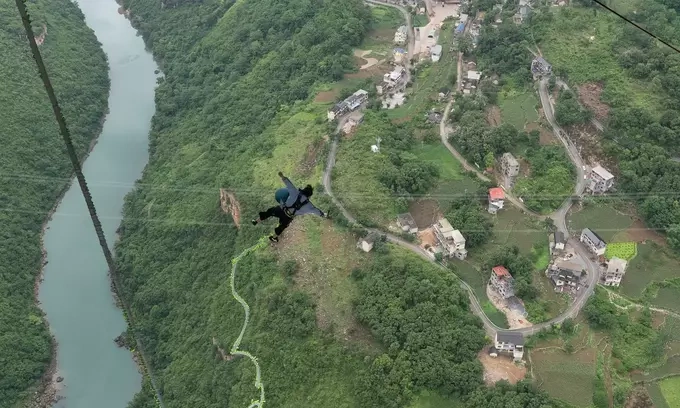
Onlookers held up their phones, eager to capture the moment, and safety personnel ran a final check on his harness.
Standing on a platform suspended beneath a bridge deck that looms nearly nine times higher above the water than San Francisco’s Golden Gate Bridge, he took a step forward and plunged into midair.
For seven seconds, he was in free fall toward the gorge hundreds of meters below before the cord snapped him back up to the cheers of the crowd.
|
A tourist performs a bungee jump from the Huajiang Canyon Bridge on May 29, 2026. Photo by AP |
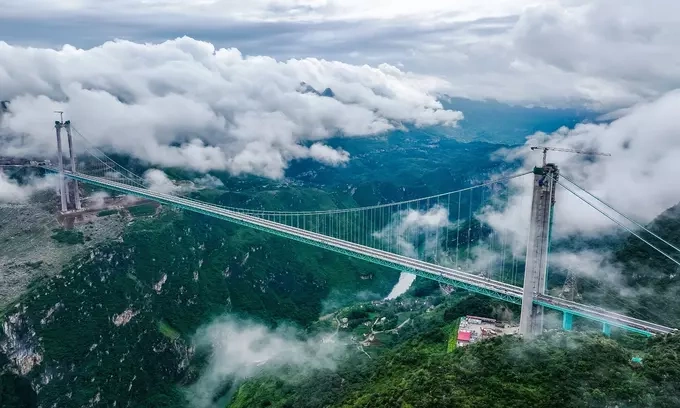
The Huajiang Grand Canyon Bridge over the Beipan River in Guizhou Province opened in September 2025.
At 626 meters above the riverbed, equivalent to a 200-story skyscraper, and stretching nearly 2.9 kilometers, it was recognized by Guinness World Records as the world’s highest bridge.
The megastructure was built to cut travel time across the canyon from two hours down to just two minutes, connecting remote mountain communities with China’s broader highway network.
It is a popular destination, with local authorities estimating there has been around 3.3 million visitors by August 2026.
During the nine-day Lunar New Year holidays in February, the service area got 300,000 visitors.
Tourists can take an elevator up the bridge tower, admire views from the glass observation deck, or walk along a wooden walkway suspended in midair.
In the villages nestled below, the impact extends far beyond shorter travel times.
Since it opened to traffic, Huajiang Township and surrounding areas have received more than 1.48 million visits, news agency Xinhua reported.
This surge in tourism has spurred the growth of food and beverage businesses, hotels, and guesthouses, and indirectly created over 2,000 jobs.
Among those seizing the new opportunity is Lin Guoquan, a Guizhou native who returned home after working for years as a chef in other provinces to convert his house into a lodging facility.
Even after expanding from nine to 52 rooms, his homestay struggles to keep up with demand, he told CNN.
Lin has also built a social media following of over 100,000 people by livestreaming his village with the bridge looming overhead.
 |
|
An aerial view of the Huajiang Canyon Bridge. Photo by VCG |
Cao Luyao, PR and marketing manager at the Onaemont Hotel, where all 83 rooms overlook the structure, says travelers are no longer just passing through but staying overnight, changing local tourism from quick day trips into immersive stays.
But as China continues to build mega infrastructure, the long-term economics of these projects have come under scrutiny.
Li Linna, an associate professor at Beijing Normal University, studied 295 high bridges in Guizhou and found that their contribution to county-level transport connectivity averaged around 8% between 2010 and 2015, but fell to 5% between 2015 and 2020 as the highway network expanded.
“The marginal gains in accessibility brought by each additional bridge therefore decline,” she told CNN.
Still, that does not make these projects obsolete.
In remote, mountainous regions, a new bridge can significantly boost regional access.
More importantly, the metrics for evaluating a bridge’s value are evolving.
Beyond reducing transit times and freight costs, landmarks like the Huajiang Canyon Bridge give travelers a compelling reason to visit remote destinations.
“The crucial question for the future is where we build these high bridges and what specific problems each bridge will solve,” Li added.
For Xie Boran, director of the Huajiang Project Office under the Guizhou Transport Investment Industry Group, the bridge’s opening year brought unexpected highlights, from couples posing for wedding photos against the backdrop to travelers testing their courage on the bungee platform.
Centuries ago, merchants needed a month to traverse this perilous terrain.
Today, visitors travel hundreds of kilometers to Huajiang not merely to cross the canyon, but to stay, sightsee, and marvel at a structure suspended amid the mountain forests.