
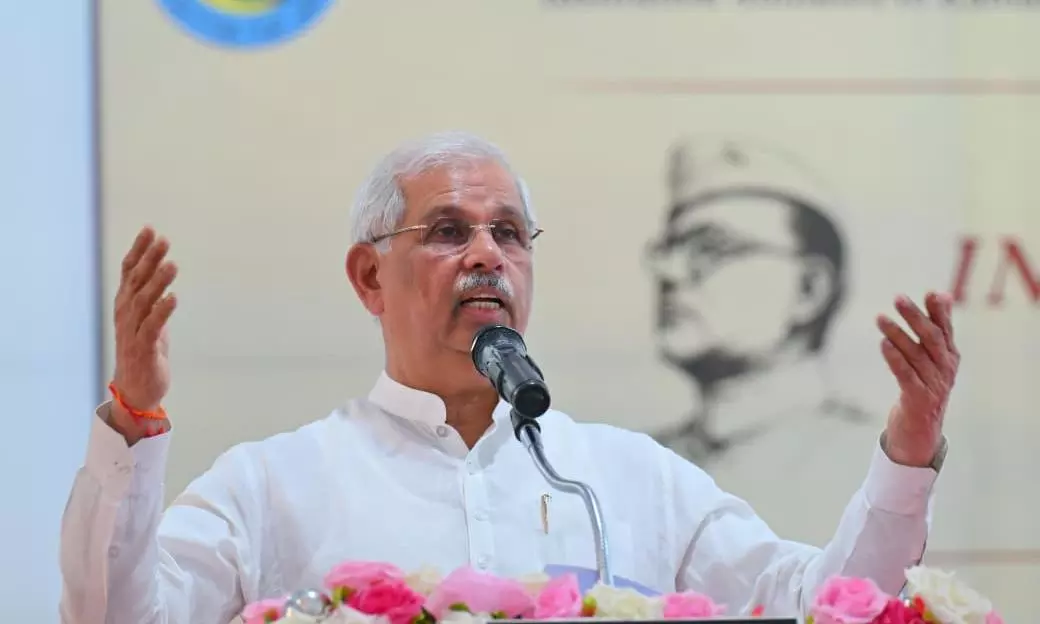

Tamil Nadu’s Governor-in-charge Rajendra Vishwanath Arlekar has triggered a political storm with his visit to Madurai, where he held a detailed review meeting with senior district officials. His comment that Lok Bhavan will have to “step in” if river Vaigai is not restored has once again fueled a state-Centre clash, raising questions on constitutional overreach, parallel administration, and erosion of state autonomy.
Concerns over Vaigai
On Thursday (July 2), Arlekar, who holds additional charge of Tamil Nadu while primarily serving as Kerala’s Governor, participated in an event at Saurashtra College in Thiruparankundram, Madurai, held to celebrate the 80th anniversary of Netaji Subhas Chandra Bose’s Indian National Army (INA). While addressing students, he remarked on the condition of the river Vaigai.
Also read: TN Assembly begins with state anthem, ends Governor protocol row
“I saw the Vaigai. There is a river, but where is the water? We must take responsibility. Patriotism is not only about taking up guns and going to war; restoring our rivers is also an act of patriotism. Madurai’s youth should turn this into a goal and come forward to reclaim the Vaigai. If no one restores the Vaigai, the Governor’s office itself will step into the field,” he said.
Review meeting
Later that afternoon, at Circuit House on Alagar Koil Road, the Governor held a nearly one-hour review meeting with Madurai District Collector Nishanth Krishna, City Police Commissioner S Rajendran, the Municipal Commissioner, and other senior officials. Topics discussed at the meeting reportedly included the implementation of welfare schemes and development projects, law and order, women and children’s safety, anti-narcotics drives and protection and maintenance of water bodies (including Vaigai) and other schemes.
Also read: Hung Assembly in Tamil Nadu: what the Governor can and cannot do
The Madurai district administration later clarified that officials met the Governor “as a mark of respect” upon his arrival at the Circuit House. However, reports and the Governor’s own public comments confirm a review took place. The visit came just a day after Arlekar met Union Home Minister Amit Shah in Delhi on July 1.
DMK slams Governor, Vijay govt
The developments drew immediate and strong condemnation from several leaders, who framed it as a classic Centre vs state clash with the Governor accused of bypassing the elected state government and directly engaging with the bureaucracy. Leader of Opposition Udhayanidhi Stalin issued a detailed statement accusing the Governor of acting like an elected representative despite holding only an appointed, additional-charge position.
“The practice of the Governor conducting ‘reviews’ in Madurai, reminiscent of the colonial-era Kootathoor administration (AIADMK rule), is resurfacing under the current horse-trading government. The Governor has forgotten that he is in a nominated post, that too with additional charge as Tamil Nadu Governor, and has conducted a review like a people’s representative. Strong condemnation to the Governor for this act against the Constitution and state rights, and to the Tamil Nadu government that allowed it.”
Read/watch: ‘It is clear that all Governors are acting in concert’ | Capital Beat
Udhayanidhi added, “While the maintenance of the Governor’s palace is the responsibility of the Tamil Nadu government, he arrogantly declared that if the government does not restore the Vaigai, the Governor’s House will intervene. The ruling party’s helplessness is the reason for this audacity. We had raised questions in the Assembly about compromises that reduced the importance of Tamil Thai Vazhthu in events attended by the Governor. The ruling party, which failed to give proper answers then, has today clearly compromised state rights by permitting this review.”
‘Why no mention of Cauvery, Mekedatu?’
MDMK leader, Vaiko, called the Governor’s actions “an overreach,” accusing him of running a parallel administration. He warned that continued violations of constitutional limits would force protests.
Vanni Arasu, VCK leader and state Social Justice Minister, questioned the Governor’s additional-charge status and lack of focus on core Tamil Nadu issues like the Cauvery dispute and Karnataka’s proposed Mekedatu dam. He noted that the Governor met Amit Shah recently and asked whether he raised Tamil Nadu’s concerns or received instructions to act against constitutional principles. He accused the Governor of insulting the elected government and democracy by directly calling officials for review meetings instead of offering constructive advice to the chief minister.
Also read: TN panel report slams governor office ‘misuse’, recommends fixed 5-year tenure
Su Venkatesan, CPI(M) MP from Madurai, highlighted the selective nature of the intervention: “Last week, when the Governor went to address the Assembly, he crossed the Cooum in Chennai. Was the river water crystal clear there? Was there no need for the Governor’s House to intervene? The intent behind saying the Governor’s House will directly intervene is not to solve the problem but to create a parallel administration. Tamil Nadu has a history of defeating Governors’ political motives. If there is any doubt, ask RN Ravi.”
Past precedents
This controversy is not new. In 2017, during the AIADMK government, then governor Banwarilal Purohit conducted similar district-level review meetings in Coimbatore, Salem, and elsewhere. The then Opposition DMK staged widespread black flag protests, accusing him of encroaching on the executive domain of the elected state government and violating federal principles.
Also read: Can states scrap governor’s address? PDT Achary explains
DMK argued that only the elected state Cabinet and ministers have the authority to review district administration. Ironically, during former Governor RN Ravi’s tenure, when he sought information on government schemes, the DMK had described it as “nothing wrong”.
Where should Governors draw the line?
Under Article 163 of the Constitution, the Governor is bound by the ‘aid and advice’ of the Council of Ministers (state Cabinet) except in matters where he has discretionary powers (such as government formation or reservation of bills). Direct review meetings with district officials, public warnings of intervention in state subjects like river restoration and local administration, and bypassing the elected executive are widely viewed by regional parties as undermining state autonomy and the federal structure.
Also read: Governor as catalyst, not inhibitor: When SC showed Raj Bhavan its place
In an interaction with The FederalTVK Minister CTR Nirmal Kumar categorically asserted that the Governor has no constitutional authority to conduct administrative reviews or inspect government schemes. “Only the members of the government elected by the people have the right to review schemes and programs,” the minister said, underscoring that the Governor’s role remains largely ceremonial and bound by the aid and advice of the elected Council of Ministers.
He warned that continuing such review meetings would invite severe condemnation from the state government.
Won’t allow such interference: TVK minister
The minister also made it clear that the current dispensation would never permit the Governor to interfere in state administration or assume review powers without any mandate.
Read/watch: What’s behind Centre’s Governor rejigs? | Capital Beat
“The Governor has no right whatsoever to come and review any scheme anywhere. This government will not allow it at any time. If the Governor unnecessarily intervenes in this government’s administration or its review processes anywhere, it will be met with the strongest condemnation,” he declared, reinforcing the state’s firm stance against perceived overreach and defending the principles of federalism and elected governance. As of now, the Governor’s office has not issued an official, detailed response clarifying the exact nature and mandate of the review meeting.

Comments are closed.