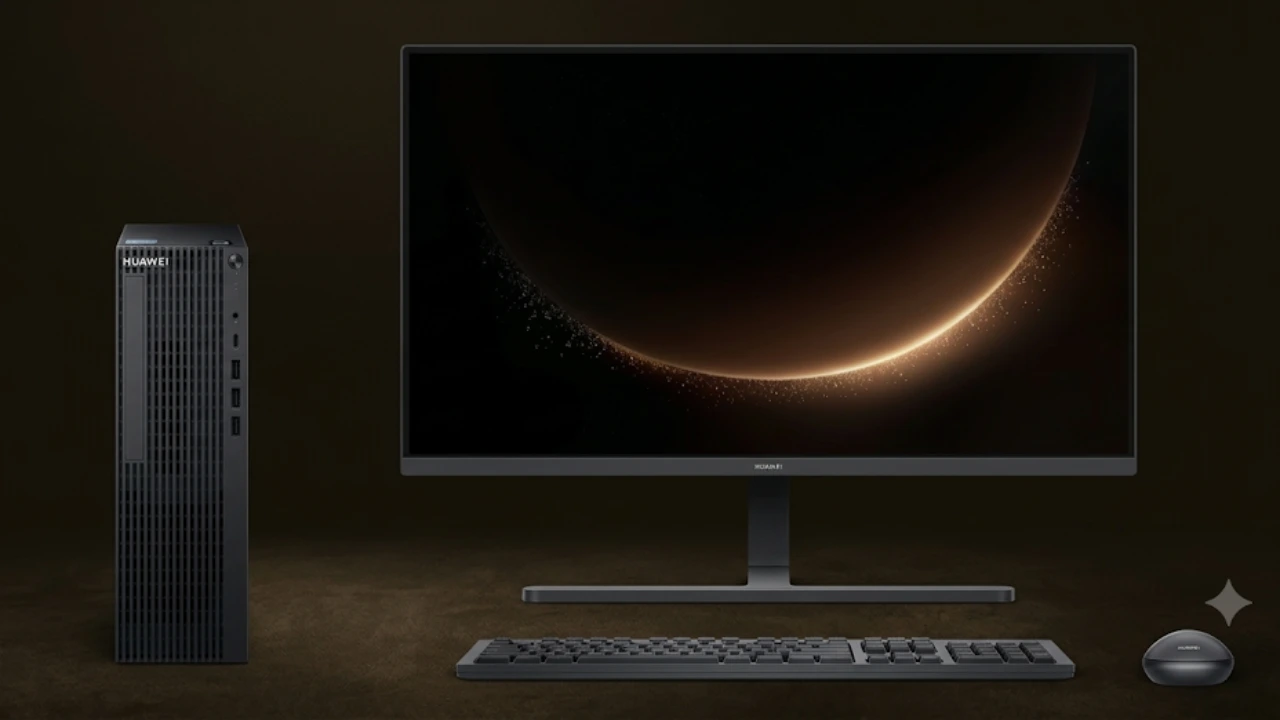
Huawei has officially introduced its first HarmonyOS-powered desktop computer series, the Qingyun HM650, marking a new step in its enterprise computing strategy. Announced on November 5, 2026, at the HarmonyOS Office Industry Summit in Wuhan, China, the lineup includes the HM650 and HM650g. Both models use Huawei’s Kirin X90 processor family and run HarmonyOS V1.0 Enterprise Edition.
The series is designed for commercial use. The HM650 primarily targets enterprise customers, while the HM650g is positioned for government organizations. Huawei is focusing on security, device management, AI-assisted office work, and integration with its wider HarmonyOS ecosystem.
The announcement is significant because it moves Huawei’s desktop strategy from earlier plans to officially documented products. However, the bigger question is whether HarmonyOS can support the applications and workflows that businesses currently run on Windows.
What’s Inside?
The Qingyun HM650 family is built around Huawei’s Kirin X90 desktop processor. The lineup includes eight-core and 10-core configurations, with the 10-core version supporting 20 threads. It also features LPDDR5 memory and SSD storage, with additional mechanical hard-drive support on selected configurations.
| Huawei Qingyun HM650 series | |
| Models | HM650 and HM650g |
| Dimensions | 293 × 93 × 315.5mm |
| Processor | Huawei Kirin X90 |
| Operating system | HarmonyOS V1.0 Enterprise Edition |
| CPU configurations | 10-core and 8-core |
| Memory | LPDDR5 |
| Storage | SSD; HDD support on selected configurations |
| DVD-RW drive | Optional |
| Starting Weight | Approximately 3.6kg |
| Display outputs | HDMI and DisplayPort |
| Power Output | 180W |
| USB | Three front USB-A, Four rear USB-A and One front USB-C ports |
| Networking | Gigabit Ethernet; Wi-Fi on selected configurations |
| Target customers | Government and enterprise organisations |
The computers include a dual-sided cooling design intended to manage heat and operating noise. Huawei also advertises performance improvements for application launches, large-file opening and archive extraction. These results come from Huawei’s own laboratory testing and should not be treated as independently verified benchmarks.
Huawei further claims that the HM650 series has received certification for 100% domestically produced components. This refers to the sourcing of hardware components; it does not establish that all software, technologies, or intellectual property used in the computers are domestically developed.
HarmonyOS Enterprise Edition Is the Main Difference
One important detail is the operating system version. Huawei’s official product specifications identify the software as HarmonyOS V1.0 Enterprise Edition. It should not be confused with HarmonyOS 7.0, as some secondary reports have described the platform.
The enterprise edition is designed to address requirements beyond the usual desktop experience. These include centralized device management, identity controls, application permissions and secure handling of business information.
One notable feature is Enterprise Digital Dual Space. It allows a computer to maintain separate environments for internal business operations and other activities. Administrators can apply different access, application, and network permissions to these spaces. Huawei also describes a zero-touch deployment system for distributing configurations and security policies across company computers.
AI Features Bring Xiaoyi Into Everyday Office Work
Huawei is placing considerable emphasis on system-level AI. The HM650 series includes Xiaoyi, the company’s intelligent assistant, with tools for common workplace tasks.
Xiaoyi Work can assist with information gathering and document-related tasks. Xiaoyi HuiJi focuses on meeting transcription and summarisation, while Xiaoyi Deep Research is designed to support more involved research activities.

The desktops also support cross-device collaboration, including file sharing, multi-screen interaction, and application continuity. However, this integration is not universal across smartphones. Huawei specifies that users need a compatible HarmonyOS 5 or later smartphone, the same Huawei account on both devices, and a desktop configured with Wi-Fi and Bluetooth.
Can the Huawei HM650 Replace a Windows Desktop?
This is the most important question for businesses considering the new computers. Huawei’s announcement establishes the HM650 as a dedicated HarmonyOS desktop, but it does not establish that every Windows application can run natively on it.
Huawei’s HarmonyOS PC ecosystem reportedly includes more than 21,000 independent applications. This is an ecosystem-wide figure, not a count of applications individually verified on the HM650 series. The platform includes office and professional software, with Xinhua’s summit coverage identifying applications such as ZWSOFT CAD, GstarCAD, and ZW3D.
These examples demonstrate progress in adapting professional software for HarmonyOS. However, an adapted HarmonyOS application is not the same as native compatibility with its Windows counterpart.
Businesses relying on legacy Windows-only accounting tools, specialized enterprise applications, or custom internal software will need to investigate alternatives. Depending on the application, virtualization solutions may also be worth evaluating, but compatibility and performance must be tested.
Huawei HM650 Price and Availability
The initial November 5 announcement positioned the HM650 series as commercial hardware for enterprise and government customers. IT Home reported that buyers were initially directed towards authorized sales representatives.
A subsequent IT Home report on November 6 identified listings on JD.com and reported a December 1 sales date. This is an important development, but an online listing and an announced sales date do not, by themselves, establish confirmed delivery, broad consumer availability or unrestricted retail distribution.
Reported starting prices are:
| Reported price | |
| HM650g, 8-core, 16GB RAM, 512GB SSD | 6,899 yuan |
| 256GB SSD, 1TB HDD | 7,099 yuan |
| HM650, 10-core, 16GB RAM, 512GB SSD | 7,199 yuan |
| HM650, 10-core, 16GB RAM, 512GB SSD, Wi-Fi | 7,399 yuan |
| 512GB SSD, 1TB HDD | 7,699 yuan |
| 24GB RAM, 512GB SSD, 2TB HDD, Wi-Fi | 10,499 yuan |
All prices are reported figures for the Chinese market, not confirmed international prices. Huawei has not announced Indian or wider global availability.
Frequently Asked Questions
1. What is the Huawei Qingyun HM650?
The Qingyun HM650 is part of Huawei’s first HarmonyOS desktop series. The HM650 targets enterprise customers, while the HM650g is positioned for government organizations.
2. Which processor powers the HM650?
The series uses Huawei’s Kirin X90 processor, with eight-core and 10-core configurations. The 10-core version supports 20 threads.

3. Which operating system does the HM650 run?
Huawei’s official specifications identify the operating system as HarmonyOS V1.0 Enterprise Edition, not HarmonyOS 7.0.
4. Can the HM650 run Windows applications?
Universal native Windows application compatibility has not been confirmed. Businesses should check for adapted HarmonyOS applications, compatible alternatives or suitable virtualisation solutions before migrating.
5. How much does the Huawei HM650 cost?
November 6 reports list China-market prices starting at 6,899 yuan. Sales are reported to begin on December 1, 2026. International pricing and availability remain unconfirmed.
The Bottom Line
Huawei’s Qingyun HM650 series takes HarmonyOS into desktop computing with the Kirin X90 processor, enterprise-focused software, AI assistance, and security controls. Its growing application ecosystem includes professional tools adapted for HarmonyOS, but that does not automatically make it a replacement for Windows in every business environment.
The reported JD.com listings also represent a development in its sales rollout, not proof of unrestricted consumer availability. For businesses, the real test will be application compatibility, device management, and reliable support for existing workflows.
The HM650 is an important product milestone, but its enterprise adoption will depend on how well the complete software ecosystem performs beyond the hardware specifications.
(Source)