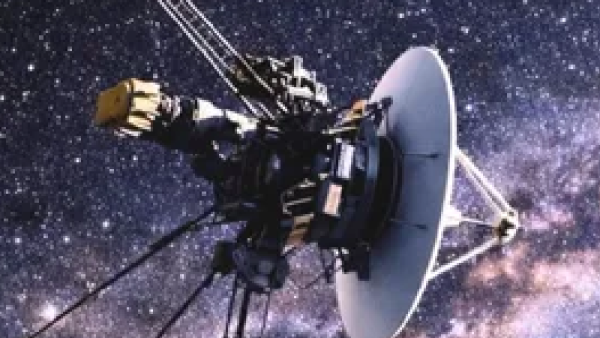
New Delhi. In the infinite depths of space, a man-made machine has created such a history that it is being counted among the great achievements of science. The American space agency NASA's spacecraft Voyager-1 has reached about 26 billion kilometers away from the Earth. It is the first man-made object that has traveled a distance of one light day from the Earth. This means that even light or radio signals sent from Earth take about 24 hours to reach this spacecraft. This vehicle, which has been traveling in space for almost five decades, is still giving scientists information about those secrets of the universe which humans themselves have not been able to reach. A special thing about this historic mission is that with it the voice of India is also on an infinite journey into space.
Voyager-1 was launched into space by NASA on 5 September 1977. Its twin spacecraft Voyager-2 was earlier launched on 20 August 1977. The initial objective of both these vehicles was to study the outer planets of the solar system, but with time their mission reached interstellar space. Voyager-1 gathered many important information about Jupiter and Saturn. It contributed to the discovery of a thin ring around Jupiter and its two new moons, Thebe and Metis. At the same time, information about five new moons and rings called G-ring near Saturn was also revealed.
One of the biggest achievements of Voyager-1 is crossing the heliosphere. The heliosphere is a vast region formed by the solar wind and its magnetic effects from the Sun. Outside this begins interstellar space where the influence of other stars and cosmic particles becomes important. Voyager-1 became the first spacecraft to cross this limit. The data obtained from its instruments is helping scientists to understand how far the Sun's influence extends and what the environment of space is like outside it.
The most interesting thing related to this mission is the Golden Record. Both Voyager-1 and Voyager-2 were accompanied by a gold-plated copper disk. In this, natural sounds of earth, music, greetings in different languages and pictures and information related to human life have been recorded. Its purpose is to introduce any possible alien civilization to Earth and the identity of humans. The record also includes a rendition of Raag Bhairavi by India's famous classical singer Kesarbai Kerkar. Apart from this, greeting messages are recorded in 10 Indian languages. In this way, India's cultural heritage has also become a part of this unique space message of humanity.
The biggest question now facing scientists is how far the Sun's influence actually extends. Scientists associated with NASA's Voyager project believe that the spacecraft's instruments are recording the effects of solar storms and coronal mass ejections even from such a distance. These data can help understand the true extent of the Sun and the nature of the space that exists between the stars. Voyager-1 has also shown that space is not completely empty and quiet. Phenomena such as plasma and shock waves generated by solar explosions are present here.
However, now the challenge of energy has arisen before this historic mission. Both vehicles receive power from nuclear power based systems but their energy production capacity is decreasing over time. To save electricity, NASA has switched off many of their equipment. Voyager-1's cameras are also not working now. Scientists hope that despite limited energy, these vehicles can maintain contact with Earth for the next three to four years.
The journey of Voyager-1 not only provided new information to space science but also provided experience in conducting missions lasting decades. Scientists have learned techniques to make changes to the spacecraft's software remotely and keep the equipment operational in difficult conditions. On the other hand, other spacecraft like Voyager-2, Pioneer-10 and Pioneer-11 have also visited or are traveling to the outer regions of the solar system. New Horizons is also studying the Kuiper Belt, located beyond Neptune's orbit. This achievement of Voyager-1 reminds man that even a small machine from Earth can search for answers to new questions for decades in the vastness of the universe.