
Hyundai’s upcoming entry-level electric SUV has now been spotted at a public fast-charging station in Vijayawada, another sign that the HE1i programme is moving closer to launch. The test team reportedly asked whether a 120kW charger was available. That does not prove the production car will accept 120kW, but it does show Hyundai is validating fast-charging behaviour outside its own test facilities.
The timing matters because Hyundai has already said this locally built compact EV will make its debut by the end of 2026. It will sit below the Creta Electric and is expected to be the company’s cheapest electric car here, with market positioning aimed at the Tata Punch EV, Nexon EV, Mahindra XUV 3XO EV and Kia Syros EV.
Image source: Rushlane
The HE1i is based on Hyundai’s E-GMP (K) architecture, the same affordable electric platform used by the Inster sold overseas. The international Inster can use a 120kW DC charger and complete a 10-80 percent charge in about 30 minutes. That makes the Vijayawada sighting interesting, but Hyundai has not yet published the India-spec car’s charging peak, so the production figure could still differ.

Image source: Rushlane
Hyundai has confirmed standard-range and long-range versions for the new model. Battery capacities have not been announced. The related Inster uses 42kWh and 49kWh packs, with WLTP ranges of up to 327km and 370km in its latest form. Those figures provide a useful reference, not a specification sheet for the HE1i.
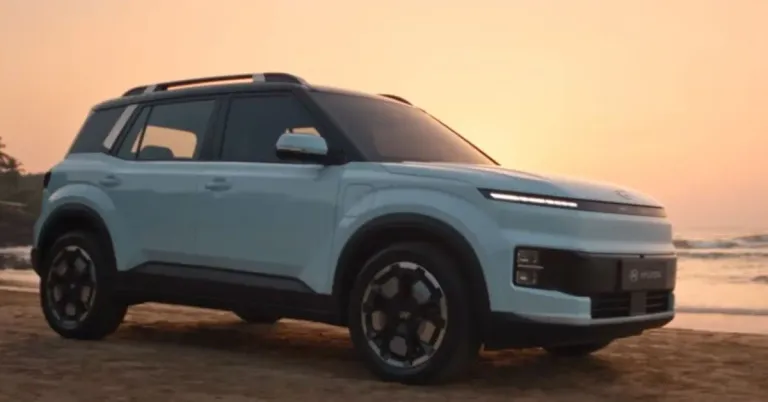
The new EV will be manufactured at Hyundai’s Sriperumbudur plant in Tamil Nadu and has been developed for local use rather than simply imported from the Inster programme. Hyundai has confirmed a next-generation infotainment system and Level 2 driver-assistance technology. The car is also expected to be larger and more SUV-like than the overseas Inster, helping it compete with the Nexon EV and Syros EV rather than only the smaller Punch EV.
Battery localisation is part of the plan as well. Hyundai originally intended to source locally made cells from Exide, but delays to Exide’s production schedule mean the first cars are expected to use Svolt cells. Local cell sourcing can follow once domestic supply is ready. That matters because battery cost is the single biggest lever Hyundai has if it wants this car to reach the volume end of the EV market.

The current Creta Electric starts at around Rs 19.1 lakh, leaving plenty of room below it. Market estimates place the new compact EV around Rs 10-14 lakh, although Hyundai has not announced prices. The Punch EV currently starts just above Rs 10 lakh, while the Nexon EV, XUV 3XO EV and Syros EV sit higher, depending on battery and trim.
Separate HE1i prototypes have also been seen with different headlamp layouts. That may point to variant differences, although camouflage makes a firm conclusion difficult. What is clearer is that Hyundai is now testing charging, software, ADAS and local production together rather than just running early road prototypes.