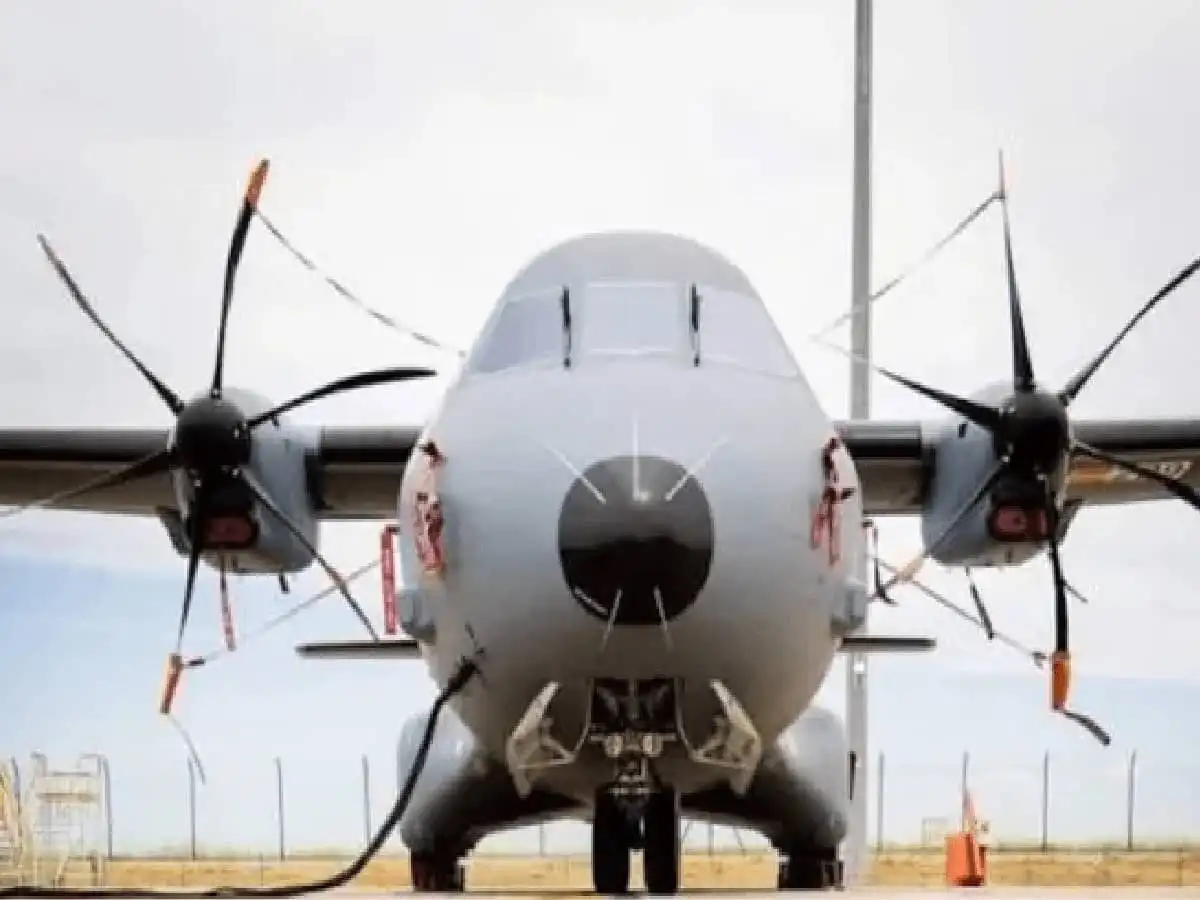
India’s aerospace and defence manufacturing sector stands on the brink of a historic breakthrough as the Indian Air Force (IAF) prepares to induct its first indigenously manufactured C295 medium tactical transport aircraft by December 31, 2026—marking the very first military aircraft built in India by a private-sector industrial consortium. Jointly executed by Tata Advanced Systems Limited (TASL) and European aerospace giant Airbus at their dedicated Final Assembly Line (FAL) in Vadodara, Gujarat (inaugurated in October 2024), the aircraft is currently undergoing final flight trials and airworthiness certification ahead of year-end handover. Once formally delivered, the aircraft will join one of the IAF’s two operational C295 squadrons stationed at Agra in Uttar Pradesh and Vadodara in Gujarat, replacing the service’s ageing, 1960s-vintage HS-748 Avro transport fleet. Originally slated for rollout at the end of September 2026 before minor technical checks shifted the schedule to December 31, this flagship delivery anchors the ₹21,935-crore contract signed by the Ministry of Defence in September 2021 for 56 C295 aircraft. Under that agreement, Airbus has already delivered all 16 flyaway aircraft from Seville, Spain, while 40 aircraft are being manufactured and assembled domestically in India, with the remaining 39 India-built planes scheduled for delivery by August 2031. For defence watchers, engineering students, and citizens across northern India—including communities in Lucknow and neighboring Uttar Pradesh cities such as Unnao, Kanpur, Prayagraj, Varanasi, and Agra (home to one of the IAF’s premier C295 transport bases and a major node of the Uttar Pradesh Defence Industrial Corridor)—the arrival of the first Made-in-India C295 underscores how private industry is reshaping India’s frontline airlift capabilities.
Self-reliance (Atmanirbharta) in aerospace manufacturing is a cornerstone priority for Air Chief Marshal Ashutosh Dixit, who assumed office as the 29th Chief of the Air Staff on October 31, 2026, and unveiled his four-pillar ‘VAYU’ strategic vision—focused on operational readiness, technological innovation, indigenous capability, and tri-service unity of effort.
With domestic deliveries commencing at year-end, the IAF is preparing to raise its third C295 squadron next year, expanding rapid troop, equipment, and humanitarian relief deployment across forward airfields and high-altitude sectors along the Line of Actual Control (LAC) with China.
Engineered for rugged tactical missions in demanding terrain, the C295 combines deep domestic supply-chain participation with proven short-takeoff performance:
| Aircraft Dimension / Feature | Specifications & Operational Capability |
| Indigenous Manufacturing Ecosystem | Over 13,000 detailed parts and 4,600 sub-assemblies are manufactured across India by TASL and MSME aerospace suppliers, while Airbus supplies engines, landing gear, and core avionics. |
| Propulsion & Speed | Powered by twin Pratt & Whitney Canada PW127G turboprop engines, achieving a maximum cruise speed of 480 km/h (260 knots). |
| Payload & Troop Capacity | Carries up to 9 tonnes of cargo, 71 troops, or 45 paratroopers, with configurations for medical evacuation (24 stretchers) and VIP/logistics transport. |
| Short & Unprepared Airstrip Operations | Capable of taking off and landing on short, semi-prepared, or unpaved forward landing grounds (under 700 meters) and equipped with a hydraulic rear ramp for low-altitude para-dropping of troops and supplies. |
Beyond strengthening the Indian Air Force’s tactical transport fleet, the Vadodara final assembly line establishes a complete end-to-end private-sector aircraft manufacturing ecosystem in India—spanning component fabrication, sub-assembly integration, flight testing, certification, and lifecycle maintenance—positioning Indian aerospace engineering for both domestic defence self-sufficiency and future global export opportunities.