
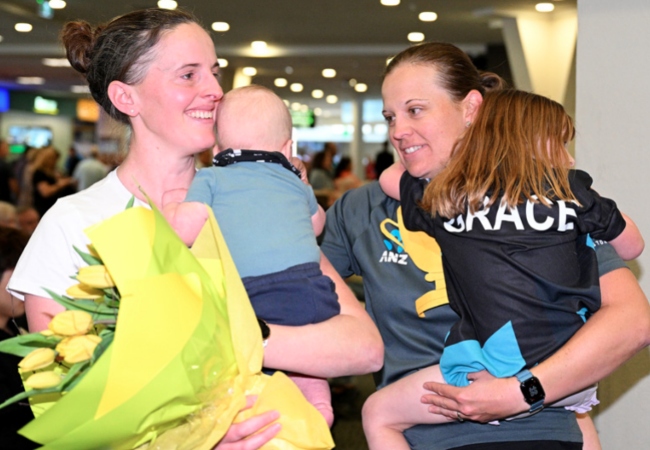
ICC issued guidelines regarding pregnancy of female players, these facilities will be provided by the boards

ICC Post-Pregnancy Guidelines: The ICC has issued guidelines for women cricketers regarding pregnancy and their subsequent return to top level cricket. In which it has been suggested to the member board that the board should appoint a special case manager for each player, provide a flexible training environment, help in child care and travel, and ensure access to medical and health related facilities during pregnancy and post-childbirth period.
Read :- ICC fined Haris Rauf 30 percent of match fee, warned opener Farhan
In fact, this step has been taken by the ICC amid the increasing professionalization of women’s cricket, as more players are now deciding to start families during their playing careers. These guidelines have been prepared by the Medical Advisory Committee of the ICC and have been led by Dr. Philippa Inge, the doctor of Australia’s women’s team. Their purpose is to help member boards formulate their pregnancy and return-to-play policies in accordance with local laws, while keeping the well-being of players a priority.
At the heart of this system is a six-step model of return to play – Ready, Review, Restore, Recondition, Return and Refine. It describes the gradual process from recovery after the birth of the child to return to competitive cricket and continuous monitoring thereafter. Key recommendations include the appointment of a specific ‘case manager’ (usually a doctor or physiotherapist) who will act as the player’s main contact person throughout their pregnancy and journey back to sport. The case manager will coordinate support services, oversee reviews and ensure that decisions are made with the best interests of both mother and baby in mind.
Regular meetings related to player management at important milestones have also been suggested in the guidelines document shared by ICC. These include meetings held at the time of the player’s pregnancy announcement, the third trimester, six to eight weeks after the birth of the child and every four weeks when rejoining the cricket environment. It calls for creating a multi-disciplinary support team, which includes medical staff, physiotherapists, strength and conditioning coaches, psychologists, dieticians, coaches and a family support network. At the same time, it emphasizes the need for a flexible and player-centric approach.
The guidelines state that the decision to declare pregnancy should be entirely the player’s and the board should not make pregnancy test mandatory. Although exercise during pregnancy is encouraged, decisions regarding training and competition should be individualized for each athlete and should be made in consultation with medical professionals. Although the document recommends that athletes stop participating in competitions after the first trimester, it emphasizes that there is no set period of pregnancy after which participation must be stopped. These decisions should be taken by the player in consultation with his treating doctors and the cricket medical staff.
Comments are closed.