
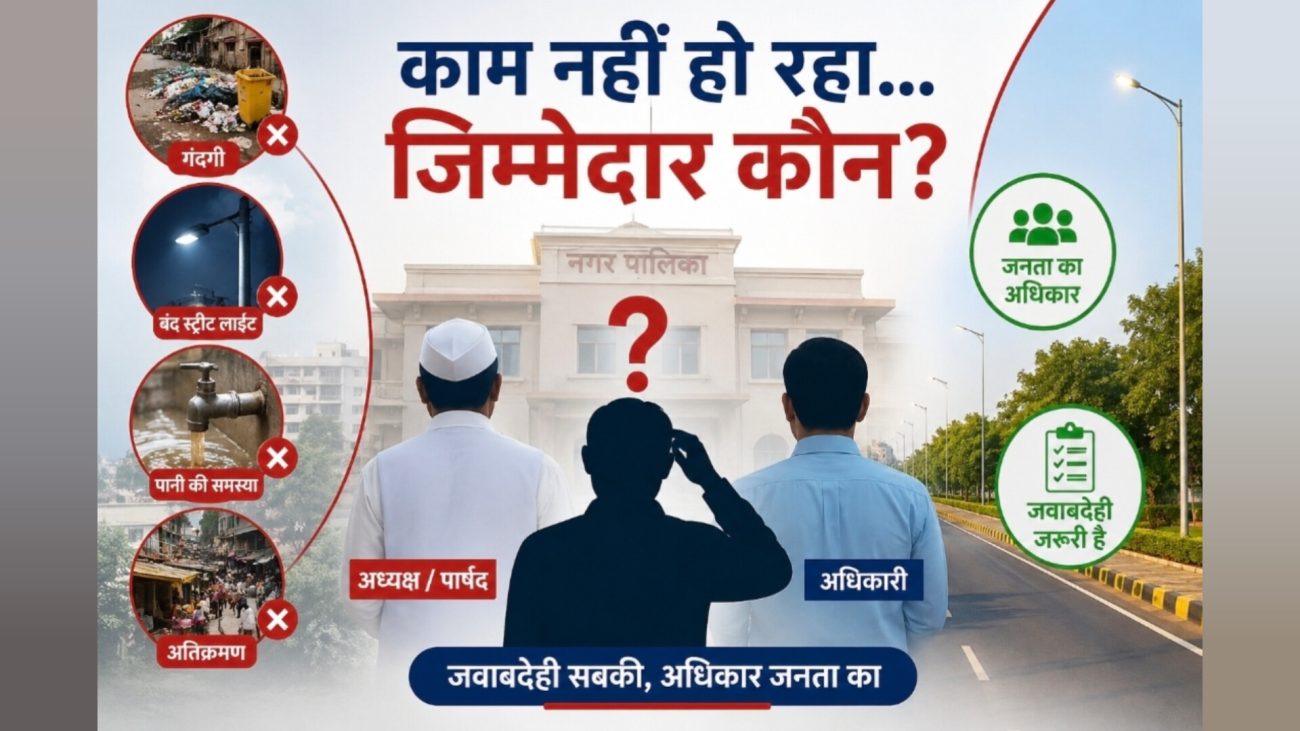
If work is not being done in the municipality then who is responsible? Only officers or president and councilors too?

Regarding the poor condition of basic facilities in the cities of Madhya Pradesh, the question often arises as to whose responsibility it is. Be it broken roads, clogged drains, lack of waste management or switched off street lights, the question that comes to the mind of the common citizen is whether only the municipal officers and employees are responsible or the president and councilors elected by the public are also responsible?
The answer to this question is found not only in politics, but in the Madhya Pradesh Municipality Act, 1961 and the rules made thereunder. The law divides the municipal system into two parts. First, the elected council, which consists of the president and councilors. Second, the administrative machinery, which consists of the Chief Municipal Officer (CMO) and other officer-employees. The responsibilities of both are different, but both are responsible for the development of the city.
What is the job of president and councilor?
The post of Municipality President is not just formal. He is the head of the council and presides over the meetings. His main responsibilities include setting the priority of development works, taking decisions on different subjects, approving the budget, reviewing the functioning of the administration and seeking answers from the officials. If the basic facilities in the city remain poor for a long time, the public can ask questions to the Speaker. The duties of the Chairman-in-Council and various authorities are also clearly spelled out in the 1998 Rules.
Similarly, councilors represent their respective wards. They present the problems of their ward before the council, propose development works, discuss the budget and try to solve the problems of their area. Therefore, the councilor also has political responsibility on ward level problems.
What is the job of officers?
The Chief Municipal Officer (CMO) and other officers handle the administration of the municipality. It is their responsibility to implement the decisions taken by the council, get the work done by the employees, get the construction work done, handle the financial and administrative arrangements and run the municipal services as per the law. If the council has taken the decision and even then the work is not being done, then the administrative responsibility will be on the officials.
Whose responsibility is it for which work? This is also clear in the law
cleaning system In the case of the Chairman and Councilors, they keep an eye on the cleanliness system, raise public complaints in the Council and try to provide resources and budget as per the need. At the same time, the officials assign the duty of sanitation workers, collect garbage and maintain regular cleanliness system.
Street lights In the case of the Chairman and Councilors raise complaints about poor street lights, decide on proposals and budget for installing new street lights and monitor the work. Whereas the officers are responsible for repairing the lights, installing new lights and their maintenance.
drinking water system For this, the Chairman and Councilors give priority to planning and budget to solve the water problem and raise public complaints in the Council. Officials ensure regular water supply, repair pipelines and take care of water quality and distribution system.
removal of encroachment In case of RTI, the Chairman and Councilor raise complaints of encroachment, ask the administration to take action and take necessary decisions in public interest. Authorities issue notices, take legal action and conduct drives to remove encroachments.
roads and drains The Chairman and Councilors approve proposals for construction and maintenance, provide budget and review the quality and progress of the work. The officers complete the tender process, execute the construction work and ensure quality control and maintenance.
waste management Under this, the Chairman and Councilors monitor the system and try to resolve the complaints of the people. The officials are responsible for door-to-door garbage collection, transportation and its proper disposal.
How right is it to blame only the officials?
It is not correct to believe that only the officers are guilty. If officials do not implement the lawful decisions of the Council, they are held liable. But if the council does not take necessary decisions, does not raise problems or does not monitor properly, then the elected public representatives also bear the responsibility. That is, the administrative responsibility of getting the work done lies with the officers, whereas it is also the responsibility of the President and Councilors to provide leadership, set policies, set priorities and remain accountable to the public.
What does the law say?
According to the Madhya Pradesh Municipal Corporation Act, 1961, the municipality is governed by a joint structure of elected council and administrative officers. The duties of the Chairman-in-Council, Chief Municipal Officer and other authorities have been mentioned in detail in the rules of the year 1998. Therefore, the credit or responsibility for the success or failure of the municipality cannot be placed on just one party.
In conclusion, whenever there is no cleanliness in the city, street lights remain switched off, water problems persist, roads are in bad condition or encroachments are not removed, the public should demand answers not only from the authorities but also from their elected councilors and president. In a democracy, officials run the administration, but public representatives are the representatives of the public. Therefore, the biggest political responsibility for development rests with them, while the administrative responsibility lies with the officials. The city will run better only when both fulfill their responsibilities honestly.

Comments are closed.