


Most of us today are fed up with the extremely bright aftermarket LED lights used in cars and other vehicles on public roads. Now, recently, according to Bengaluru traffic police estimates, it has been reported that almost 10 percent of all road accidents in the city are caused because of the usage of unauthorised lighting modifications that blind oncoming motorists and reduce visibility.
The Bengaluru traffic police recently highlighted that close to 5,000 road accidents get reported every year, out of which 500 crashes, according to the authorities, are connected to vehicles fitted with illegal LED lights. As a result of this, Bengaluru Traffic Police is now preparing for a fresh enforcement drive against violators.
Officials have warned that apart from speeding, drunk driving, reckless overtaking, pothole-ridden roads, and poorly designed junctions, these super-bright aftermarket LED lights have become one of the top contributors to accidents across the city.

The biggest issue with aftermarket LED and HID lights is the excessive glare that they produce. Many vehicle owners replace these factory-fitted headlights with powerful LED units, auxiliary lamps, and LED bars in an attempt to improve visibility. However, these modifications create the opposite effect for other road users.
What happens is that the intense white light produced by these aftermarket LED lights temporarily blinds oncoming drivers and two-wheeler riders. This becomes especially more dangerous on city roads, flyovers, and highways, where even a few seconds of reduced visibility can result in serious accidents.
Over the years, many motorists have complained about being unable to see the road after coming in front of vehicles fitted with these high-powered LEDs. Some riders have even reported having to slow down or stop completely because the glare makes it impossible to judge road conditions ahead.
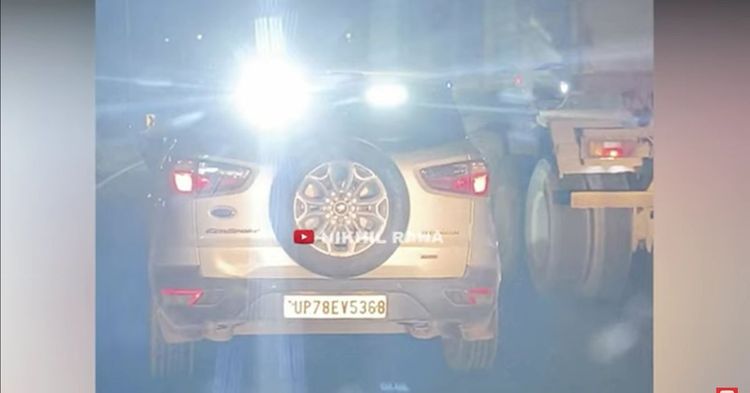
Now, although the new enforcement drive will be conducted later, there have been other drives to curb this problem before as well. During a previous enforcement campaign led by former Traffic and Road Safety ADGP Alok Kumar, more than 10,000 motorists were booked for using unauthorised lighting equipment.
At the time, these violators were fined Rs 500 each and were asked to remove the illegal fittings. However, authorities have highlighted that the problem has returned, and the number of vehicles using high-intensity aftermarket lights has once again increased.
In January 2026, it was reported that the Bengaluru Traffic Police launched a special drive against these aftermarket LED light users. The campaign, which began on January 7, managed to register 9,782 cases within a few days. On a single Saturday night alone, police recorded 1,843 violations. The city’s West Division accounted for nearly half of all cases, with 4,994 bookings.
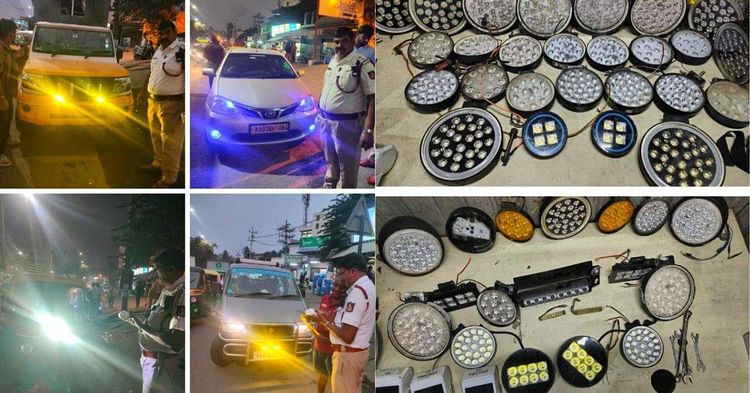
According to transport officials, vehicle manufacturers design headlights to comply with strict safety regulations. The beam pattern, brightness, and light distribution are carefully engineered to illuminate the road without affecting other motorists. However, the problem happens when owners replace standard halogen bulbs with powerful LED units, which have not been designed for the existing reflector housing.
This disrupts the beam pattern and causes light to scatter in unintended directions. Instead of focusing illumination on the road surface, the light spills above the cut-off line and goes directly into the eyes of oncoming drivers. This then increases the risk of accidents.
Also, the authorities have highlighted that there is a growing trend of private vehicles using coloured flashers and lighting systems in red, blue, and yellow shades, and their use is also illegal because it creates confusion with emergency and law enforcement vehicles.
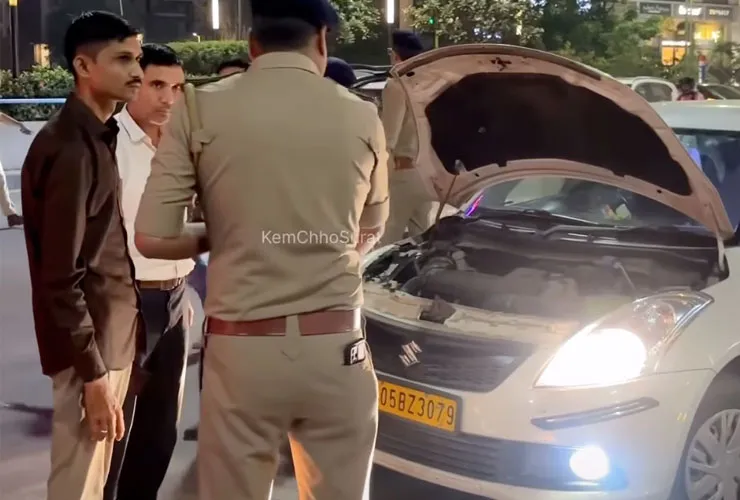
Automotive lighting in India is governed by AIS-130 standards. Under these regulations, a standard white LED headlight typically operates between 4 and 12 watts and produces around 725 lumens of light output.
However, many illegal aftermarket systems operate at 50 to 100 watts or even higher. These lights can produce several thousand lumens, which officials describe as a “blinding wall of light” for oncoming traffic. Transport department officials have warned that such modifications not only violate regulations but can also directly contribute to head-on collisions and fatal accidents.
A little while ago, the Supreme Court of India also directed all states and Union Territories to strictly regulate and ban dazzling LED headlights that can temporarily blind oncoming motorists. Authorities have reiterated that any modification altering factory specifications without approval violates Central Motor Vehicle Rules.
Vehicle owners who feel their factory headlights are inadequate are advised to install only certified lighting systems that comply with prescribed luminance and beam-pattern regulations. Officials have also urged motorists to use low beams whenever possible and avoid modifications that could endanger other road users.
Comments are closed.