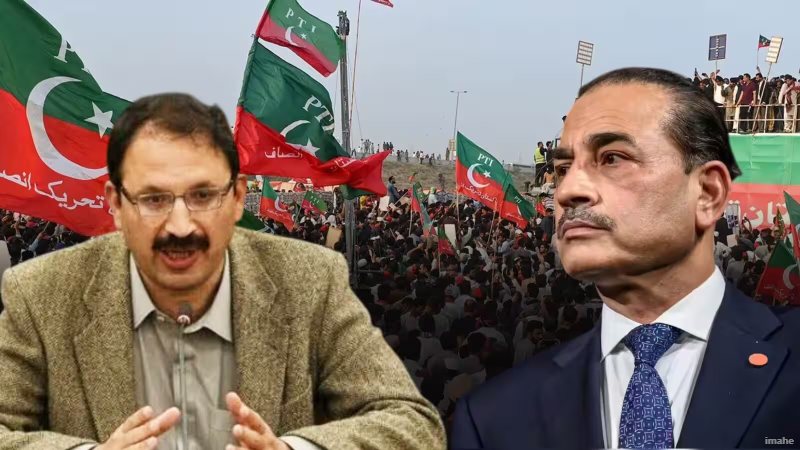
These days, the temperature of political and internal security is at its peak in the neighboring country Pakistan. The statement of a senior leader of former Prime Minister Imran Khan's party Pakistan Tehreek-e-Insaf (PTI) has shocked the country's government and military establishment. The leader has made a direct attack and said that if the attitude of the government and the army remains so oppressive, then they will turn 'Islamabad into Somnath'. After this sensitive statement related to the pages of history and religion and the mention of the name of Mahmood Ghaznavi, there has been a sensation in the corridors of power of Pakistan. After this sensational threat, there has been deep panic in the camp of Army Chief General Asim Munir and Prime Minister Shahbaz Sharif. Let us know what is the whole story behind this sharp statement and what is its political meaning. The atmosphere of tension in Pakistan's politics has been continuously deepening for the last few months. On one hand, the legal clampdown is continuously being tightened on Imran Khan's party, while on the other hand, party leaders and workers are openly warning to take to the streets against the oppressive policies of the government. In this provocative speech given from a public platform recently, the PTI leader took on the ruling coalition and the powerful military leadership. Citing the attacks of Mahmud Ghaznavi and historical references, he used such language which has stunned Pakistani security agencies. Such statements have once again raised a big question mark on the internal peace and law and order of the country. Politics in the name of Mahmood Ghaznavi: Why has the religious and political atmosphere heated up in Pakistan? The use of religious symbols and symbols of historical aggression in Pakistani politics is nothing new, but this time the context is directly related to challenging the country's capital Islamabad and the rulers sitting there. The main purpose of using words like 'Somnath' and 'Ghaznavi' by the PTI leader was to send a message to the government and the army that they are not going to bow down under any pressure. Political analysts believe that such rhetoric promotes polarization and adds fuel to the already smoldering political fire in the country. The government is considering this statement as treason and open rebellion against the military leadership, due to which more strict legal action is being prepared against PTI leaders. If we look at the current situation in Pakistan, Islamabad and Rawalpindi have already been converted into cantonments. Heavy police forces, rangers and army personnel have been deployed at various places. At such a time, giving such an aggressive warning by a senior leader of the opposition clearly shows that both the parties are now determined to have a one-on-one fight. The government of Army Chief General Asim Munir and Prime Minister Shehbaz Sharif seems to be fully committed to crush any opposition protest, while PTI workers seem ready to go to any extent for the release of their supreme leader Imran Khan and restoration of democratic rights. The biggest internal security crisis facing the Shahbaz government and Army Chief Asim Munir. This time is going through a very difficult period for the current government of Pakistan. The country's economy is already on ventilator and the general public is suffering under the burden of International Monetary Fund (IMF) conditions. In such a situation, if situations like political instability and civil war arise, it will become impossible to manage the country. The military leadership is deeply concerned that if such extreme rhetoric and demonstrations within the capital are successful, the army's image will be dealt a huge blow to the country and the world. This is the reason why the administration has intensified the action of conducting raids against the opposition leaders and detaining them without any leniency. Supporters of the opposition party say that the government and the army together are strangling their democratic rights. The constitutional right to express one's views and demonstrate peacefully is also being crushed forcefully. The leaders also allege that when both the judiciary and the administration have started working at the behest of the ruling coalition, then the public is left with no other option but to protest. This is the reason why such sharp and aggressive words are being used in the speeches of the leaders, which are directly challenging the central power and system of the country. The impact of these internal conditions of Pakistan is now clearly visible at the international level as well. Major countries and media organizations around the world are keeping a close eye on this political upheaval in Pakistan. Such internal conflicts and extremist or historical statements in a nuclear power country are creating deep apprehensions in the minds of global investors. Foreign investors are completely shying away from investing their money in a country with such an unstable environment, due to which Pakistan's foreign exchange reserves are continuously falling into the trough. Diplomatic experts from Western countries believe that if Pakistan's rulers do not soon adopt the path of political dialogue, the country could fall into the grip of a serious and uncontrolled civil war. The direction Pakistan's politics will take in the coming days will depend on how the government deals with this pressure from the opposition. Will PTI leaders succeed in implementing their warnings or will the army and the government together crush this mass movement completely? The situation remains extremely delicate and new political equations are emerging every moment. The common Pakistani citizen is getting crushed in this struggle for power, who is neither able to get two square meals a day nor is there any assurance of security left in the country. This threatening statement taken out of the pages of history has proved that the political future of Pakistan is currently surrounded by clouds of great uncertainty.