
In today’s technology-driven era, research and the unexpected are essential to be future ready – Raj Nath Singh

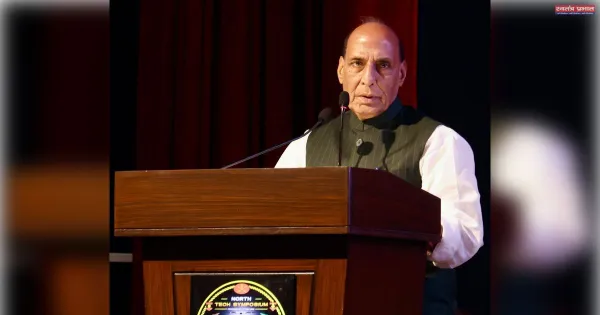
Defense Minister Rajnath Singh stressed the importance of continuously focusing on research and adopting a strategy of unexpected innovation to be future ready in the current era of rapid technological revolution. The Defense Minister expressed these views while addressing defense personnel, industrialists, innovators, startups and representatives of academia at the inaugural session of the three-day North Tech Seminar organized by the Northern and Central Command of the Indian Army and the Indian Defense Manufacturers Society at Prayagraj, Uttar Pradesh on May 4, 2026.
The Defense Minister also informed about the rapid pace of technological changes taking place in modern warfare and the unexpected emergence of spontaneous attacks. He said that in the Russia-Ukraine conflict, the nature of war changed from tanks and missiles to revolutionary equipment like drones and sensors in just three-four years. Apart from this, objects which have become a part of daily life are also becoming deadly weapons. Pager attacks in Lebanon and Syria have prompted a re-evaluation of modern warfare methods. We have to be prepared in such a situation.
Rajnath Singh stressed the need to adopt a proactive approach and develop capabilities that would enable the country to launch a surprise attack on its enemy if necessary. He said that history is witness to the fact that the decisive advantage in war is always given to the one who has the power to attack suddenly. Although our defense forces are already working in this direction, we have to move forward more proactively.
Emphasizing the importance of ensuring adaptability in the present complex and rapidly changing environment, the Defense Minister said that the nation which adopts the technological revolution fastest will have a decisive edge in the future war scenario. He said that in today’s world there is no substitute for research and how future wars will be fought is being determined in laboratories today.
Rajnath Singh said that the government has kept defense research at the center of its priorities and has attempted to take it to the next level through DRDO. He said that DRDO is no longer alone on this journey. Inspired by the mantra of ‘Together to go far’, it is moving forward shoulder to shoulder with a large number of industries.

The Defense Minister said that 25 percent of the Defense Research and Development budget has been allocated to industry, academia and startups and so far these institutions have utilized more than Rs 4,500 crore of the budget. He said that a new policy of technology transfer has been implemented, under which the earlier 20 percent fee for development-cum-production partners, development partners and production agencies has been completely waived off. As a result, DRDO has so far transferred more than 2,200 technologies to various industries.
Rajnath Singh said that DRDO has initiated a policy to provide free access to its patents to Indian industries, which will strengthen both their technological capabilities and global competitiveness. He said that DRDO’s testing facilities have also been opened to industries on payment basis. Hundreds of industries use these facilities every year for research and development assistance.
The Defense Minister said that industries should move forward and achieve excellence in areas such as directed energy weapons, hypersonic weapons, submerged area awareness, space situational awareness, quantum technology, artificial intelligence and machine learning. He assured full support of the government in this endeavour.
Rajnath Singh praised the defense forces and industry for thoroughly analyzing the changing circumstances and ensuring India’s preparedness and described Operation Sindoor as an excellent example of technological warfare and the nation’s readiness. He said that Operation Sindoor demonstrated the valor and capabilities of our defense forces to the world. During this operation, state-of-the-art indigenous equipment including advanced missile systems like Akashteer, Akash missile system and BrahMos were used. This is irrefutable proof that we not only understand the changing nature of war, but are also implementing technological advancements with unwavering confidence.
Highlighting the steps taken by the Government led by Prime Minister Shri Narendra Modi to strengthen the country’s defense ecosystem, the Defense Minister said that initiatives like Innovation for Defense Excellence (IDEX), Accelerating Development of Innovative Technologies with IDEX (ADITI) and Technology Development Fund (TDF) strive to promote innovation and significantly increase private sector participation. He said that infrastructure development is being given priority in the defense sector. Giving information about several infrastructure projects directly related to the defense sector initiated in Uttar Pradesh, especially the establishment of Defense Industrial Corridor, he said that these are actively enhancing India’s defense capabilities.
Rajnath Singh said the government’s self-reliance efforts are yielding positive results as domestic defense production reaches a record Rs 1.54 lakh crore in FY 2025-26, while defense exports reach an all-time high of Rs 38,424 crore. He said that this growth is likely to become even faster and the private sector has contributed significantly to this achievement. He said that it is our collective effort to establish ourselves as the most powerful military power in the world in the times to come.
In his address, Lieutenant General Anindya Sengupta, General Officer Commanding-in-Chief (GOC-in-C), Central Command, said that the symposium provides a unique platform to the Defense Forces, industry, startups, innovators and academia to develop indigenous technological solutions aimed at addressing critical operational challenges. He said this effort is guided by the principle of Jointness, Self-Reliance and Innovation (JAI), which is essential to strengthen the country’s combat capability.
Lieutenant General Prateek Sharma, Chief Executive Officer, Northern Command, emphasized that the objective of the seminar is to convert ideas, innovations and experiences into deployable capabilities. He said that in view of recent conflicts, specific capabilities such as unmanned aerial systems (UAS), counter-UAS systems, AI-enabled decision-making tools, precision strike capabilities and advanced artillery systems have become indispensable to establish battlefield dominance.
On this occasion, Shri Nand Gopal Gupta Nandi, Minister of Industrial Development, Export Promotion, NRI and Investment Promotion, Government of Uttar Pradesh; Army Chief General Upendra Dwivedi; Air Officer Commanding-in-Chief of the Central Air Command Air Marshal Balakrishnan Manikantan; Surgeon Vice Admiral Aarti Sarin, Director General of Armed Forces Medical Services; SIDM President Arun T Ramchandani; and Professor Ramakrishnan S of IIT Madras were present.
An exhibition was organized showcasing indigenous solutions presented by various participants including Small and Medium Enterprises (MSMEs), private defense technology firms, startups and uniformed innovators.
Comments are closed.