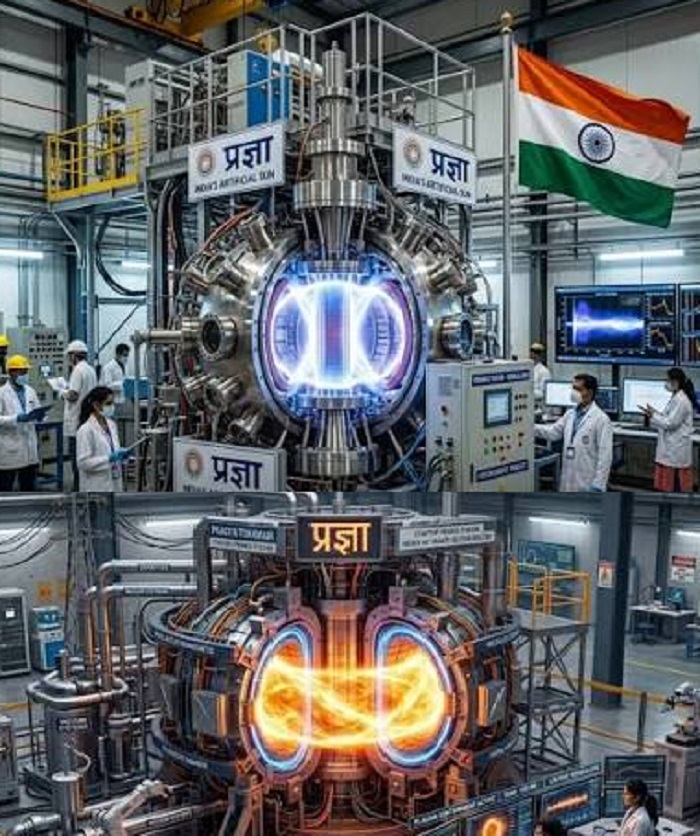
Recently, the news of China preparing the world's largest superconducting magnet for its 'artificial sun' was revealed. Now Indian scientists have also succeeded in an important challenge related to fusion technology.
What are scientists doing in Gujarat's lab?
According to the report, scientists at Gujarat's Institute for Plasma Research have created a powerful 82.6 GHz Gyrotron Has been started. The device produces high-frequency microwave energy, which is used to heat the plasma to extremely high temperatures.
The fusion process requires maintaining the plasma at extremely high temperatures. Gyrotron will help scientists in this process and will contribute in developing the ability to maintain hot plasma for a longer period.
What is plasma?
Plasma is considered to be the fourth state of matter. After solid, liquid and gas, it is an extremely hot and electrically charged state of matter. At very high temperatures atoms start losing their electrons and a plasma state consisting of ions and electrons is formed.
This plasma is very important in fusion experiments, because extremely high temperatures are required to fuse the nuclei of light atoms together.
How is it used in SST-1 Tokamak?
SST-1 i.e. Steady State Superconducting Tokamak It is India's fusion machine. It has been designed to study the process of generating energy through nuclear fusion, like the Sun.
In a fusion reactor, radioactive fuel is not split like in a conventional nuclear power plant. Instead, the nuclei of lighter atoms are fused together at extremely high temperatures. Energy is released in this process.
But it is extremely difficult to keep such hot plasma away from the walls of the reactor. If the plasma hits the surface of the reactor directly, it can be damaged. For this reason, scientists use powerful magnetic fields, which help in controlling and confining the plasma.
The biggest challenge is to handle plasma for a long time
Just achieving extreme temperatures is not enough in a fusion experiment. The real challenge is to keep that hot plasma stable and controlled for a long time. SST-1 uses powerful magnetic fields inside a donut-shaped tokamak.
The new gyrotron generates high-frequency microwave energy and transmits it to the plasma. This helps to heat and maintain the plasma to extremely high temperatures.
India has achieved a temperature 20 times higher than the sun's core
Indian scientists have already done fusion experiments. over 200 million degrees Celsius Have achieved plasma temperature. This is about 20 times more than the temperature of the Sun's core.
However, achieving such high temperatures is only the first step. To practically generate electricity from fusion, scientists must keep plasma at this temperature stable and controlled for a long time.
Why is it difficult to make 'artificial sun' on Earth?
Generating electricity through nuclear fusion is one of the most complex challenges in science and engineering. Fusion is considered a potentially large source of clean energy. The elements required for its fuel are available in sufficient quantities on Earth and the radioactive waste produced from it is less long-lived than conventional nuclear energy.
Although the 82.6 GHz gyrotron does not immediately transform SST-1 into a fusion power plant, it provides a significant boost to research in India towards controlling and sustaining extremely hot plasma. This technology can pave the way for practical realization of sun-like fusion energy on Earth in the future.